wayground logo

Free Printable Worksheets

Font size

S
M
L
XL
Worksheets

Evidence of Evolution

Total questions: 20

Worksheet time: 32mins

Name
Class
Date
1.
Which species’ DNA is most similar to the DNA of the toothed whale? 
a)
Hippopotamus 
b)
Baleen Whale
c)
Grazing Mammals
d)
Camels
2.
The similarities of organisms in which two areas numbered in the picture provide the best evidence for common ancestry?
a)
1 and 2
b)
3 and 4
c)
5 and 6
d)
7 and 8
3.

Some organisms that share a common ancestor have features that have different functions, but similar structures. These are known as

a)

vestigial structures

b)

analogous structures

c)

anatomical structures

d)

embryology

4.

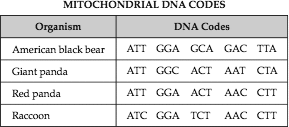
What conclusions can be made based on this table shown?

a)

the American black bear and the giant panda are most closely related

b)

the giant panda and the red panda are most closely related

c)

the red panda and the racoon are the most closely related

d)

the giant panda and the racoon are most closely related

5.
The picture shows the members of the Camelidae family. The physical features and the geographical origin of these animals provide evidence that - 
a)
they live in the same type of environment.
b)
have slowly evolved to become herbivores.
c)
have a common ancestor.
d)
exchanged DNA in the past.
6.
Structures that are similar to function. 
a)
Homologous 
b)
Analogous 
c)
Vestigial 
d)
DNA
7.
Studying the similarities in organisms development 
a)
DNA
b)
Embryonic 
c)
Vestigial 
d)
Homologous 
8.
The changes of species over time
a)
Embryonic 
b)
Natural selection 
c)
Mimicry 
d)
Evolution 
9.
Which layer is the youngest
a)
1
b)
2
c)
3
d)
4
10.
Which layer is the oldest
a)
B
b)
A
c)
E
d)
C
11.
The opossum and kangaroo both incubate their young in a pouch. This provides evidence that they---
a)
are descended from a common ancestor
b)
Have very similar skeletal structures
c)
belong to the same species
d)
must range great distances to eat
12.
The similarities of the bones in the diagram provide evidence that---
a)
The organisms shown lived in the same natural envionrment
b)
The organisms shown may have developed from a common ancestor
c)
The organisms shown have the same genetic diseases
d)
All vertebrate species have identical forelimbs
13.
In stage one (top row) of these embryos, most of the embryos________
a)
look very similar.
b)
have very different features.
c)
show different stages of development.
d)
have only a tail if they are non-human.
14.

Which scientist visited the Galapagos Islands and came up with the theory of natural selection?

a)

Theodor Schwann

b)

Gregor Mendel

c)

Charles Darwin

d)

Rudolf Virchow

15.
In recent years "SuperBugs" (bacteria that aren't effected by antibiotics) are becoming more and more common. How could natural selection explain this?
a)
Superbugs survive antibiotics and reproduce
b)
Antibiotics cause bacteria to become superbugs
c)
We have always had the same amount of superbugs; modern media just discusses them more.
d)
There is no reliable data on the origin of super bugs.
16.
Why do peppered moths tend to be the same color as the trees on which they live?
a)
The coloring goes along with tasting like the tree. 
b)
It keeps the moth the same temperature as the tree. 
c)
It makes the moths faster than the birds
d)
It makes the moths harder to see.
17.
Why are advantageous traits more likely to be passed onto offspring?
a)
Because they are more likely to survive and reproduce.
b)
Because they come from dominant alleles.
c)
Because they come from recessive alleles.
d)
Because the trait is an acquired phenotype.
18.
Which organisms are most likely to survive?
a)
the best adapted
b)
the fastest
c)
the strongest
d)
the most domesticated (tamed)
19.
Yellow toucan birds seek out one another to make babies together and tend to avoid the green toucan birds.
a)
Genetic Drift
b)
Non-random mating
c)
Gene flow
d)
Mutation
20.

Mutations are important because they bring about

a)

death of the organism in which they develop

b)

genetic variation needed for a population to evolve

c)

benefits for the individual, not for the population

d)

Hardey-Weinberg equilibrium within a population