
 Worksheets
Review: mirrors, plane, concave, convex, mirror equation
Total questions: 57
Worksheet time: 52mins
An image behind the mirror is considered:
virtual
real
upside down
upright
An image drawn above the principal axis (PA) is
virtual
real
upright
upside down
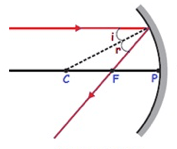
This ray diagram is for which mirror?
concave
convex
plane
window

what is A on the diagram?
center of curviture
focal length
reflected ray
focal point
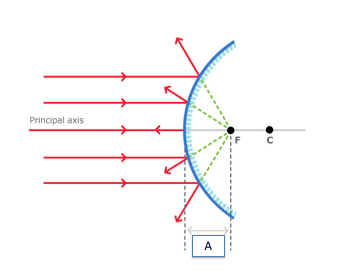
In the image, all the rays meet at F, What is F
focal length
focal point
center of curvature
reflection
this type of mirror is used in supermarkets to see around bends
concave
convex
plane
window
The image of an object, which is placed one foot in front of a plane mirror, will be ___.
behind the mirror and reversed, left to right.
behind the mirror.
in front of the mirror and reversed, left to right.
in front of the mirror.
A shopkeeper wants to keep an eye on his store in order to prevent shoplifting. What could the shopkeeper hang on the wall in order to see a wider image of his store and his customers?
a convex mirror
a concave mirror
a convex lens
a concave lens
A flat mirror is an example of a ___.
plane mirror
concave mirror
convex mirror
spherical mirror
What word means to bend light rays toward each other?
Converging light
Diverging light
Virtual Light
Real Light
What word means to bend light rays away from each other?
Converging light
Diverging light
Virtual Light
Real Light

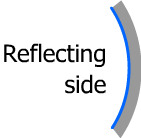
The following is a picture of what type of mirror?
Convex Mirror, diverging
Concave Mirror, converging
Convex Mirror, converging
Concave Mirror, diverging
A real image having a height of -10 cm is formed by a concave mirror. The height of the object is 5 cm.The magnification of the object is
-5
5
2
-2
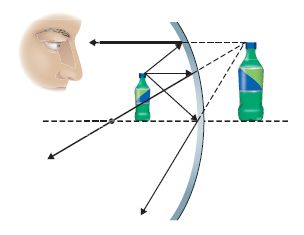
Which terms describe the reflection seen in this image?
virtual, upright
virtual, inverted
real, upright
real, inverted


In the mirror equation above d0 represents:
Distance of the object from the mirror
Distance of the image from the mirror
The focal length
The plane of incidence
If the focal length is negative a _________ mirror is being used
concave (diverging)
convex (converging)
concave (converging)
convex (diverging)
How much does a plane mirror magnify an image?
1x
2x
3x
4x

If you are 6ft tall how large of a space on a mirror do you need to see yourself?
6ft
12ft
3ft
It depends on how close to the mirror you are
An object is placed 20 cm from a concave mirror with a focal point of 15 cm. Where will the image be located.
15 cm
20 cm`
60 cm
-8.6 cm
An object is located 5 cm from a convex mirror with a focal point of -15 cm. What is the location of the image?
-7.5 cm
-3.75 cm
7.5 cm
there is no image
The bowl of a shiny spoon forms an enlarged, upright image similar to that of a ____ mirror.
wide-angle
convex
concave
refracting
Outside rear-view mirrors on automobiles are generally ____.
concave
convex
plane
real images
Light rays that hit a convex mirror ____ as they are reflected.
magnify
diverge
disappear
unite

This reflection is
regular.
diffuse.

The object distance is positive and the image distance is
positive.
negative.
upright.
inverted.

This image is
real.
virtual.

The image formed by this converging mirror is
upright, same size, virtual
inverted, same size, real
inverted, larger, virtual
upright, smaller, real

The image formed by this converging mirror is
upright, same size, virtual.
inverted, same size, real.
upright, larger, virtual.
inverted, smaller, real.
no image is formed.

What shape does a mirror need to have in order to avoid spherical aberration?
straight
spherical
parabolic
convex
The distance of the radius of curvature is equal to:
C
F
2F
V
If an image in a curved mirror is virtual, you can say that the mirror is:
definitely convex
definitely concave
could be concave or convex
Dashed lines on a ray diagram symbolize ____ rays.
parallel
virtual
distant
inverted
If hi is a negative number, this means it is:
upright
inverted
real
virtual
If di is a negative number, this means that the image is:
upright
inverted
real
virtual
If the magnification (m) is a positive number, this means that the image is:
larger
smaller
upright
inverted
When constructing ray diagrams on a curved mirror, incident rays going parallel to the PA reflect back:
on themselves
through F
parallel to the PA
When constructing ray diagrams on a curved mirror, incident rays going towards the F will reflect back:
along themselves
through F
parallel to the PA
When constructing ray diagrams on a curved mirror, incident rays directed towards the center of curvature reflect:
back on themselves
through F
parallel to the PA
When lines are extended behind the mirror, the dashed lines are an extension of:
the incident ray
the reflected ray
If a person is standing 10 m in front of a plane mirror, how far away from the mirror is his image?
10m
5m
20m
30m
If you are walking at a speed of 2.0m/s towards a plane mirror, how fast is your image walking towards the mirror?
2.0 m/s
4.0 m/s
1.0 m/s
If you are walking towards a plane mirror at a speed of 1.0 m/s, how fast are you and your image approaching each other?
1.0 m/s
0.50 m/s
2.0 m/s
4.0 m/s

Which letter represents the vertex?
(a)
Which letter represents the focal length?
(a)
Which letter represents the center of curvature, C?
(a)
Which letter represents the principal axis?
(a)
Which letter represents the radius of curvature?
(a)
Which letter represents the focal point, F?
(a)
Which letter(s) could represent twice the focal length?
(a)

If a ray of light hits the mirror at an angle of 350 FROM THE MIRROR, what is the angle of incidence?
550
300
900

