wayground logo

Free Printable Worksheets

Font size

S
M
L
XL
Worksheets

U.S. History Semester Test Review

Total questions: 137

Worksheet time: 34hrs 15mins

Name
Class
Date
1.
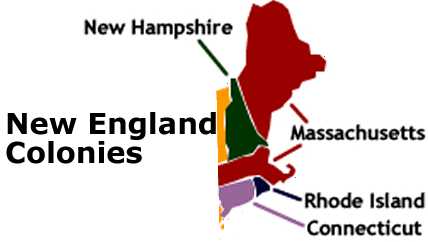
Which group are the New England colonies?
a)
Connecticut 
New Hampshire
Rhode Island
Massachusetts
b)
North Carolina
South Carolina
Virginia
Maryland
Georgia
c)
Pennsylvania
Deleware 
New York
New Jersey
d)
Illinois
Indiana
Ohio
Wisconsin
2.
Which colonies have large plantations?
a)
Middle
b)
Southern
c)
New England
d)
Northeast
3.
Why was Massachusetts founded?
a)
To have more job opportunities.
b)
Quakers wanted to found a community based on their religious beliefs.
c)
To escape debtor's prison.
d)
Puritans wanted to create a community based on their religious beliefs.
4.
Which group are the Southern colonies?
a)
Connecticut 
New Hampshire
Rhode Island
Massachuttes
b)
North Carolina
South Carolina
Virginia
Maryland
Georgia
c)
Pennsylvania
Delaware
New York
New Jersey
d)
Florida
Georgia
Louisiana
Alabama
5.
Why did the Pilgrims come to a new land and form a settlement?
a)
They wanted to be ruled by a king in Great Britain
b)
They wanted freedom to practice their own religion
c)
They wanted to start plantations and earn money
d)
They wanted to learn from the Native Americans
6.
William Penn founded which colony?
a)
Massachusetts
b)
Pennsylvania
c)
New York
d)
Nebraska
7.
What is the major industry of the New England Colonies?
a)
Cash Crops
b)
Metalwork
c)
Slavery
d)
Shipbuilding and Fishing
8.
Which of the following was the first permanent English settlement of North America? 
a)
Plymouth
b)
Roanoke
c)
Youngstown
d)
Jamestown
9.
Why was Georgia formed or established?
a)
As a place for Catholics to practice their religion
b)
Industrial settlement for crafts people
c)
 A creative centers for artists
d)
Second chance or safe haven for debtors/poor people
10.
The Southern economy was based on what jobs?
a)
Fur trade and hunting
b)
Small family farms and plantations
c)
Lumber and industry
d)
Fishing and shipbuilding
11.
How was the agreement which bonded Pilgrims called?
a)
Mayflower Compact
b)
Declaration of Independence
c)
Napoleonic Code
d)
Geneva Conventions
12.
How did the Virginia Company make money?
a)
Selling furs
b)
Selling lumber
c)
Growing and selling tobacco
d)
Growing and selling grain
13.
Who established the Massachusetts Bay Colony. 
a)
Pilgrims
b)
Puritans
c)
both
d)
neither
14.
Who established Plymouth Colony in 1620?
a)
Pilgrims
b)
Puritans
c)
both
d)
neither
15.
The colony of New Netherland was renamed as what?
a)
Pennsylvania
b)
New Jersey
c)
New Orleans
d)
New York
16.
The city of New Amsterdam was renamed as what?
a)
New York City
b)
Trenton
c)
Philadelphia
d)
Delaware
17.
Which of the following was named after an island in the English Channel?
a)
Delaware
b)
New Amsterdam
c)
New Jersey
d)
Pennsyvania
18.
Where was Jamestown located (today)?
a)
Missouri
b)
Mississippi
c)
Virginia
d)
North Carolina
19.
What was the soil like in the New England colonies?
a)
Thin and sandy
b)
Thin and rocky
c)
Thin and rich
d)
Thin and fertile
20.

What is the middle passage?

a)

the trip from England to Africa

b)

the trip from England to the Americas

c)

the trip from Africa to the Americas

d)

the trip from Africa to England

21.

The trade that allowed movement of goods, people and materials among the continents.

a)

Continental trade

b)

Triangular Trade

c)

Slave Trade

d)

European Trade

22.

Where did a majority of the slaves live and work?

a)

plantations

b)

factories

c)

schools

d)

they didn't work

23.

What were the country's that found the Triangular Trade Route

a)

Europe, North America, China

b)

Europe, Africa, The America's

c)

The America's, Africa, Hong Kong

d)

Vietnam, Africa, South America

24.
Slave traders captured Africans from different parts of Africa and purchased some slaves from African rulers.
a)
True
b)
False
25.
Laws that made it illegal for slaves to assemble without their master's permission or earn money (among others things) were called
a)
Emancipation Proclamation
b)
Fundamental Constitutions of Carolina
c)
Carolina Compromise
d)
Slave Codes
26.

Capturing, transporting, and selling people is called the

a)

Middle Passage

b)

Slave Auction

c)

Slave Trade

d)

Triangular Trade

27.

The main reason so many Africans died during the Middle Passage was that

a)

Fellow Africans killed them

b)

They tried to escape and drowned

c)

Crowded and unsanitary conditions led to diseases

d)

Pirates attacked slave ships and murdered them

28.
The main source of income for the French was fur trading.
a)
True
b)
False
29.
What was one cause of the F & I War?
a)
Land
b)
Freedom
c)
Money
d)
Slavery
30.
When and where did the French and Indian War begin?
a)
The war started in 1776 in New England.
b)
The war started in 1754 in New England.
c)
The war started in 1754 in the Ohio River Valley.
d)
The war started in 1776 in the Ohio River Valley.
31.
During the French and Indian War, the British and French were fighting over control of which area?
a)
Mississippi River Valley
b)
Ohio River Valley
c)
Connecticut River Valley
d)
Pennsylvania River Valley
32.
Who was the young military leader from Virginia who fought in the French and Indian war?
a)
William Pitt
b)
Edward Braddock
c)
King George II
d)
George Washington 
33.
What was the main cause of the French and Indian War?
a)
The French and British claimed the same land.
b)
The French and Indians claimed the same land.
c)
The Indians and British claimed the same land.
d)
The Indians wouldn't sell their land.
34.
What ended the French and Indian War?
a)
Treaty of Paris 1763
b)
Proclamation of 1763
c)
Treaty of Versialle
d)
Proclamation of France defeat 1763
35.

Which British leader sent money and supplies to North America to help them win the war?

a)

William Pitt

b)

Brad Pitt

c)

Joseph Brant

d)

General Sanders

36.

In the Treaty of Paris, after the French and Indian War, who gained control of all the land East of the Mississippi (except New Orleans)?

a)

Britain

b)

France

c)

Spain

37.

Benjamin Franklin's proposal to unite all of the colonies, except for Georgia, under one government. He believed the colonies would be stronger if united when fighting against the French. This was _______ Plan of Union.

a)

The Parliament

b)

Albany's

c)

France's

d)

The British

38.

What did Benjamin Franklin do to get support for his Plan of Union?

a)

Destroyed the "Join" or "Die" cartoon.

b)

Drew the "Join" or "Die" cartoon.

c)

Published the "Join" or "Die" cartoon.

d)

Sold the "Join" or "Die" cartoon.

39.
What were the Navigation Acts?
a)
Laws made by Americans to stop trading with England
b)
Laws made by the British to gain money from colonial trade
c)
Laws made by the French to make the English mad
d)
Laws made by the Spanish to keep English colonists out of Florida
40.

The Great Awakening was a __________ movement.

a)

political

b)

scientific

c)

religious

d)

artistic

41.

Smuggling means

a)

Trading good illegally

b)

Trading slaves

c)

Trading provisions

d)

None of these

42.

What is mercantilism?

a)

A system where a mother countries gains money and power from natural resources that come from its colonies.

b)

where colonies trade gold and silver with each other.

c)

Wars that start over money.

d)

Plantation colonies trading slaves for money.

43.

The impact of mercantilism was that

a)

The rate of slavery in the Americas went down

b)

Trade was limited in the Atlantic

c)

The Colony grew wealthy

d)

The Mother Country grew wealthy

44.
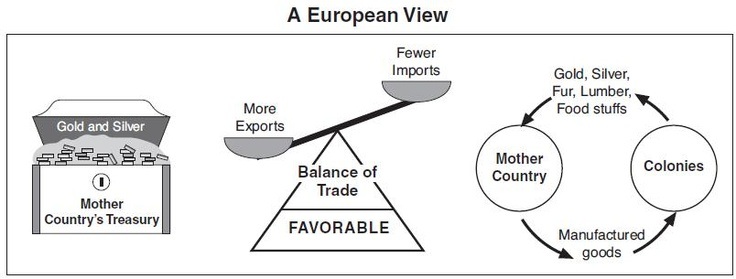
Based on the political cartoon, how does mercantilism benefit the mother country?
a)
The mother country always has something to eat.
b)
The mother country can get rich from the colonies.
c)
The colonies provide everything to the mother country.
45.
What was the significance of the Boston Massacre?
a)
(1770) An incident in which British soldiers fired into a crowd of colonists, killing 5 people.
b)
(1773) A protest against the Tea Act in which a group of colonists boarded British ships and dumped more than 340 chests of tea into Boston Harbor
c)
1754-1763-This war took place between the British and the French (who had made treaties with the Indians.)The British won all land east of the Mississippi, Florida and Canada leaving New Orleans and Louisiana to the French and Spain.
d)
(1774) laws passed by Parliament to punish the colonists for the Boston Tea
46.
What was the significance of the Boston Tea Party?
a)
(1770) An incident in which British soldiers fired into a crowd of colonists, killing 5 people.
b)
(1773) A protest against the Tea Act in which a group of colonists boarded British ships and dumped more than 340 chests of tea into Boston Harbor
c)
1754-1763-This war took place between the British and the French (who had made treaties with the Indians.)The British won all land east of the Mississippi, Florida and Canada leaving New Orleans and Louisiana to the French and Spain.
d)
(1774) laws passed by Parliament to punish the colonists for the Boston Tea
47.
What was the significance of the Intolerable Acts?
a)
(1770) An incident in which British soldiers fired into a crowd of colonists, killing 5 people.
b)
(1773) A protest against the Tea Act in which a group of colonists boarded British ships and dumped more than 340 chests of tea into Boston Harbor
c)
1754-1763-This war took place between the British and the French (who had made treaties with the Indians.)The British won all land east of the Mississippi, Florida and Canada leaving New Orleans and Louisiana to the French and Spain.
d)
(1774) laws passed by Parliament to punish the colonists for the Boston Tea Party
48.
Who won the French & Indian War?
a)
The French who wanted to increase its holding in North America.
b)
The Indians who wanted their land returned to them.
c)
The British who wanted to remain a world power.
d)
The Spanish who wanted revenge on the British.
49.
The Proclamation of 1763 restricted--
a)
colonists from moving back to Great Britain.
b)
the western movement of settlers.
c)
the control of colonial legislatures.
d)
the amount of tea imported from Europe.
50.
Which famous Americans led their fellow patriots in throwing tea into Boston Harbor to protest tea taxes?
a)
George Washington & Thomas Jefferson
b)
John Adams & John Hancock
c)
Samuel Adams & Paul Revere
d)
Williams Dawes & Samuel Prescott
51.

This law placed a tax on all printed material in the colonies including wills, contracts, newspapers, and playing cards.

a)

The Declaratory Act

b)

The Stamp Act

c)

The Intolerable Acts

d)

The Coercive Acts

52.

What was the COLONIAL name for the acts that closed Boston Harbor, banned town meetings, and other harsh penalties?

a)

The Coercive Acts

b)

The Townshend Acts

c)

The Intolerable Acts

d)

The Proclamation of 1763

53.
The group that organized the Boston Tea Party protest was called the ...
a)
Sons of the Constitution
b)
Minutemen
c)
Sons of Liberty
54.
What act was the cause of the Boston Tea party?
a)
The Townshend act
b)
Tea Act
c)
Sugar Act
55.

What city did the Continental Congress convene in?

a)

New York City

b)

Boston

c)

Philadelphia

d)

Charleston

56.

Who was made President of the Second Continental Congress?

a)

Samuel Adams

b)

John Hancock

c)

Benjamin Franklin

d)

John Adams

57.

As the Continental Army was formed, who was put in command?

a)

Samuel Adams

b)

John Hancock

c)

George Washington

d)

Paul Revere

58.

Define militia.

a)

Well trained Continental soldiers

b)

Well trained British soldiers

c)

Volunteer British soldiers

d)

Volunteer Patriot soldiers

59.

What ultimately forced the retreat of the militia soldiers at the Battle of Bunker Hill?

a)

They were scared

b)

They ran out of ammunition

c)

The cannons completely destroyed their bunker

d)

The war ended

60.

Who won the Battle of Bunker Hill between the British and the colonial militia? Remember the movie i showed for help

a)

The Patriots

b)

The British

61.
Who was the main author of the Declaration of Independence?
a)
Benjamin Franklin
b)
Samuel Adams
c)
Thomas Jefferson
d)
Paul Revere
62.
Why was the Declaration of Independence written?
a)
To stop taxes from the British Empire.
b)
To make a United States army.
c)
To gain independence from the British Empire
d)
To install their own king in America
63.
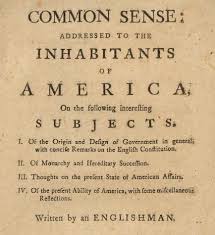
Who wrote a pamphlet called "Common Sense"?
a)
George Washington
b)
Thomas Paine
c)
Thomas Jefferson
d)
Patrick Henry
64.
Thomas Jefferson was inspired by a famous man of the Enlightenment.  His name was...?
a)
William Penn
b)
Roger Sherman
c)
John Locke
d)
Robert Livingston
65.

Who was involved in the battles of Lexington and Concord?

a)

The British and the French

b)

The French and Indians

c)

The American Colonists(militia) and the British

d)

The Puritans and the Catholics

66.

The British Army was more disciplined, trained and experienced than the American militia's

a)

True

b)

False

67.

Why did the soldiers march to Concord?

a)

They marched to Concord to burn houses

b)

They didn't march to Concord

c)

They marched to Concord to destroy weapons hid on a farm

68.
Soldiers froze here because of the harsh winter
a)
Paris
b)
Valley Forge
c)
Rio Grande Valley 
d)
Yorktown 
69.
Who was the opponent at Valley Forge?
a)
Winter, starvation, disease
b)
British
c)
French
d)
Indians
70.
Which battle is considered the Turning Point of the American Revolution?
a)
Battle of Trenton
b)
Battle of Saratoga
c)
Lexington & Concord
d)
Battle of Bunker Hill
71.
The "shot heard 'round the world" was which battle?
a)
Battle of Bunker Hill
b)
Battle of Saratoga
c)
Battle of Trenton
d)
Battle of Lexington & Concord
72.

After the victory at Saratoga, which country was convinced that the Americans could win the war with Britain and decided to aid the Americans with resources and soldiers.

a)

Poland

b)

France

c)

Germany

d)

Japan

73.
When Washington crossed the icy Delaware River, where was he planning to attack?
a)
Trenton & Princeton
b)
King's Mountain
c)
Saratoga & Valley Forge
d)
Bunker Hill 
74.
________ took place during the winter of 1777 to 1778 and more than ⅕ of the soldiers died of disease and/or malnutrition.
a)
Saratoga
b)
Yorktown
c)
Valley Forge
d)
Trenton
75.

General Cornwallis surrenders to General Washington during this battle which was the final major battle of the Revolutionary War.

a)

Yorktown

b)

Lexington and Concord

c)

Saratoga

d)

Bunker Hill

76.
Who surrounds General Cornwallis at the Battle of Yorktown in Virginia?
a)
Spanish navy ships & the Continental Army
b)
Canadian navy ships & the Continental Army
c)
American navy ships & the Continental Army
d)
French navy ships & the Continental Army
77.

What was the last major battle of the American Revolution?

a)

Lexington & Concord

b)

Yorktown

c)

Saratoga

d)

Valley Forge

78.

What officially ended the American Revolution?

a)

Treaty of Guadalupe Hidalgo

b)

Treaty of Versailles

c)

Treaty of Paris 1763

d)

Treaty of Paris 1783

79.

American allies during the Revolution:

a)

England, France

b)

France, Spain

c)

France, Mexico

d)

Germany, Mexico

80.

The disease that was stopped by vaccinating the soldiers at Valley Forge with a small part of the disease?

a)

Chicken Pox

b)

Cocoa Pops

c)

Measles

d)

Smallpox

81.

Unfamiliar with countryside

a)

Continental army

b)

British army

82.

No navy

a)

British army

b)

Continental army

83.

Fought for their own liberty

a)

British army

b)

Continental army

84.

Small poorly trained army

a)

British army

b)

Continental army

85.

Run public schools

(Choose the government)

a)

Federal

b)

State

c)

Shared

86.

Make treaties and deals with foreign countries

(Choose the government)

a)

Federal

b)

State

c)

Shared

87.

Declare War

(Choose the Government)

a)

Federal

b)

State

c)

Shared

88.

Provide local police and local emergency services

(Choose the government)

a)

Federal

b)

State

c)

Shared

89.

Create an army and a navy

(Choose the government)

a)

Federal

b)

State

c)

Shared

90.

Issue licenses (marriage, hunting, driver's, etc.)

(Choose the government)

a)

Federal

b)

State

c)

Shared

91.

Make and enforce national and state laws

(Choose the government)

a)

Federal

b)

State

c)

Shared

92.

Federalism is the idea that power is...

a)

Shared between Federal and State Governments

b)

Shared between Three Branches of Government

93.

The powers of the federal government are separated into

a)

two branches

b)

three branches

c)

one branch

d)

four branches

94.
The __________________________ Branch of our government makes the laws.
a)
Senate
b)
Executive
c)
Legislative
d)
Judicial
95.
What are the two parts of our Congress?
a)
The Station and the House
b)
The Supreme Court and the White House
c)
The President and the Vice President
d)
The Senate and the House of Representatives
96.
The _________________________ Branch of our government enforces our laws.
a)
Legislative
b)
Democratic
c)
Executive
d)
House of Representatives
97.

The _________________ is the leader of the Executive Branch of our government.

a)

Senator

b)

Governor

c)

President

d)

Mayor

98.
The number of representatives a state has is based on the state's _________________________.
a)
location
b)
name
c)
population
d)
altitude
99.
What is the main job of the Judicial Branch?
a)
Enforce Laws
b)
Makes Laws
c)
Veto Laws
d)
Declare if laws are constitutional
100.

What is the highest court in the Judicial Branch called?

a)

Congress Court

b)

Judge Judy

c)

County Court

d)

Supreme Court

101.
What is another name for the Legislative Branch?
a)
Supreme Court
b)
Congress
c)
President
102.
How many houses are in Congress?
a)
1
b)
2
c)
3
d)
4
103.
What is the term of office for a Supreme Court Justice?
a)
6 years
b)
Life
c)
4 years
d)
2 years
104.

The ___________ are for the ratification (approval) of the U.S Constitution.

a)

Federalists

b)

Anti-Federalists

105.

The ___________ are NOT for the ratification (approval) of the U.S Constitution.

a)

Anti-Federalists.

b)

Federalists.

106.

The ___________ are NOT for the ratification (approval) of the U.S Constitution.

a)

Anti-Federalists.

b)

Federalists.

c)

Whiggs.

d)

Supreme Court Justices.

107.

Anti-Federalists were in favor of:

a)

States Rights and the protection of individual rights.

b)

A strong National Government.

108.

Which group favored a much stronger central government?

a)

Federalists

b)

Anti-Federalists

109.

Who is known as the leader of the Federalists?

a)

Alexander Hamilton

b)

John Adams

c)

Patrick Henry

d)

Benjamin Franklin

110.

Federalist wrote essays called the Federalist Papers. What might they have supported?

a)

Bill of Rights

b)

Strong central government

c)

Three-fifths compromise

111.
Checks and balances means the different branches of the government 
a)
Stop each other from being too powerful through things like declaring a law unconstitutional, or amending the Constitution.
b)
Limited government - The government has less power 
c)
Popular sovereignty means the people choose the government.
d)
Federalism - The National/Federal Government and States share power.
112.
Dividing the government into 3 specific branches is called?
a)
Checks and Balances
b)
Tri-Government Balance
c)
Pyramid of Power
d)
Separation of Powers
113.
Which compromise concerned the issue of how to count slaves for representation and taxation?
a)
The Great Compromise
b)
The Commerce Compromise
c)
The 3/5 Compromise
d)
The Connecticut Compromise
114.
How many Supreme Court justices are there?
a)
100
b)
9
c)
435
d)
0
115.

Due process gives you the right to...

a)

a farmer

b)

a doctor

c)

a lawyer

116.

What is legally required of every citizen?

a)

community service

b)

obey the laws

c)

military service

d)

voting

117.

This plan would benefit larger states.

a)

New Jersey plan

b)

Virginia plan

118.

This plan would benefit smaller states.

a)

Large plan

b)

Virginia plan

c)

Small plan

d)

New Jersey plan

119.
The group of executive department heads that served as George Washington's chief advisors became known as the ___________.
a)
federal  judiciary
b)
cabinet
c)
Executive Council
d)
All of these
120.
Thomas Jefferson and James Madison founded the ________ Party.
a)
Democratic
b)
Republican
c)
Federalist
d)
Democratic-Republican
121.
Federal armies marched into the Trans-Appalachian West in 1794 to fight Pennsylvanian farmers in the 
a)
Appalachian Advance
b)
Turtle Tragedy
c)
Whiskey Rebellion
d)
Pennsylvania Project
122.
A series of four laws enacted in 1798 to reduce the political power of recent immigrants.
a)
Alien and Sedition Acts
b)
Federal Judiciary Act 
c)
First Amendment Revocation
d)
All of these
123.

Which nation began impressment (seizing) our sailors and forcing them to fight for them during the French and British War?

a)

France

b)

Italy

c)

Holland

d)

Spain

124.
Three French agents tried to get bribes from the United States and caused a scandal known as the?
a)
The XYZ Affair
b)
The Impressment Affair
c)
The Alien Act
d)
The Sedition Act
125.

What type of people supported the Democratic-Republican party?

a)

farmers

b)

bankers

c)

wealthy elite

d)

businessmen

126.

What type of people supported the Federalist party?

a)

farmers

b)

women

c)

ranchers

d)

bankers

127.

What political party split over the Alien and Sedition Acts?

a)

Democratic- Republican

b)

Federalist

128.

Which person was elected as president in 1800 and a tie had to be broken between him and his Vice President?

a)

Adams was re-elected by a narrow margin

b)

Jefferson won by a decision in the House of Representatives

c)

Adams was re-elected in an overwhelming landslide

d)

Jefferson won in an easy victory

129.

What was an effect of the Whiskey Rebellion?

a)

Farmers were paid more.

b)

The whiskey tax was repealed

c)

It proved our new government could enforce it's laws.

130.
The USA paid this much for the Louisiana Purchase.
a)
$12 million
b)
$250 million
c)
$15 million
d)
$32 million
131.
Napoleon wanted to sell the Louisiana Territory for this reason.
a)
He wanted to control the Caribbean.
b)
He was tired of trying to expand his empire.
c)
He knew Spain wanted to control the Mississippi.
d)
He needed the money to pay for his war against Britain.
132.
The United States purchased the Louisiana Territory from what country?
a)
Great Britain
b)
France
c)
Russia
d)
Spain
133.

What was the impact of the Marbury v Madison case?

a)

The case gave the Supreme Court the power of judicial review, it also allowed them to make laws and passed by Congress to be unconstitutional.

b)

The case impacted nothing

c)

It gave the courts power

134.

What did the marbury vs madison establish?

a)

It establish the judicial review (Supreme Court rules on laws)

b)

It establish a weak national government

c)

It establish the rights of humans

135.
The expedition of Lewis and Clark was successful because
a)
they brought back valuable information about the land west of the Mississippi River
b)
they converted Native Americans to Christianity
c)
They won Mexico from Spain
d)
all of the above
136.
Lewis and Clark’s expedition had peaceful dealings with the Native Americans because 
a)
Merriweather Lewis knew how to speak the Native American language
b)
Sacagawea and her baby accompanied the expedition
c)
the Corps of Discovery used their weapons to strike fear into Native Americans
d)
the Native Americans were often hostile to the expedition
137.
Study the Image.  In which state did the Lewis and Clark expedition begin?
a)
Missouri
b)
Arkansas
c)
Oregon 
d)
California