wayground logo

Free Printable Worksheets

Font size

S
M
L
XL
Worksheets

Benchmark 2020

Total questions: 133

Worksheet time: 2hrs 36mins

Name
Class
Date
1.
What is a conductor on the Underground Railroad?
a)
a person who drives a train
b)
a safe house
c)
an engineer
d)
a person who escorts slaves to safety
2.
This person shocked audiences with the words "all men and women are created equal".
a)
Elizabeth Cady Staton
b)
Sojourner Truth
c)
Harriet Tubman
3.
Which event did Elizabeth Cady Staton help organize?
a)
Women's Rights Convention of the South
b)
Seneca Falls Convention
c)
Abolitionists Movement
d)
Ohio Convention for Woment
4.

Who was the first feminist who fought for women's rights?

a)

Abigail Adams

b)

Mr.Coll

c)

Abigail Williams

d)

Harriet Tubman

5.
the right to vote
a)
register
b)
legislature
c)
suffrage
d)
organizer
6.
The Northwest Ordinance said that slavery was illegal in the Northwest Territory
a)
True
b)
False
7.
The Northwest Ordinance provided a pathway for territories to apply for
a)
statehood
b)
federal funding
c)
infrastructure grants
8.
In order to become a state, territories had to have which of the following?
a)
$1,000,000
b)
5000 people
c)
60,000 free men
d)
slaves
9.

Lumber and ship building was a successful enterprise in which colonies?

a)

New England

b)

Middle

c)

Southern

d)

MIddle and Southern

10.

If you lived along the Atlantic coast, you were more likely to have a job in what industry?

a)

Fishing or shipbuilding

b)

Fur or mining

c)

Dressmaking or Theatre

d)

Glass blowing or blacksmithing

11.

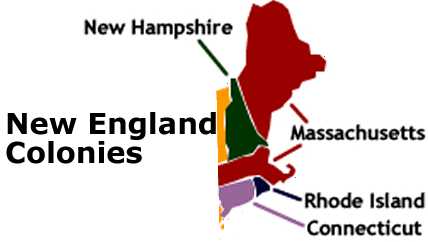
What is the major industry of the New England Colonies?

a)

Cash Crops

b)

Metalwork

c)

Slavery

d)

Shipbuilding and Fishing

12.

A cash crop is

a)

Traded with other crops

b)

Raised for sale in markets to make money

c)

Planted only for one's family

d)

Only for personal use

13.

What was the New England economy shaped by?

a)

Rocky soil, long winters

b)

Fertile Soil, short winters

c)

Forest, mild summers

d)

Mountainous land

14.

The success of large plantations in the Southern Colonies was dependent on?

a)

Native Americans

b)

Debtors

c)

Slaves

d)

Pacifists

15.

The Southern economy was based on what jobs?

a)

Fur trade and hunting

b)

Small family farms and plantations

c)

Lumber and industry

d)

Fishing and shipbuilding

16.

Why were the Mid-Atlantic colonies nicknamed "The Bread Basket?"

a)

They grew many types of grain.

b)

Making bread was a great economic opportunity.

c)

They ate bread with every meal.

d)

They imported many types of grain

17.

The English policy of allowing the Colonies to rule themselves is known as...

a)

Mercantilism

b)

Triangle Trade

c)

Salutary Neglect

d)

Self-government

18.

The Mayflower Compact was created

to —

a)

attract more settlers to the new colony

b)

satisfy church leaders back in England

c)

establish self government in the new colony

d)

justify settlement on American Indian lands

19.

The Virginia Company authorized a general assembly in Virginia so that colonists could —

a)

self-govern on a local level

b)

participate in the triangle trade

c)

vote in the British Parliament

d)

express dissatisfaction with British rule

20.

The first successful written constitution of modern time

Recognized the right of people to rule themselves

Allowed citizens to elect a legislative assembly

Had legislative assembly elect a governor


Which document is described above?

a)

Navigation Acts

b)

Fundamental Orders of Connecticut

c)

Declaration of Independence

d)

U.S. Constitution

21.

Which of the following was a characteristic of the Virginia House of Burgesses?

a)

They refused to trade with anyone except England.

b)

Members were chosen by the governor.

c)

The governor had no power in its decisions.

d)

Representatives were elected by the people.

22.

Which statement best explains the significance of the Mayflower Compact?

a)

It limited the power of future colonial governments.

b)

It weakened the influence of religion in government.

c)

It established a form of self-government based on a social contract.

d)

It guaranteed liberties for colonists through local government.

23.

The idea that people hold the power of government and consent to being governed comes from --

a)

King George

b)

William Penn

c)

John Locke

d)

James Town

24.
What are the three branches of the U.S. government?
a)
legislative, gubernatorial, judicial
b)
Congress, President, Senate
c)
legislative, judicial, executive
d)
none of the above
25.
What are the two parts of our Congress?
a)
The Station and the House
b)
The Senate and the House of Representatives
c)
The President and the Vice President
26.
What is "checks and balances?"
a)
Each branch of power has the ability to limit the power of the other branches. 
b)
The people elect their leaders. 
c)
The people are in charge. 
d)
The people have rights. (Bill of Rights) 
27.
What is republicanism?
a)
There are three branches of government. 
b)
The state and national government share power. 
c)
The people are in charge. 
d)
The people vote for their leaders, who then represent the people. 
28.

What is federalism?

a)

The people vote for their leaders who then represent them.

b)

The people have individual rights.

c)

There are three branches of government.

d)

The states and national government share power.

29.
What is popular sovereignty?
a)
"The people rule." 
b)
There are three branches of government. 
c)
There are two houses in the legislature. 
d)
The people vote for their leaders who then represent them. 
30.
"No one is above the law" is the principle of 
a)
individual rights
b)
limited government
31.

A republican form of government is described as one in which

a)

There is a two-party system

b)

Representatives are elected by the people

c)

Elected officials have limited terms

d)

Government power is limited by checks and balances

32.

Which principle of the government creates 3 different branches?

a)

Limited Government

b)

Separation of Powers

c)

Checks and Balances

d)

Federalism

33.

What is not a part of the 1st amendment?

a)

Freedom of Voting

b)

Freedom of Religion

c)

Freedom of the Press

d)

Freedom of Speech

34.
After Shay's rebellion, America decided that--
a)
They needed a stronger national government
b)
Give farmers more money
c)
They needed a weaker national government
d)
farmers need more land
35.
The Great Compromise was a compromise between--
a)
Mass. Plan and New Jersey Plan
b)
Virginia Plan and New Jersey Plan
c)
Virginia Plan and New York Plan
d)
Virginia Plan and Delaware Plan
36.
The Virginia Plan wanted representation based on--
a)
population
b)
equality for every state
c)
state size
d)
money
37.
The New Jersey Plan wanted representation in government based on--
a)
population
b)
equality for every state
c)
state size
d)
money
38.
For the Great Compromise, how is the number of Senators determined?
a)
based on population of each state
b)
equal number - 1 from each state
c)
equal number - 2 from each state
d)
slaves count as 3/5
39.
What did the southern states want?
a)
Slaves to count as population
b)
Slaves to become free.
c)
Slaves to not count as population
d)
To get rid of slaves in the north.
40.
The Great compromise said that the ______ would have two representatives from each state
a)
House of Representatives
b)
Presidency
c)
Judges 
d)
Senate
41.

Who are the "Big Three" European nations colonizing the Americas?

a)

England

b)

France

c)

Spain

d)

Greece

42.

An economic theory that a nation becomes strong by strictly controlling trade

a)

mercantilism

b)

charter

c)

alliance

d)

legislature

43.

What connected the colonies, Africa and the West Indies and was a part of the slave trade?

a)

Great Awakening

b)

mercantilism

c)

monopoly

d)

Triangular Trade Route

44.

What continent do Spain, France, and England (Britain) belong to?

a)

Europe

b)

South America

c)

Australia

d)

Asia

45.

The Spanish were motivated to explore and colonize by three factors

a)

Christmas, Easter, and Summer Vaca

b)

God, Gold, and Glory

c)

Rice, Ropes, and Rhinestones

d)

Friends, Furs, and Fish 🐠

46.

The three French motives to explore and colonize were

a)

Friends, Furs, and Fish

b)

God, Gold, and Glory

c)

Christmas, Easter, and Summer vaca

d)

Christians, Crowns, and Creativity

47.
In the Dred Scott decision, it was decided that:
a)
African Americans can not be citizens
b)
There cannot be slaves in free states
c)
Slavery is illegal
d)
Maine would be free, Missouri would be slave state
48.

This legislation brought California in as a free state, and also created Utah and New Mexico. The Fugitive Slave Act was included in this legislation, as well:

a)

Compromise of 1820

b)

Compromise of 1850

c)

Dred Scott Decision

d)

Fugitive Slave Law

49.
In the Fugitive Slave Act, it was ILLEGAL for a northerner to let a runaway slave go free
a)
True 
b)
False
50.
To nullify a law means …
a)
to agree to the law
b)
to secede.
c)
to void or cancel the law.
d)
to vote on the law.
51.
Which state said they wouldn‘t pay the new tariff and passed the Nullification act?
a)
North Carolina
b)
South Carolina
c)
Virginia
d)
Georgia
52.
Tariffs caused the price of ____ to go up.
a)
foreign goods
b)
american made goods
c)
ice cream
d)
slaves
53.
Which region of the country had a lot of manufacturing?
a)
the north
b)
the south
c)
the west
d)
Alaska
54.
These speakers below are debating an issue that eventually became known as the —
a)
Monroe Doctrine
b)
Nullification Crisis
c)
Missouri Compromise
d)
Three-Fifths Compromise
55.
One attempt to resolve this issue below without violence involved which action?
a)
The Cherokee Nation challenged Georgia’s anti-Cherokee laws before the U.S. Supreme Court.
b)
Georgia asked the federal government for funds to purchase Cherokee land.
c)
The Cherokee Nation asked President Andrew Jackson to negotiate with Georgia.
d)
Georgia offered to grant U.S. citizenship to the Cherokees.
56.
In the United States, you may_______________.
a)
start your own business to meet a need
b)
decide what fees to charge for a service or product
c)
own and run any business as long as the laws are obeyed
d)
all of the answers are correct
57.
In the American Free Enterprise System, you have the right to buy or sell private property.
a)
True
b)
I do not believe that people should own property, or have the right to buy or sell it.
c)
False
58.

A person who chooses to, and is free to, open a grocery store is participating in a

a)

command economy

b)

centrally-planned economy

c)

free enterprise economy

d)

traditional economy

59.

Overcrowding, pollution, crime, and disease were some of the problems of what? (WR)

a)

Manifest Destiny

b)

Education

c)

Equal Pay

d)

Urbanization

60.

This Political Party is known for being against immigrants and not wanting them to hold public office.

a)

Know-Something Party

b)

Know-Nothing Party

c)

Know-now Party

d)

Know-Trump Party

61.
The failure of this crop, forced 1.5 million Americans to emigrate to the United States.
a)
Potato
b)
Lettuce
c)
Tomato
d)
Cucumber
62.

This was a time of renewed vigor for religious feelings.

a)

Renaissance

b)

Enlightenment

c)

Second Great Awakening

d)

Revival Movement

63.
Whose philosophical ideas about life and liberty influenced the way that Thomas Jefferson worded the Declaration of Independence? 
a)
Thomas Hobbes
b)
Jean-Jacques Rousseau
c)
John Locke 
d)
Adam Smith
64.
Finish this American Colonist Motto, "No Taxation without..."
a)
Transportation
b)
Relaxation
c)
Representation
d)
Sensation
65.
Why were the American Colonist taxed after the French and Indian War?
a)
Britain was in debt and needed money
b)
That was the agreement with the Native Americans
c)
They made too much money
d)
Townshend Acts
66.
The Second Continental Congress addressed the steps to the colonies governing themselves and the creation of what military group?
a)
Colonial militias
b)
Marines
c)
Continental Army
d)
Navy
67.
Pamphlet that sparked the independent spirit within the colonies during the revolution.
a)
Common Sense
b)
Catching Fire
c)
Declaration of Independence
d)
Mayflower Compact
68.
Freedom of speech, press, religion, assembly, and petition.  Which amendment is this?
a)
1st
b)
2nd
c)
3rd
d)
4th
69.
What freedom gives you the right to say anything you want just long as you are not  threatening safety of anyone?
a)
Press
b)
Petition
c)
Assembly
d)
Speech
70.
What freedom gives you the right to practice any religion or faith of your choice?
a)
religion
b)
press
c)
speech
d)
assembly
71.
Guarantees freedom from testifying against yourself
a)
1st Amendment
b)
3rd Amendment
c)
5th Amendment
d)
7th Amendment
72.
Guarantees the right to a speedy and public trial
a)
2nd Amendment
b)
4th Amendment
c)
6th Amendment
d)
8th Amendment
73.
Offices usually need a _______ to search you or your property
a)
Baton
b)
Firearm
c)
Warrant
d)
Bible
74.

What is an amendment?

a)

the introduction to the Constitution

b)

a change to the Constitution

c)

the signers of the Constitution

75.
The US received what territory from the Adams-Onis Treaty?
a)
Texas
b)
Missouri
c)
Alabama
d)
Florida
76.
Which of the following stopped European colonization in America.
a)
Adams-Onis Treaty
b)
Monroe Doctrine
c)
Watauga Compact
d)
Convention of 1818
77.
The feeling of pride and accomplishments refers to what time period.
a)
Age of Enligtenment
b)
Industrial Age
c)
Era of WestwardExpansion
d)
Era of Good Feelings
78.
The American System called for what?
a)
A tariff to stimulate American industry
b)
An embargo to slow American industry
c)
To expand the national government
d)
To close the national bank
79.
The Monroe Doctrine said __________________.
a)
no more European colonies could be started in the Americas
b)
Europe must leave the Americas alone
c)
the United States would stay out of Europe's business
d)
all of the above
80.
Which President warned against forming political parties?
a)
George Washington
b)
John Adams
c)
Thomas Jefferson
d)
Andrew Jackson
81.
Which founding father is known as the founder of the Federalist Party?
a)
Thomas Jefferson
b)
George Washginton
c)
Alexander Hamilton
d)
Benjamin Franklin
82.
Which founding father is known as the founder of the Democratic Republican Party?
a)
Benjamin Franklin
b)
Alexander Hamilton
c)
George Washington
d)
Thomas Jefferson
83.
The Federalist party believed that a strong _______ government was necessary in the United States.
a)
central
b)
state
84.
What is the term that means "the powers of government are divided into 3 different branches to make sure that no one branch [or one person] is too powerful"?
a)
separation of powers
b)
popular sovereignty
c)
federalism
d)
republicanism
85.

We must start with a fresh document, fixing the Articles of Confederation isn’t enough.

a)

Federalist

b)

Antifederalist

86.

The Constitution contains no Bill of Rights to protect individual liberties like freedom of speech, trial by jury, and the right against searches and seizures.

a)

Federalist

b)

Antifederalist

87.

A strong President is necessary to protect the country against foreign attack and make sure laws are carried out properly.

a)

Federalist

b)

Antifederalist

88.

The Constitution gives too much power to the central government, overpowering the states.

a)

Federalist

b)

Antifederalist

89.

The President created by the Constitution is really just a king.

a)

Federalist

b)

Antifederalist

90.
This Federalist is known as the "Father of the Constitution".
a)
Thomas Jefferson
b)
Thomas Paine
c)
James Madison
91.
Which party was Alexander Hamilton a member of?
a)
Federalist
b)
Tea Party
c)
Anti-federalists
92.
This event broke tensions between the colonist and the British troops where shots were fired. Crispus Attucks was the first to be killed.
a)
Lexington and Concord
b)
Boston Tea Party
c)
Boston Massacre
d)
Bloody Valentine
93.
This battle where the American Colonist won and was called "The shot heard 'round the world". 
a)
Battle of Saratoga
b)
Battle of Yorktown
c)
Lexington and Concord
d)
Battle of Bunker Hill
94.
Colonists were forbidden to settle west of the Appalachian Mountains.
a)
Proclamation line of 1763
b)
Proclamation boundary
c)
Manifest Destiny
d)
Borderlands
95.
Life, Liberty and the pursuit of happiness were...
a)
Unalienable rights
b)
Bill of Rights
c)
Freedom to live
d)
Will Smith movie
96.
OFFICIALLY gives colonists independence 
a)
Declaration of Independence 
b)
Treaty of Paris
c)
Yorktown
d)
2nd Continental Congress 
97.
The French began to support the Americans after this battle
a)
Lexington and Concord
b)
Yorktown
c)
Saratoga
d)
Treaty of French 
98.
Soldiers froze here because of the harsh winter
a)
Paris
b)
Valley Forge
c)
Rio Grande Valley 
d)
Yorktown 
99.
The Quartering Act stated that…
a)
British soldiers could stay in private colonial homes
b)
Colonists could stay in British forts
c)
King George could stay in any colonial home
d)
Colonist had to pay a quarter tax for a pound of tea
100.

The creation of the Erie canal played a key role in which development?

a)

New Orleans becoming a leader in manufacturing and trade

b)

Washington, D.C., becoming a cultural and political center of the nation

c)

Boston becoming one of the country's largest transportation hubs

d)

New York becoming an important commercial center

101.

"production of goods moved from home to factories....major changes in transportation, communications, transformed the daily lives of Americans"

Which of the following was most responsible for the revolution described in this excerpt?

a)

expanded public education

b)

rapid technological innovation

c)

increased government spending

d)

rapid territorial expansion

102.
  • entrepreneurship
  • Competition
  • Private property
  • profit motive
  • consumer choice

Which of the following would be the best title for the list?

a)

Free Enterprise System

b)

Mercantile system

c)

Federalism

d)

Republicanism

103.

What did Samuel Morse invent?

a)

phonograph

b)

telegraph

c)

light bulb

d)

batteries

104.
Where were most immigrants from?
a)
Italy
b)
Slavic Countries
c)
Mexico, Cuba, Puerto Rico
d)
Europe
105.

During the period from 1880 to 1910, why did the majority of immigrants to the United States settle in urban areas in the North?

a)

They were looking for work on farms

b)

Factories created many job opportunities.

c)

They wanted to settle on the frontier

d)

Most immigrants had lived in cities in their native countries.

106.
 Which factor contributed to the shifting of population from rural to urban areas from 1870-1900?
a)
Not enough families took advantage of the Homestead Act
b)
Great Plains Indians left their reservations to buy new farmland
c)
Houses in cities were less expensive than those in the counttryside
d)
 Better jobs in industry attracted farmers and laborers to cities
107.
Allowing states to decide by popular vote whether or not to prevent slavery is called
a)
cession
b)
permanent school fund
c)
veto
d)
popular sovereignty
108.
The Treaty of Guadalupe-Hidalgo made the _______________ river the boundary between 
a)
Nueces River
b)
Sabine River
c)
Colorado River
d)
Rio Grande River
109.
Slavery became a major issue in the 1840s and 1850s because:
a)
The northern states tried to abolish slavery in the southern states
b)
The nation was expanding to the West
c)
The southern states demanded the end of slavery
d)
None of these
110.
Texas joined the United States through a process called
a)
expedition
b)
veto
c)
annexation
d)
joint resolution
111.
The lands gained by the United States as a result of the Mexican War are known as the 
a)
Texas Annexation
b)
Mexican Cession
c)
Gadsen Purchase
112.
This president was a strong believer in expanding the nation westward
a)
Henry Clay
b)
Andrew Jackson
c)
James K. Polk
113.
Who was the president for the U.S during the time of the war 
a)
President Polk
b)
Macys cat Oliver
c)
Thomas Jefferson 
d)
John Quincy Adams 
114.
Practice of rewarding government jobs  to political supporters; replacing government employees with the winning candidate's supporters.
a)
Bureaucracy
b)
Mudslinging
c)
Spoil System
d)
Plurality
115.
What did Andrew Jackson's philosophy become to be known as?
a)
Jacksonian Doctrine
b)
Jacksonian Diplomacy
c)
Jacksonian Democracy
d)
Jacksonian Republic
116.
In the 1820's voting rights expanded to include who?
a)
All white men 21 and over.
b)
All white men and women over 21.
c)
All White and Black men 21 and older.
d)
All white and Native Americans 21 or older.
117.
The Indian Removal Act authorized the U.S. government to...
a)
Arrest Native Americans that were against the United States.
b)
Forcibly change the culture of all Native Americans.
c)
Declare war against all Native Americans.
d)
Negotiate treaties forcing Native Americans to move west. 
118.
The ___ allowed the president to use the US military to enforce acts of Congress.
a)
Nullification Bill
b)
Executive Order
c)
Force Bill
d)
Nullification Crisis
119.
To cancel or make something ineffective is to __ it.
a)
cancellate
b)
relocate
c)
nullify
d)
bereaucracy
120.
What is the practice of kidnapping sailors and forcing them to serve?
a)
Impressment
b)
Isolationism
c)
Sedition
d)
Embargo
121.
What two nations kept attacking American ships during Madison's presidency?
a)
France and Spain
b)
England and Spain
c)
France and England
d)
France and Mexico
122.

Overcrowding, pollution, crime, and disease were some of the problems of what? (WR)

a)

Manifest Destiny

b)

Education

c)

Equal Pay

d)

Urbanization

123.

Which freed slave was a writer, speaker and leading member of the Abolitionists?

a)

Frederick Douglass

b)

Nat Turner

c)

John Brown

d)

Dred Scott

124.
George Washington's foreign policy is best exemplified by the...
a)
Embargo Act 
b)
Neutrality Proclamation
c)
Aggressive Manifest Destiny
d)
XYZ Affair
125.
Which of the following laws was passed by Thomas Jefferson in order to prevent foreign interference with American trading ships? 
a)
Alien & Sedition Acts
b)
Embargo Act
c)
Neutrality Proclamation
d)
Barbary Act
126.
Which Supreme Court case established the doctrine of judicial review? 
a)
Marbury v. Madison
b)
McCulloch v. Maryland
c)
Gibbons v. Ogden
d)
Worcester v. Georgia
127.
Which early Supreme Court Chief Justice is considered the most influential? 
a)
John Jay
b)
Roger Taney
c)
John Marshall
d)
John Roberts
128.
Which President's domestic policy included putting down the Whiskey Rebellion? 
a)
George Washington
b)
John Adams
c)
Andrew Jackson
d)
James Madison
129.
Which President's domestic policy resulted in the Trail of Tears? 
a)
John Quincy Adams
b)
Andrew Jackson
c)
Thomas Jefferson 
d)
James Madison
130.

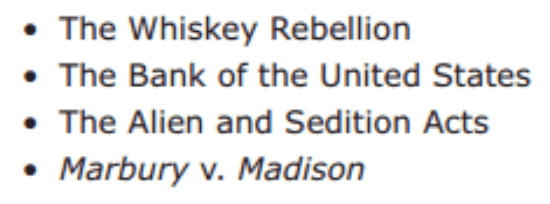
This list provides examples of -

a)

topics discussed during the Second Constitutional Convention

b)

domestic issues faced by the leaders of the new republic

c)

weakness of the government under the Articles of Confederation

d)

issues leading to the ratification of the first constitutional amendments

131.
Created the Fugitive Slave Act
a)
Missouri Compromise
b)
Compromise of 1850
132.
Which entered the US as a free state in the Missouri Compromise?
a)
Missouri
b)
Maine
c)
California
d)
Washington DC
133.

Northern and Southern delegates vehemently argued on how slaves should be counted as population for representation purposes, the result of this debate was the -

a)

Three-fifths compromise

b)

Great Compromise

c)

Virginia and Kentucky Resolutions

d)

Missouri Compromise