
 Worksheets
7A Evidence of Evolution Level 2
Total questions: 10
Worksheet time: 7mins


The similarities of the bones in the diagram provide evidence that---
The organisms shown lived in the same natural envionrment
The organisms shown may have descended from a common ancestor
The organisms shown have the same genetic diseases
All vertebrate species have identical forelimbs
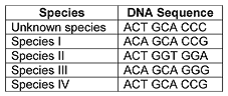
According to this data, the unknown bacterial species is most closely related to:
Species I
Species II
Species III
Species IV

The similarities of organisms in which two areas numbered in the picture provide the LEAST evidence for common ancestry?
1 and 2
2 and 3
5 and 6
6 and 7

The picture shows the members of the Camelidae family. The similar physical features and the geographical origin of these animals provide evidence that -
they live in the same type of environment.
they have slowly evolved to become herbivores.
these species are closely related to each other
they exchanged DNA in the past.

Both these mammals incubate their immature offspring in a pouch which provides evidence that they-
belong to the same species
must range great distances to eat
have very similar skeletal structures
are descended from a common ancestor
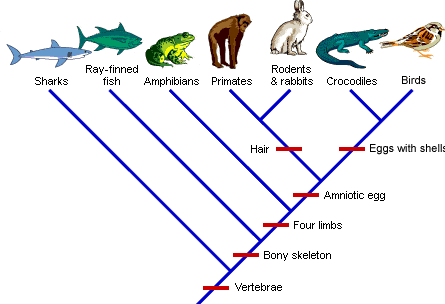
According to this cladogram, birds are LEAST related to:
Amphibians
Sharks
Ray Finned Fish
Crocodiles
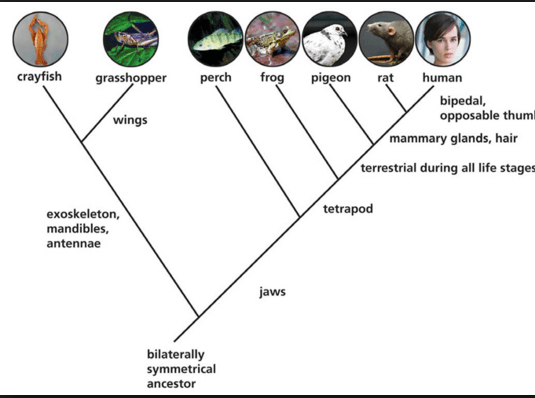

In this image provided, the fossil record is indicating that...
the most ancient species are in the deepest layer of rock
the most recent species are found in the middle layers of rock
evidence of species from only the last 10,000 years can be found
species that existed at different times are in the same layer of rock

Which statement best represents the illustration?
All of the above species are mammals.
All of the above structures show no evidence of relationship.
All of the above structures share anatomical homology.
All of the above species evolved in the same habitat.

