
 Worksheets
Motion: Displacement, Speed, Velocity, and Acceleration
Total questions: 24
Worksheet time: 49mins
Name
Class
Date
1.

A runner races in the 100 meter dash. It takes her 10 seconds to finish. What is her average speed?
a)
10 m/s
b)
1000 m/s
c)
100 seconds
d)
10 seconds
2.

What does this graph represent?
a)
Constant Speed
b)
Acceleration
c)
Not moving
3.
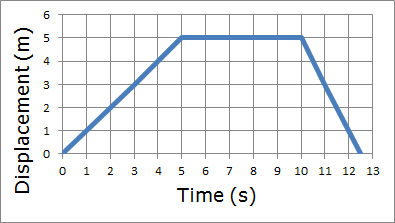
According to the graph how far does the person travel in the first 5 seconds?
a)
2 m
b)
10 m
c)
0 m
d)
5 m
4.
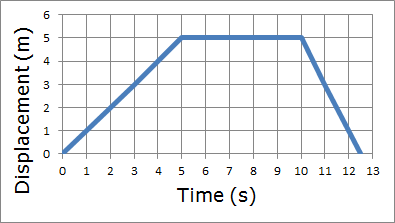
What is the person doing from 5 seconds to 10 seconds?
a)
Walking
b)
Running
c)
Standing Still
d)
Walking Fast
5.
Velocity is both ____ and _____.
a)
speed , direction
b)
direction, mass
c)
volume, density
d)
direction, magnitude
6.
Which of the following represents a velocity?
a)
40 m
b)
40 m north
c)
40 m/s
d)
40 m/s north
7.

Which statement is true about velocity?
a)
Must have measurement of speed.
b)
Must have a measurement of speed and direction.
c)
Must have only direction.
d)
Has neither a measurement of speed or direction.
8.

How do you calculate velocity?
a)
Distance divided by time.
b)
Displacement divided by time.
c)
Speed multiplied by time.
d)
Displacement divided by velocity.
9.
How do you calculate distance?
a)
Distance divided by time.
b)
Displacement divided by time.
c)
Speed multiplied by time.
d)
Displacement divided by velocity.
10.

A car moves a distance of 1000 m with an average speed of 28 m/s. Calculate the time.
a)
36 seconds
b)
28,000 seconds
c)
28 seconds
d)
972 seconds
11.

A cheetah runs with an average speed of 32 m/s for 30 seconds. How far did the cheetah run?
a)
960 m
b)
1.07 m
c)
0.94 m
d)
62 m
12.
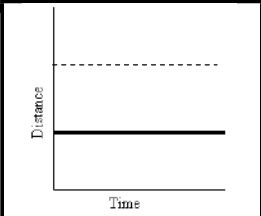
What does this graph represent?
a)
Constant speed
b)
Acceleration
c)
Not moving
13.

What is the speed of the red line?
a)
4 m/s
b)
16 m/s
c)
32 m/s
d)
2 m/s
14.

What is happening in this graph from point B to C?
a)
The object is going down a hill.
b)
The object is returning to its starting location.
c)
The object is slowing down.
d)
The object is staying still.
15.
Scott travels north 5 miles and then goes west 3 miles before coming straight back south 2 miles. What is his distance?
a)
10 m
b)
7 m
c)
8 m
d)
6 m
16.

Can your displacement ever be greater than your distance?
a)
Yes
b)
No
17.

Why don't the runners in the 400m dash start at the same line?
a)
so their distance is the same
b)
so their displacement is the same
c)
so their speed is the same
d)
so their velocity is the same
18.

If a sprinter runs 200m W and 100m E, what is his displacment?
a)
300m
b)
300m W
c)
100m
d)
100m W
19.

Acceleration is the rate of change of
a)
position
b)
time
c)
speed
d)
velocity
20.

How can acceleration be zero?
a)
a car runs out of gas and slowly rolls to a stop
b)
a car decreases speed at a constant rate until it comes to rest
c)
car has constant speed and is traveling on a straight path
d)
the car travels round trip and is back at the starting point
21.

When unbalanced forces act
a)
the motion does not change
b)
object accelerates
c)
the inertia increases
d)
the mass decreases
22.

The strength of gravity depends on
a)
friction and tension
b)
speed and direction
c)
mass and distance
d)
centripetal and centrifugal
23.

How would you calculate the distance traveled by a comet that is flying through the solar system at a speed of 50,000 km/hr for 4 hours?
a)
50,000 ÷ 4
b)
50,000 × 4
c)
4 ÷ 50,000
d)
4 - 50,000
24.

How would you calculate the average speed of a ball if it rolls a distance of 5 meters in a time of 10 seconds?
a)
5 ÷ 10
b)
5 × 10
c)
10 ÷ 5
d)
10 + 5
100 %

