
 Worksheets
Unit 9 Review: Nuclear Chemistry
Total questions: 36
Worksheet time: 53mins
Finish this equation
20983Bi--> _______ + 20581Tl
42He
0-1e
y
Identify the missing substance in each of the following nuclear reaction.
_____→13756 Ba + 0−1 e
13755Ba
13757La
13856Ba
13755Cs
The three types of nuclear radiation in order of increasing penetrating power are ____.
alpha, beta, gamma
X ray, beta, gamma
alpha, gamma, beta
X ray, gamma, beta


Finish the following alpha decay reaction:


What is an isotope?
forms of the same element that contain equal numbers of electrons but different numbers of protons
forms of the same element
forms of the same element that contain equal numbers of protons but different numbers of neutrons
An atom with no nucleus
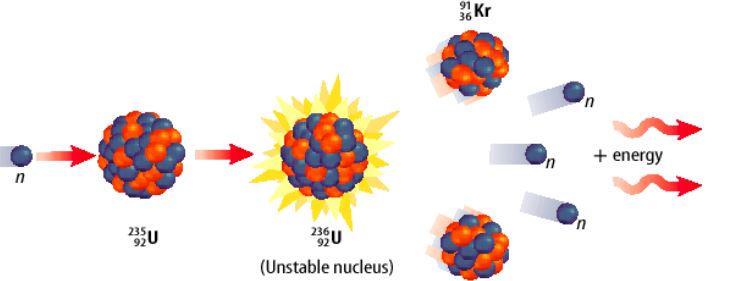
Fission and fusion are similar because both
combine lighter nuclei in to one heavier nucleus
split a large nucleus into two smaller nuclei
convert mass into energy
convert energy into mass
Determine the time required for a sample of radon-222 to decay until only 1/8 of the original sample remains unchanged
3.823 d
7.646 d
11.469 d
15.292
In which reaction is an atom of one element converted into an atom of another element?
combustion
fermentation
oxidation-reduction
transmutation
What is the half-life of a radioactive element if an 80 gram sample decayed to 40 grams in 12 hrs?
12 h
6 h
24 h
36 h

Complete the nuclear equation for the decay of Cobalt-60:
6026Co
6026Fe
6025Mn
6028Ni

Which nuclear equation represents spontaneous decay?
(1)
(2)
(3)
(4)
The radio of the mass of U-238 to the mass of Pb-206 can be used to
diagnose thyroid disorders
diagnose kidney functions
date geological formations
date once-living things
Using equal masses of reactants, which statement describes the relative amounts of energy released during a chemical reaction and a nuclear reaction?
The chemical and nuclear reactions release equal amounts of energy.
The nuclear reaction releases half the amount of energy of the chemical reaction.
The chemical reaction releases more energy than the nuclear reaction.
The nuclear reaction releases more energy than the chemical reaction.
What fraction of an original K-42 sample remains unchanged after 24.72 hours?
1/2
1/4
1/8
1/16
Which nuclear emission has the least penetrating power and the greatest ionizing ability?
alpha particle
beta particle
gamma ray
positron

Which type of nuclear reaction is represented by the equation?
fission
fusion
beta decay
alpha decay
Which phrase describes a risk of using the radioisotope Co-60 in treating cancer?
production of acid rain
production of greenhouse gases
increased biological exposure
increased ozone depletion
Determine the time required for a 16.00-gram sample of I-131 to decay until only 1.00 gram of the sample remains unchanged.
8.021 d
16.042 d
24.063d
32.048 d

Which nuclear emission is listed with its notation?
(1)
(2)
(3)
(4)
What evidence indicates that the nuclei of strontium-90 atoms are unstable?
Strontium-90 electrons are in the excited state.
Strontium-90 electrons are in the ground state.
Strontium-90 atoms spontaneously absorb beta particles
Strontium-90 atoms spontaneously emit beta particles
The energy released during a nuclear reaction is a result of
breaking chemical bonds
forming chemical bonds
mass being converted to energy
energy being converted to mass
Which radioisotope is used to determine the age of once-living organisms?
carbon-14
cobalt-60
iodine-131
uranium-238

Choose the correct missing particle that correctly completes the nuclear equation shown in the picture.
(1)
(2)
(3)
(4)
What is the mass of an original 5.60-gram sample of iron-53 that remains unchanged after 25.53 minutes?
0.35 g
0.70 g
1.40 g
2.80 g

