wayground logo

Free Printable Worksheets

Font size

S
M
L
XL
Worksheets

Midterm Practice

Total questions: 61

Worksheet time: 2hrs 45mins

Name
Class
Date
1.
A location in space that is represented by a dot and has no dimensions
a)
Point
b)
Line
c)
Plane
d)
Angle
2.
What is it called when points lie on the same line.
a)
Midpoint
b)
Coplanear
c)
Segment Bisector
d)
Collinear
3.
Consists of 2 endpoints and all the points in between.
a)
Ray
b)
Line
c)
Line Segment
d)
Angle
4.
What is this Symbol called?
a)
Congruent
b)
Equal
c)
Parallel Lines
d)
Angle
5.

Two rays that have a common endpoint and form a line.

a)

Linear Pair

b)

Opposite Rays

c)

Right Angle

d)

Supplementary Angles

6.

flat surface that has no thickness and extends forever.

a)

point

b)

line

c)

plane

d)

ray

7.
This is a(n):
a)
Line
b)
Ray
c)
Angle
d)
Line Segment
8.
This is a(n):
a)
Line
b)
Ray
c)
Angle
d)
Line Segment
9.
RS is the segment bisector.  If OQ = 32 and PO = 4x, what does x equal?
a)
8
b)
28
c)
128
d)
36
10.
Given that R is between S and T.
RS=6, TR=4.5, TS= ______
a)
1.5
b)
10.5
c)
6
d)
4.5
11.
D is the midpoint of EF.
ED = 4x + 6
DF = 7x -9
 Find EF.
a)
5
b)
26
c)
52
d)
22
12.

Another name for  ABD \angle ABD\   is ______________________.

a)

 ADB\angle ADB  

b)

 BDA\angle BDA  

c)

 DBA\angle DBA  

d)

 B\angle B  

13.

 ABD\angle ABD  is a _____________ angle.

a)

Acute angle

b)

Obtuse angle

c)

Right angle

d)

A straight angle

14.

 LMN\angle LMN  is called __________________.

a)

An acute angle

b)

An obtuse angle

c)

A right angle

d)

a straight angle

15.

 LMP and NMP\angle LMP\ and\ \angle NMP  form __________________.

a)

Complementary Angles

b)

A Linear Pair

c)

Vertical Angles

d)

Consecutive Interior Angles

16.

 AEC and BED\angle AEC\ and\ \angle BED  are called __________________.

a)

A Linear Pair

b)

Vertical Angles

c)

Supplementary Angles

d)

The same angle

17.

What do we call two angles or line segments that have the same measure?

a)

Complementary

b)

Supplementary

c)

Vertical

d)

Congruent

18.
Name the angle pair. 
a)
Complementary
b)
Supplementary
c)
Adjacent
d)
Vertical
19.
Angles 1 and 2 are what angle pair?
a)
Complementary
b)
Acute
c)
Adjacent
d)
Vertical
20.
Angles 4 and 1 are what angle pair?
a)
Complementary
b)
Linear Pair
c)
Acute
d)
Vertical
21.

Find x

a)

30°30\degree

b)

60°60\degree

c)

90°90\degree

d)

150°150\degree

22.
Use the Law of Detachment to draw a conclusion from the two given statements. If not possible, write not possible.
Statement 1: If I study for one hour each day, then I will score well on the exam
Statement 2: I will score well on the exam
a)
 I study for 1 hour each day.
b)
I do not study for 1 hour each day
c)
If I do well on the exam, I studied for 1 hour each day.
d)
not possible
23.
Use the law of syllogism to draw a conclusion from the two given statements:
Statement 1: If you exercise regularly, then you have a healthy body
Statement 2: If you have a healthy body, then you have more energy
a)
You have more energy
b)
If you exercise regularly, then you have more energy
c)
You have a healthy body
d)
If you do not have a healthy body, then you do not exercise regularly
24.
p→q
q→r
∴p→r
Which law is modeled?
a)
Law of Syllogism
b)
Law of Detachment
c)
Law of Contrapositive
d)
Law of Shannon
25.
p→q
p
∴q
Which law is modeled?
a)
Law of Syllogism
b)
Law of Detachment
c)
Law of Contrapositive
d)
Law of Shannon
26.
If possible, use the Law of Detachment to draw a conclusion from the two given statements. If not possible, write not possible.
Statement 1: If x = 2, then 2x – 10 = –6.
Statement 2: x = 2 
a)
2x – 10 = –6 
b)
x = 2
c)
 If 2x – 10 = –6, then x = 2
d)
not possible 
27.
__________________________ uses specific observations to make generalizations.
a)
Deductive reasoning
b)
Inductive reasoning
28.
__________________________ uses generalizations to make specific conclusions.
a)
Deductive Reasoning
b)
Inductive Reasoning
29.
Given, "If angles are congruent, then the measures of the angles are equal." Identify the contrapositive.
a)
If the measures of the angles are equal, then the angles are congruent.
b)
If angles are not congruent, then the measures of the angles are not equal.
c)
If the measures of the angles are not equal, then the angles are not congruent.
d)
If the angles are not congruent, then the measure of the angles are equal.
30.
Original: If Emily is not late to class, then she will not be marked tardy.
What is this? If Emily is late to class, then she will be marked tardy.
a)
Converse
b)
Inverse
c)
Contrapositive
d)
Negation
31.
Given, "If angles are congruent, then the measures of the angles are equal." Identify the converse.
a)
If the measures of the angles are equal, then the angles are congruent.
b)
"If angles are not congruent, then the measures of the angles are not equal."
c)
If the measures of the angles are not equal, then the angles are not congruent.
d)
If the angles are not congruent, then the measure of the angles are equal.
32.
Given, "If I have a Siberian Husky, then I have a dog." Identify the hypothesis.
a)
If I have a Siberian Husky.
b)
I have a Siberian Husky.
c)
Then I have a dog.
d)
I have a dog.
33.
Given, "If I have a Siberian Husky, then I have a dog." Identify the conclusion.
a)
If I have a Siberian Husky.
b)
I have a Siberian Husky.
c)
Then I have a dog.
d)
I have a dog.
34.
What is the if-then-form of the following statement? "It is time for dinner if it is 6 pm."
a)
If it is 6pm, then it is time for dinner.
b)
If it is time for dinner, then it is 6pm.
c)
If you want to eat dinner, then you must eat at 6pm.
d)
None of these are right
35.
What is this?
a)
Conditional
b)
Inverse
c)
Converse
d)
Contrapositive
36.
What does this mean?
a)
Conditional 
b)
Converse
c)
Inverse
d)
Contrapositive
37.
What is a conjecture?
a)
A statement believed to be true based on observations.
b)
An example which disproves an hypothesis.
c)
the performance of tricks that are seemingly magical
38.
Find the next term in the sequence:
A, D, G, J, _____
a)
L
b)
M
c)
P
d)
K
39.
Complete the conjecture.  Think of examples to help.
The product of any two odd numbers is _____________
a)
even
b)
odd
c)
zero
d)
positive
40.
Used to prove that a conjecture is false.
a)
Counterexample
b)
Inductive Reasoning
c)
Concluding statement
d)
Conjecture
41.
Which is a counterexample of: The difference of two numbers is less than the greater number.
a)
(5) - (2) = 3
b)
(-5) - (4) = -9
c)
(2) - 0 = 2
d)
(3) - (3) = 0
42.
Which number is a counterexample to the following statement? : 
All numbers that are divisible by 2 are divisible by 4
a)
0
b)
12
c)
28
d)
42
43.
What is the area of the figure? 
a)
11 square units
b)
15 square units
c)
25 square units
d)
30 square units
44.
What is the area of the rectangle?
a)
28 units squared
b)
45 units squared
c)
33 units squared
d)
19 units squared
45.
Find the distance between (-9, -1) and (-2, -6).Round to the nearest tenth.
a)
8.6
b)
12.1
c)
9.9
d)
13.0
46.
Find the midpoint of the segment with the endpoints:(6, 7) and (6, -5) 
a)
(0, -1)
b)
(6, 1)
c)
(1, 6)
d)
(0, 1)
47.

Find the endpoint of the segment with the endpoint of (-4, 5) and midpoint of (7, 9)

a)

(18, 13)

b)

(13, 18)

c)

(11,4)

d)

(1.5, -2)

48.

Another name for line k

a)

 DB\overleftarrow{D}\overrightarrow{B} 

b)

 DE\overleftarrow{D}\overrightarrow{E}  

c)

 EC\overleftarrow{E}\overrightarrow{C}  

d)

 ED\overleftarrow{E}\overrightarrow{D}  

e)

plane MM  

49.

intersection of plane M and line k

a)

 CB\overleftarrow{C}\overrightarrow{B} 

b)

 \cdot E

c)

j

d)

plane MM  

50.

another name for plane Q

a)

FGI

b)

m

c)

FG

d)

plane P

e)

FEG

51.

intersection of plane ABC and plane ABE

a)

BC\overleftarrow{B}\overrightarrow{C}

b)

BE\overleftarrow{B}\overrightarrow{E}

c)

AB\overleftarrow{A}\overrightarrow{B}

52.

Are  \cdot D  and  \cdot E  collinear? 

a)

Yes

b)

No

53.

Are  \cdot D  and  \cdot H  coplanar? 

a)

Yes

b)

No

54.

Do P and Q intersect?

a)

Yes

b)

No

55.

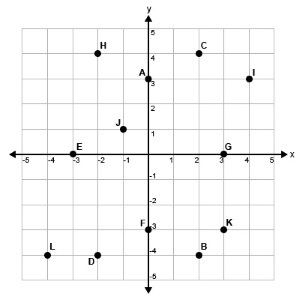
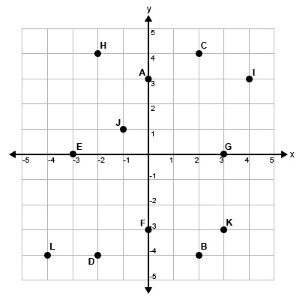
What is the ordered pair for point K?

a)

(-3, -3)

b)

(3, -3)

c)

(-4, -4)

d)

(5, 8)

56.

What are the coordinates of point H?

a)

(-4, 2)

b)

(4, -2)

c)

(-2, 4)

d)

(4, 4)

57.

What is an ordered pair?

a)

a set of numbers used to locate a point on the coordinate plane

b)

the vertical number line

c)

a number that corresponds to a number on the y-axis

d)

a point where the numbers intersect

58.

The horizontal number line is called the _____________?

a)

y-axis

b)

y-coordinate

c)

x-axis

d)

x-coordinate

59.

The vertical number line is called the __________?

a)

x-coordinate

b)

x-axis

c)

y-axis

d)

y-coordinate

60.

In an ordered pair ( __ , __) which axis comes first?

a)

y

b)

x

61.

Ordered pair (-4, -4) would lead you to which plot point?

a)

H

b)

L

c)

I

d)

K