
 Worksheets
DP Biology Topic 6.1
Total questions: 32
Worksheet time: 11mins
Which organ of the digestive system stores bile after it has been produced by the liver?
(a)

What is the name of the process whereby food moves down the oesophagus?
(a)

Where are villi located?
Small intestine
Large intestine
Stomach
Which product is produced after salivary amylase has broken down its substrate?
Glucose
Dextrose
Maltose
Which of the following organs are CORRECTLY paired with their function? Select all that apply
stomach - protein digestion
large intestine - bile production
small intestine - nutrient absorption
pancreas - enzyme production
This muscular tube moves food down to the stomach.
(a)
This organ is not actually part of the alimentary canal, but it produces bile to help break down fats.
Stomach
gallbladder
Pancreas
Liver

Used to cut and grind food into smaller pieces.
Small Intestine
Villi
Teeth
Pancreas

This organ absorbs water and dissolved minerals
(a)

Physical breakdown of food is done digestive system by (select all that apply)
Teeth
tongue
oesophagus
stomach
Saliva contains this enzyme to start the digestive process.
(a)

The highlighted organ is the
(a)

Where are the microvilli located?
(a)

Which of these IS stored by the liver (select all that apply)
Vitamins
Bile
Iron
Glycogen
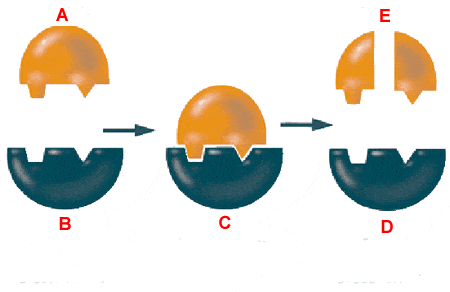
This reaction shows a (a) reaction
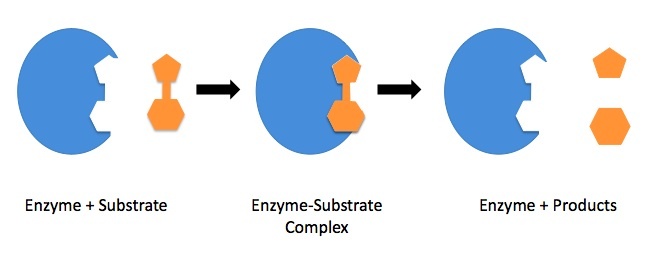
The current model of enzyme action is referred to as the:
(a)
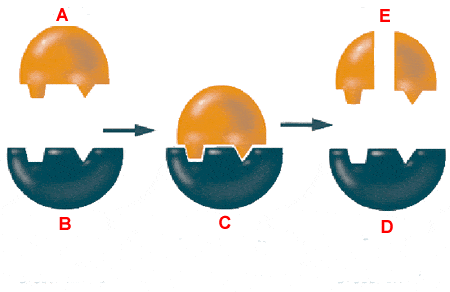
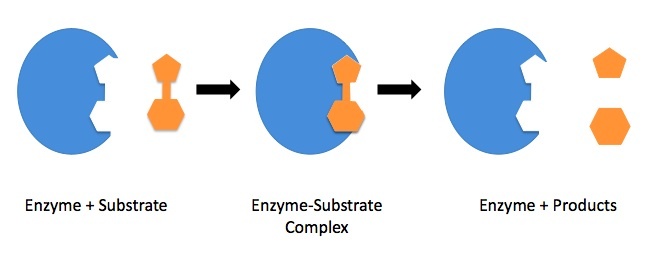
Most enzymes have the ending:
(a)

The graph below shows how the activity of an enzyme changes over a range of pH values. Which of the following conclusions can be drawn from this graph? Select all that apply
The optimum pH of the enzyme is 7
The optimum pH of the enzyme is cannot be known
The enzyme’s activity continually increases as pH increases from 5.0 to 7
The enzyme’s activity is greater around pH of 8.0 than around pH of 5.0.
Which of the following best explains why enzymes are necessary for many cellular reactions? select all that apply
Enzymes supply the oxygen necessary for the reactions
Enzymes change reactants from solid to liquids during the reactions.
The reactions take up too much space in the cell if the enzymes are missing.
The reactions are too slow to meet the needs of the cell if enzymes are missing.

The enzyme lactase will break down the sugar lactose. Name a specific product
(a)
The human body maintains a temperature of around 37 degrees at all times. Enzymes are involved in almost every chemical reaction in the body. Which of the following statements are incorrect? Select all that apply
Enzymes function best at a specific temperature.
The body needs to be warm to prevent hypothermia.
The body is kept relatively warm to prevent too much enzyme action.
There is no connection between the two statements.
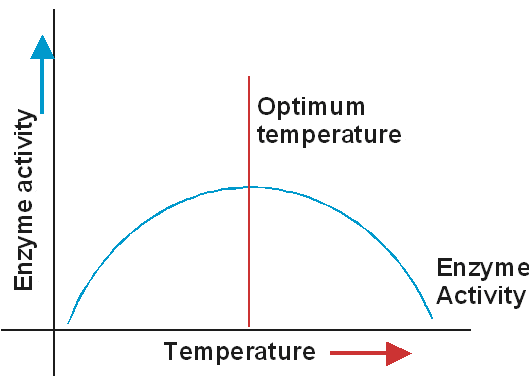
At high temperatures enzyme activity declines due to (select all that apply)
Denaturation
Decreased Kinetic Motion
Increased H-Bonding
Dissociation of Ionic Compounds
At low temperatures enzyme activity declines because of (select all that apply)
Denaturation
Decreased Kinetic Motion
Increased H-Bonding
Dissociation of Ionic Compounds

This organ produces digestive enzymes and hormones
(a)

Which of the following are accessory organs? Select all that apply
Salivary Glands
Pancreas
Liver
Gall Bladder

Which of the following are organs in the alimentary canal? Select all that apply
Oesophagus
Pancreas
Small Intestine
Large Intestine

What is the main method of transport of monosaccharides such as fructose across the intestinal epithelium?
(a)

What is the missing label?
(a)

The epithelial lining of the intestine is folded into finger-like projections called villi (singular: villus). How do they optimise the rate of absorption?
(a)

Why is it called the duodenum?
(a)

