wayground logo

Free Printable Worksheets

Font size

S
M
L
XL
Worksheets

SOL Review

Total questions: 40

Worksheet time: 20mins

Name
Class
Date
1.
An experiment is performed on plants to see how different liquids affect plant growth. Each plant in the experiment is given a different liquid; water, apple juice, or milk. Each plant has the same amount of soil, sunlight, and listens to the same music. In this investigation, the independent variable is ...
a)

The type of plant

b)

The amount of sunlight

c)

The type of music

d)

The type of liquid

2.

If you increase the amount of spinach you eat, then you will increase the iron in your blood.


What is the dependent variable?

a)

amount of iron in your blood

b)

spinach you eat

3.
What is adhesion?
a)
Water's ability to stick to itself
b)
Water's ability to stick to other substances
c)
The strength of the cohesion of all the water molecules combined
d)
Tape, glue and other adhesives
4.
What is cohesion?
a)
Water's ability to stick to itself
b)
Water's ability to stick to other substances
c)
The strength of the cohesion of all the water molecules combined
d)
Tape, glue and other adhesives
5.
Large bodies of water do not quickly fluctuate in temperature. Why?
a)
Water is a solvent.
b)
Water has a high heat capacity.
c)
Water acts as a buffer.
d)
Water is non-polar.
6.
Water is a universal solvent because it...
a)
It can be found anywhere
b)
It freezes when it gets cold
c)
floats when frozen
d)
Dissolves most substances
7.
The fact that ice floats on liquid water is due to the fact that water's solid is ___________ than it's liquid form
a)
less polar
b)
more polar
c)
less dense
d)
more dense
8.
What does "polar" mean?
a)
A molecule is cold
b)
A molecule has ionic bonds
c)
A molecule has covalent bonds
d)
A molecule has areas of positive and negative charge
9.
What biomolecule do enzymes belong to? 
a)
Carbohydrate
b)
Lipid
c)
Nucleic Acid
d)
Protein
10.

Which biomolecule helps form muscles?

a)

Nucleic Acid

b)

Carbohydrate

c)

Protein

d)

Lipids

11.
What is the purpose  of an enzyme?
a)
give permission for the reaction
b)
raise activation energy
c)
speed up reactions
d)
control how many reactions occur
12.
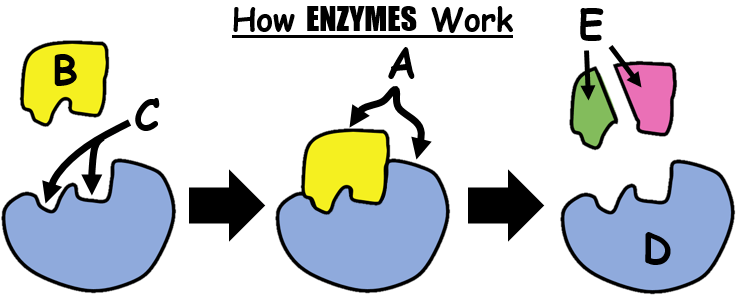
Letter D...
a)
active site
b)
enzyme
c)
substrate
d)
products
13.

Which of the following biomolecules are correctly matched with their monomer?

a)

carbohydrate - monosaccharide

b)

protein - amino acid

c)

nucleotide - nucleic acid

d)

lipid - fatty acid & glycerol

e)

nucleic acid - amino acid

14.

Which of the following biomolecules are correctly matched to their function?

a)

carbohydrate - main source of energy

b)

protein - enzymes, structure, movement

c)

lipids - insulation, make up cell membranes, long-term energy

d)

nucleic acids - contain genetic material of the cell

15.

Which of the following biomolecules are correctly matched to their function?

a)

carbohydrate - main source of energy

b)

protein - insulation, make up cell membranes, long-term energy

c)

lipids - enzymes, structure, movement

d)

nucleic acids - contain genetic material of the cell

16.

Which of the following biomolecules are correctly matched to their function?

a)

carbohydrate - contain genetic material of the cell

b)

protein - enzymes, structure, movement

c)

lipids - insulation, make up cell membranes, long-term energy

d)

nucleic acids - main source of energy

17.

Select the 3 parts of Cell Theory.

a)

Cells are the basic unit of life

b)

All living things come from cells

c)

All cells came from pre-existing cells

d)

All cells divide through meiosis

18.
Who discovered and named cells? 
a)
Captain Hook
b)
Robert Hooke
c)
Zacharias Janssen
d)
Rudolf Virchow
19.

Who noted that animals are made of cells?

a)

Rudolf Virchow

b)

Anton van Leeuwenhoek

c)

Theodor Schwann

d)

Robert Hooke

20.

Who discovered that cells come from preexisting cells?

a)

Matthias Schleiden

b)

Robert Hooke

c)

Zacharias Janssen

d)

Rudolf Virchow

21.
What was Schleiden convinced of? 
a)
All plants are made of cells
b)
All animals are made of cells
c)
All cells form spontaneously
d)
None of the above
22.
The movement of molecules across a membrane from high concentration to low concentration is called:
a)
Osmosis
b)
Diffusion
c)
Endocytosis
d)
Active Transport
23.
Active Transport typically uses ______ to transport materials across the cell membrane.
a)
ATP
b)
Glucose
c)
Na+
d)
K+
24.

The movement of materials that does NOT require energy is called...

a)

active transport

b)

passive transport

c)

massive transport

d)

proactive transport

25.

The process where only water is allowed to pass through the cell membrane from a high to low concentration.

a)

meiosis

b)

osmosis

c)

facilitated diffusion

d)

respiration

26.
What is the chemical equation for cellular respiration?
a)
Glucose + Oxygen -> Carbon dioxide + Water + Energy
b)
Oxygen + Carbon dioxide + Energy  -> Glucose + Water
c)
Carbon dioxide + Glucose -> Oxygen + Water + Energy
d)
Water + Carbon dioxide + Energy -> Oxygen + Glucose
27.
What is the equation for photosynthesis
a)
Water + Carbon dioxide + Energy -> Oxygen + Glucose
b)
Carbon dioxide + Glucose -> Oxygen + Water + Energy
c)
Oxygen + Carbon dioxide + Energy  -> Glucose + Water
d)
Glucose + Oxygen -> Carbon dioxide + Water + Energy
28.
Where does cellular respiration take place?
a)
Mitochondria
b)
Chloroplast
c)
Stomata
d)
Leaf
29.
What pigment in the leaf captures energy from the sun?
a)
carbon
b)
chlorophyll
c)
air
d)
chloroplast
30.

In which part of the cell does photosynthesis occur?

a)

vacuole

b)

mitochondria

c)

cell wall

d)

chloroplast

31.

The exchange of pieces of chromatin between homologous chromosomes during Prophase I of meiosis is called

a)

independent assortment

b)

mutation

c)

crossing over

d)

random fertilization

32.

Any change in the sequence of DNA is a

a)

recombination

b)

mutation

c)

chromatin

d)

independent assortment

33.

Which source of genetic variation is NOT a result of sexual reproduction?

a)

Crossing over

b)

Independent assortment (due to random orientation

c)

Gene mutation

d)

Random fertilization

34.
A red flower (Rr) is crossed with a white flower (rr). What is the genotypic ratio?
a)
0 RR; 0 Rr: 4 rr
b)
2 RR; 0 Rr: 2 rr
c)
4 RR; 0 Rr: 0 rr
d)
0 RR; 2 Rr: 2 rr
35.
What gamete possibilities could come from this parent's genotype?
a)
AB, AB, aB, aB
b)
Ab, AB, Ab, ab
c)
Ab, Ab, Ab, Ab
d)
AB, aB, ab, aB
36.
What does every food chain start with? (Even if it's not drawn or written there!)
a)
producers
b)
sun
c)
consumer
d)
decomposers
37.
How do lichens contribute to primary succession?
a)
Lichens decompose organic matter from animals and plants
b)
Lichens begin to break down rock to form soil
c)
Lichens are nitrogen fixing bacteria
d)
Lichens convert carbohydrates into fossil fuels.
38.
After a forest fire, an ecosystem would start regrowth through -
a)
primary succession
b)
secondary succession
c)
climax community
d)
limiting factors
39.
Which catastrophic event will most likely have the effect of returning an ecosystem to primary succession?
a)
A tornado
b)
A volcanic eruption
c)
A flood
d)
A drought
40.

Which of the following are differences between prokaryotes and eukaryotes?

a)

Prokaryotes do not have a nucleus; eukaryotes do

b)

Prokaryotes do not have a cell membrane; eukaryotes do

c)

Prokaryotes have a cell wall; eukaryotes do not

d)

Prokaryotes are typically smaller than eukaryotes