NEW
Font size
 Worksheets
DNA Structure and Replication Review
Total questions: 35
Worksheet time: 20mins
The synthesis (S) phase is characterized by
DNA replication
cell division
replication of the mitochondria and other organelles
the division of the cytoplasm
DNA Replication is called semi-conservative because
The new strands are only made of new daughter cells
The new strands contain both a parent and a daughter strand
The parent strand completely disintegrates
There are no new daughter strand
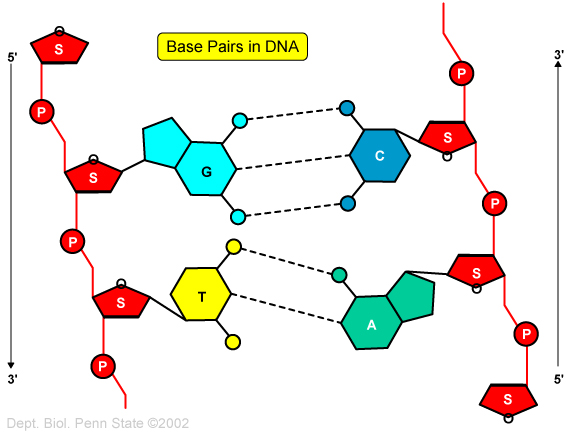
The backbone of DNA is composed of
sugars linked to phosphates
organic bases
hydrogen-bonded molecules
links between bases and sugars
Watson and Crick described the DNA molecule as a
straight chain
double helix molecule
single-stranded molecule
branching chain
The two DNA strands that make up a double helix run in opposite directions to each other with the 5' end of one, right next to the 3' end of the other. The term used to describe this is called?
semi conservative
duplication
parallel
antiparallel
Why are the new bases of the two DNA strands added in opposite directions during replication?
The DNA polymerase can work only in one direction, 5' to 3'
The bases are positively and negatively charged
The new bases are not added in opposite directions
It increases efficiency and prevents mutations
All of the following are true about the structure of DNA except
short strands of DNA are contained in chromosomes inside the nucleus of a cell.
every DNA nucleotide contains a sugar, a phosphate group, and a nitrogen base.
DNA consists of two strands of nucleotides joined by hydrogen bonds.
the long strands of nucleotides are twisted into a double helix.
The part of the molecule for which deoxyribonucleic acid is named is the
phosphate group
pentose sugar
hydroxyl group
none of the above
Purines are pyrimidines are
nitrogen bases found in amino acids
able to replace phosphate groups from defective DNA
names of specific types of DNA molecules
classification groups for nitrogen bases.
Of the four nitrogen bases in DNA, which two are purines and which two are pyrimidines?
adenine—thymine; uracil—cytosine
adenine—thymine; guanine—cytosine
adenine—guanine; thymine—cytosine
uracil—thymine; guanine—cytosine
Pyrimidines have
single ring structures
double ring structures
triple ring structure
quadruple ring structures
The leading strand is
always made in the opposite direction of the overall replication process.
made in pieces.
always made in the same direction as the overall replication process.
made after the lagging strand.
During DNA replication, a complementary strand of DNA is made for each original DNA strand. Thus, if a portion of the original strand is CCTAGCT, ten the new strand will be
TTGCATG
AAGTATC
CCTAGCT
GGATCGA
which of the following is not true about DNA replication?
it must occur before a cell can divide.
two complementary strands are duplicated.
the double strand unwinds and unzips while it is being duplicated.
the process is catalyzed by enzymes called DNA mutagens.
The enzyme responsible for stabilizing and keeping the two DNA strands separate is
replicase
DNA polymerase
helicase
single strand binding protein
the enzyme that unwinds/unzips the DNA is called
double helixes
DNA helicase
DNA ligase
Single Strand Binding Protein
Primase
keep DNA strands separated
fuses the Okazaki fragments
short RNA segment needed to start DNA replication
produces the RNA primer
RNA Primer
produces the RNA primer
keeps DNA strands separated
is a short RNA segment needed to start DNA replication
are replication fragments of the lagging strand
Which of the following fuses fragments of the replicated DNA strand?
Helicase
RNA primer
DNA ligase
DNA polymerase
Okazaki fragments
are replication fragments of the lagging strand
keep DNA strands separated
are short RNA segments needed to start DNA replication
add DNA nucleotides to exposed bases
DNA replication
occurs by the addition of nucleotides to the end of the DNA molecule
uses each strand of DNA molecule as a template for the creation of a new strand
produces two daughter DNA molecules that are complementary to each other
results in the formation of four new DNA strands
When one DNA molecule is copied to make two DNA molecules, the new DNA contains
25% of the parent DNA
50% of the parent DNA
75% of the parent DNA
none of the parent DNA
Multiple origins of replication on the DNA molecule of eukaryotic cells serve to
shorten the time necessary for DNA replication
assure the correct orientation of the two strands in the newly growing double helix
remove errors in DNA replication
reduce the number of "bubbles" that occur in the DNA molecule during replication
If adenine makes up 20% of the bases in a double helix, what percent of the bases are guanine? Remember the base pairing rule of DNA.
60%
40%
20%
30%
After replication, ______.
one new DNA double helix consists of two old strands and the other new DNA double helix consists of two new strands
each new DNA double helix consists of two old strands
each new DNA double helix consists of one old strand and one new strand
each new DNA double helix consists of two new strands
A replication fork is
an area where the DNA separates into 2 strands and the new DNA synthesis occurs
a molecular utensil needed to stab DNA nucleotides in order to bring them to their complementary base
the point where a cell must decide to replicate its DNA
a factory made of many enzymes that bind to DNA for replication
Prokaryotic organisms have only 1 origin of replication because
their genome is so big, that they only need one
their genome is so small, that they only need one
their enzymes work faster than eukaryotic enzymes
their enzymes work slower than eukaryotic enzymes

What is the structure labeled C
The leading strand
The lagging strand

What is the structure labeled G
DNA ligase
Primase
DNA Polymerase
RNA Primers

What is the structure labeled D
DNA ligase
Single Strand Binding Proteins
Primase
RNA Primer