wayground logo

Free Printable Worksheets

NEW

Font size

S
M
L
XL
Worksheets

4-1 Evolution and Common Ancestry

Total questions: 28

Worksheet time: 46mins

Name
Class
Date
1.

What best describes the hind bones seen in the whale?

a)

fossil structures from an extinct ancestor

b)

vestigial structures that had a function in an ancestor

c)

analogous structure to the fins of a living fish

d)

homologous structures to the wings of butterflies

2.

Which statement best represents the illustration?

a)

volves, bison, and horses are mammals

b)

wolf, bison, and horse structures show no evidence of relationship

c)

wolves, bison, and horses evolved in the same habitat

d)

wolves, bison, and horses share homologous structures

3.

Which of the two species have the most distant common ancestor?

a)

species 1 & 4

b)

species 1 & 2

c)

species 1 & 3

d)

species 2 & 3

4.
What is the study of organisms at the early stages of development?
a)
DNA studies
b)
embryology 
c)
extinction
d)
fossil record
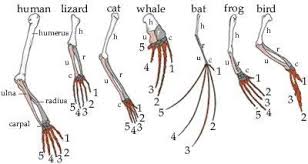
5.
What is this an example of?
a)
vestigial structures
b)
embryology
c)
homologous structures
d)
fossil record
6.
The opossum and kangaroo both incubate their young in a pouch. This provides evidence that they---
a)
are descended from a common ancestor
b)
Have very similar skeletal structures
c)
belong to the same species
d)
must range great distances to eat
7.
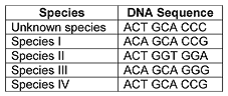
According to this data, the unknown bacterial species is most closely related to: 
a)
Species I
b)
Species II
c)
Species III
d)
Species IV
8.

What is evolution?

a)

When animals move to warmer climates in the winter

b)

How organisms change across many generations

c)

The migration of different species through the seasons

d)

Ancient rock layers and the fossils they contain

9.

What is this a picture of?

a)

Pedigree

b)

Cladogram

c)

Family Tree

d)

Oak Tree

10.

Cladograms are constructed by grouping organisms together based on their____________ characteristics.

a)

shared

b)

different

c)

vestigial

d)

opposite

11.

According to evolutionary theory, all living things have a common

a)

Purpose

b)

Function

c)

Ancestor

d)

Phone Number

12.

The hypothesis that physical structures with no known purpose are leftovers from an ancestor.

a)

Homologous Structure

b)

Vestigial Structure

c)

Anatomical Analogy

d)

Developmental Homology

13.

According to evolutionary theory, similar DNA would mean a common

a)

Ancestor

b)

Environment

c)

Interest

d)

Residency

14.
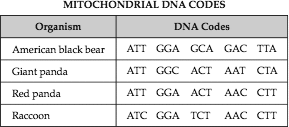
What conclusions can be made based on this table shown?
a)
the American black bear and the giant panda are most closely related
b)
the giant panda and the red panda are most closely related
c)
the red panda and the racoon are the most closely related
15.
  A _____________________ is the remains or evidence of an   ancient organism.
a)
paleontologist 
b)
 fossil
c)
preserved
d)
extinct
16.
What is the purpose of a dichotomous key?
a)
to find a common ancestor
b)
to show the evolution of organisms
c)
to show relationships between organisms
d)
to identify organisms
17.
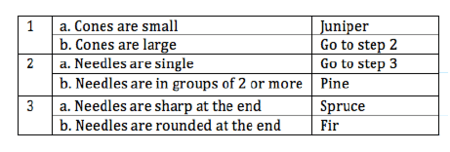
A dichotomous key for trees is provided. Hikers found a tree that has large brown cones and single sharp needles. What species of tree have the hikers found?
a)
Juniper
b)
Pine
c)
Spruce
d)
Fir
18.
A dichotomous key for insects is given. To what order does an insect with two pairs of scaly wings belong?
a)
Coleoptera
b)
Heteroptera
c)
Diptera
d)
Lepidoptera
19.
What step do we always start with when using dichotomous keys?
a)
1
b)
2
c)
3
d)
4
20.
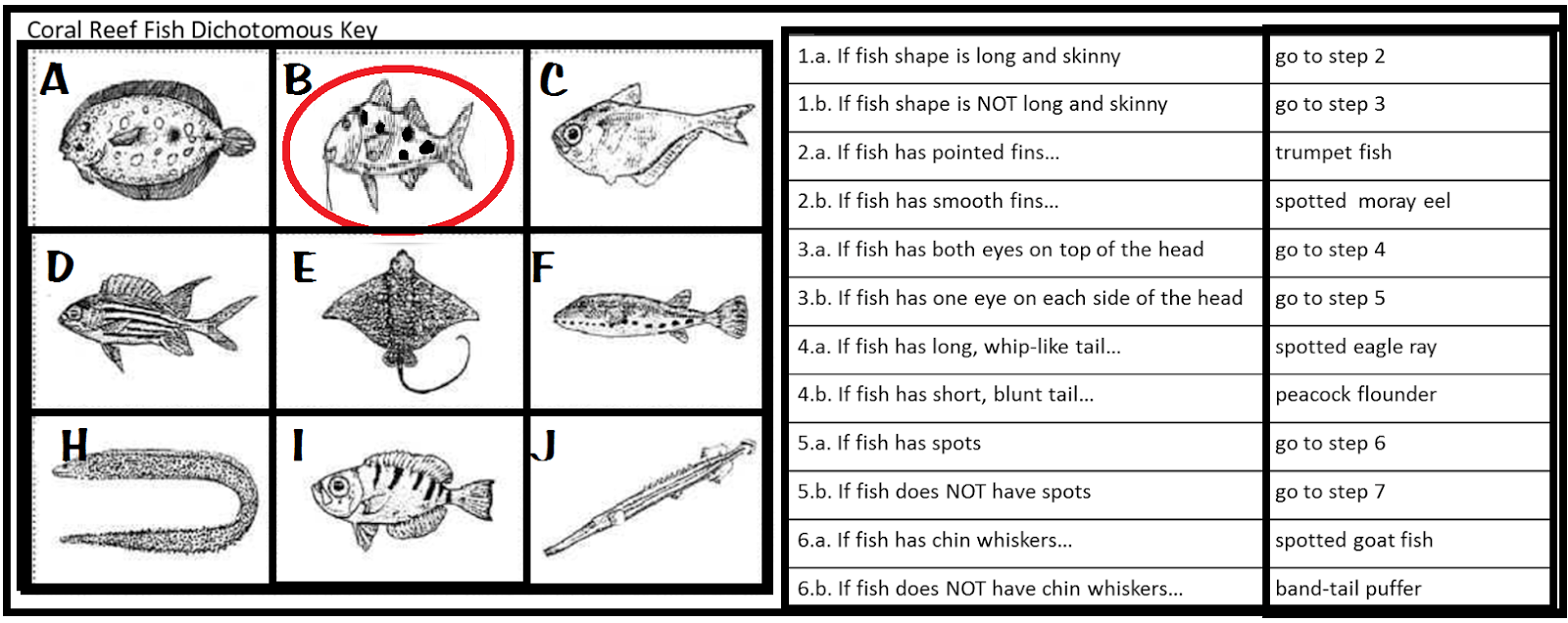
Using this dichotomous key, identity the name of the circled fish.
a)
band-tail puffer
b)
spotted goat fish
c)
peacock flounder
d)
trumpet fish
21.
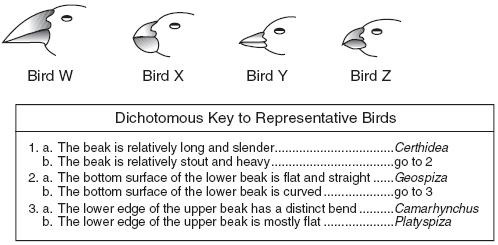
What is the name of bird W?
a)
Certhidea
b)
Geospiza
c)
Camarhynchus
d)
Platyspiza
22.
Term given to describe the 2 name naming system is:
a)
dichotmous key
b)
binomial nomenclature
c)
2 scientific names
d)
binomial key
23.
The first part of a scientific name is an organism's _______________ and the second part is its ________________.
a)
species, genus
b)
phylum, order
c)
class, spices
d)
genus, species
24.
Term given to describe the 2 name naming system is:
a)
dichotmous key
b)
binomial nomenclature
c)
2 scientific names
d)
binomial key
25.
The most general in the order of classification is?
a)
Kingdom 
b)
Phylum 
c)
Class 
d)
Order
26.
The most specific of the classifications is?
a)
class 
b)
order 
c)
genus 
d)
species
27.
Kingdom, Phylum, Class, _______
a)
Family 
b)
Order
c)
Genus 
d)
Species
28.
The 8 levels of classification, most broad to most specific.
a)
Domain, Genus, Family, Order, Class, Phylum, Kingdom, Species
b)
Domain, Species, Kingdom, Genus, Phylum, Family, Class, Order
c)
Domain, Kingdom, Phylum, Class, Order, Family, Genus, Species
d)
Order, Kingdom, Species, Domain, Phylum, Family, Class, Genus