wayground logo

Free Printable Worksheets

NEW

Font size

S
M
L
XL
Worksheets

22-23 PS Midterm

Total questions: 80

Worksheet time: 7hrs 40mins

Name
Class
Date
1.
What step does every scientific experiment begin with?
a)
hypothesis
b)
question/problem
c)
procedures
d)
conclusion
2.
The summary at the end of an experiment that explains the results. 
a)
conclusion
b)
procedures
c)
materials
d)
responding variable
3.
Testing a hypothesis often involves a(n):
a)
answer
b)
experiment
c)
problem
d)
safety check
4.
A series of steps used by scientists to solve a problem or answer a question. 
a)
scientific method
b)
recipe
c)
data collection
d)
metric system
5.
What is a hypothesis?
a)
A hypothesis is the right answer to an experiment.
b)
A hypothesis is the wrong answer to an experiment.
c)
A hypothesis is an educated guess.
d)
I don't know.
6.
The name of the information that you get from your experiment (you organize it into charts and graphs).
a)
observations
conclusion
b)
data
c)
variables
d)
hypothesis
7.
Which of the following is not an observation?
a)
Desirie used a thermometer to observe the temperature of the water.
b)
Jose believes that he remembers having seen a chupacabra (legendary creature) when he was a little boy.
c)
Pedro was looking at the bread and saw there was moisture in the bag.
d)
Michael could feel that the unknown substance was very rough. 
8.

When something is observable, which of the following is correct?

a)

You see it

b)

You smell it

c)

You feel it

d)

All of the above

9.
You use the scientific method all the time to solve everyday problems.
a)
True
b)
False
10.
Objects can be sorted using physical properties that can be measured. What property of an object can be measured using a ruler? 
a)
hardness
b)
length
c)
mass
d)
volume
11.
Hakim wants to measure the mass of a book. Which of the following would be an appropriate unit for Hakim to use? 
a)
centimeters
b)
kilograms
c)
meters
d)
milliliters 
12.
The way the surface of a mineral appears when it reflects light (dull or shiny). 
a)
Conductivity 
b)
Luster 
c)
Magnetism 
d)
Malleability 
13.
The amount of space that substance or object occupies. 
a)
Matter
b)
Mass
c)
Density 
d)
Volume 
14.
The amount of matter will fit into a given amount of space; how much mass a material has for a given volume. 
a)
Density 
b)
Mass 
c)
Volume 
d)
Matter
15.
A chemical change
a)
doesn't really change much.
b)
creates a new substance
c)
is a change in the state of matter
16.
A physical change is...
a)
a change that doesn't change the identity
b)
a change that makes something new.
c)
a chemical reaction
17.
Adding or subtracting neutrons (charge = 0, mass = 1) makes the element change into an...
a)
ion
b)
mixture
c)
isotope
d)
neutral atom
18.
The atomic number is equal to _.
a)
the number of protons and electrons
b)
the number of neutrons only
c)
the total number of protons and neutrons
d)
the number of protons neutrons and electrons
19.
Is the element shown in this image an ion, isotope or normal atom?
a)
atom
b)
isotope
c)
cation (+ ion)
d)
anion (- ion)
20.
The atomic mass is equal to _.
a)
the number of protons only
b)
the number of neutrons only
c)
the total number of protons and neutrons
d)
the number of protons, neutrons, and electrons.
21.
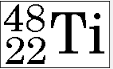
How many protons does this isotope of titanium have? Hint titanium has an atomic number of 22.
a)
48
b)
22
c)
26
d)
70
22.
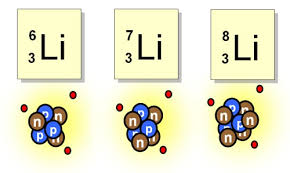
Which atom has  4 neutrons?
a)
Li-6
b)
Li-7
c)
Li-8
d)
they have the same # of neutrons
23.
What is the atomic number of Fe? (click to see image)
a)
26
b)
55.845
c)
56
d)
None of these
24.
How many neutrons does B (Boron) contain?
a)
5
b)
11
c)
6
d)
10.811
25.
Carbon has an atomic number of 6 and an atomic mass of 12. Which elements are considered isotopes of carbon?
a)
Carbon-12
b)
Carbon-13
c)
Carbon-14
d)
Both Carbon-13 and Carbon-14
26.

What charge does an atom have when it GAINS electrons?

a)

Positive

b)

Negative

c)

Neutral

27.

What is a representation of an ion?

a)

Li

b)

Na-22

c)

O-2

28.

What is the mass number of bromine?

a)

35

b)

45

c)

80

d)

79.904

29.

How many neutrons does this bromine atom have?

a)

35

b)

45

c)

80

30.

What type of atom is this?

a)

Neutral atom

b)

Cation

c)

Anion

d)

Isotope

31.

What two particles determine the mass number?

a)

Protons and electrons

b)

Electrons and neutrons

c)

Protons and neutrons

32.

What is the mass number of this Neon atom?

a)

10

b)

11

c)

21

d)

20

33.

How many electrons does this magnesium ion have?

a)

24

b)

12

c)

10

d)

14

34.

What is the representation of an isotope?

a)

N-3

b)

Al+3

c)

Si

d)

P-33

35.

What type of atom is element C?

a)

Normal atom

b)

Ion

c)

Isotope

36.

What element is this?

a)

Chromium

b)

Sodium

c)

Magnesium

37.
If an atom loses an electron it is a(n)
a)
Positive ion
b)
Negative ion
c)
Isotope
d)
Neutral Atom
38.
If an atom gains an electron it is a(n)
a)
Positive ion
b)
Negative ion
c)
Isotope
d)
Neutral Atom
39.
If an atom has an extra neutron, it is a(n)
a)
Positive ion
b)
Negative ion
c)
Isotope
d)
Neutral Atom
40.
Can an atom of Hydrogen have 2 protons?
a)
Yes, because it can be an ion
b)
No, because protons identify the atom
c)
Yes, because it can be an isotope
d)
No, because only neutral atoms exist
41.
Can an atom of Helium have 3 neutrons?
a)
Yes, because it can be an ion
b)
No, because protons identify the atom
c)
Yes, because it can be an isotope
d)
No, because only neutral atoms exist
42.
If an atom has more protons than electrons, it is a(n)
a)
Positive ion
b)
Negative ion
c)
Isotope
d)
Neutral atom
43.
If an atom has more electrons than protons, it is a(n)
a)
Positive ion
b)
Negative ion
c)
Isotope
d)
Neutral atom
44.
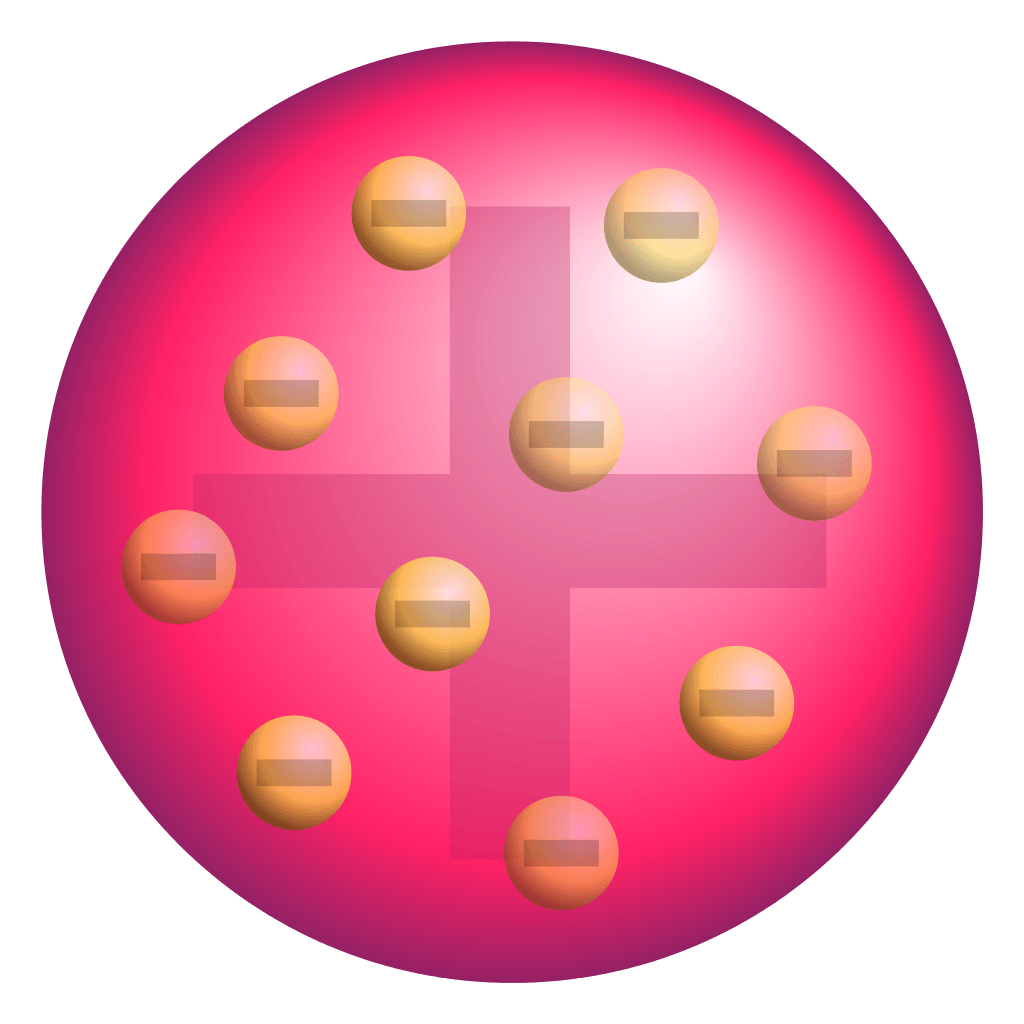
Which type of model is shown?
a)
Plum Pudding
b)
Bohr / Orbits
c)
Electron Cloud
d)
Billiard Ball
45.
Which type of model is shown?
a)
Plum Pudding
b)
Bohr / Orbits
c)
Electron Cloud
d)
Billiard Ball
46.
Which answer choice describes the subatomic particles and their respective charges?
a)
p-    e+    n
b)
p+    e     n-
c)
p+    e-    n
d)
p-     e+    n
47.
Which of the following is described as the basic unit of matter?
a)
Element
b)
Atom
c)
Molecule
d)
Compound
48.
What is a valence electron?
a)
an electron that is found in the outermost orbital of an atom. 
b)
an electron found in the innermost orbital of an atom.
c)
an electron found in the middle orbital.
49.

What do isotopes of carbon all have in common?

a)

They all have the same number of neutrons & mass number

b)

They all have the same atomic number and number of neutrons

c)

They all have the same atomic number and number of electrons

d)

They all have the same number of protons and neutrons

50.
This was the first model of the atom ever proposed. It was simple and described atoms as tiny spheres that could not be broken down into smaller pieces.
a)
Democritus's model of the atom
b)
The "Plum Pudding Model" of the atom
c)
The "Rutherford Model" of the atom
d)
The "Quantum Mechanical Model" of the atom
51.
This model was developed after J.J. Thompson discovered electrons, a particle smaller than an atom. Is shows electrons floating freely in a positive space.
a)
The "Plum Pudding Model" of the atom
b)
The "Rutherford Model" of the atom
c)
Democritus's model of the atom
d)
The "Quantum Mechanical Model" of the atom
52.
What can you conclude from the fact that scientists continue to update the atomic model?
a)
New information about atoms continues to be discovered
b)
Old information about atoms is completely useless
c)
Scientists did not have any information about atoms until a few years ago
d)
Scientists still have no idea what atoms look like
53.
In the Bohr Model, how many electrons fit in the first energy level?
a)
2
b)
4
c)
8
d)
18
54.
In the Bohr Model, how many electrons fit in the second energy level?
a)
2
b)
4
c)
8
d)
18
55.

An atom is electrically neutral because

a)

the numbers of protons and neutrons are equal.

b)

the numbers of protons and electrons are equal.

c)

neutrons balance the protons and electrons.

56.
Velocity is measured in
a)
m/s²
b)
m/s
c)
ms
d)
joules
57.
Mg2+ and Cl- create...
a)
Mg2Cl
b)
MgCl2
c)
Mg2Cl2
d)
MgCl
58.
H+ and S2- create...
a)
H2S
b)
HS2
c)
H2S2
d)
HS
59.
Ca2+ and N3- create...
a)
Ca2N3
b)
Ca3N2
c)
CaN3
d)
Ca2N
60.
Li+ and P3- create...
a)
Li3P
b)
LiP3
c)
LiP
d)
Li2P
61.
Pb2+ and O2- create...
a)
Pb2O
b)
PbO2
c)
Pb2O2
d)
PbO
62.
In the compound CuO the charge of copper is....
a)
1+
b)
2+
c)
3+
d)
4+
63.
In the compound SnCl4 the charge of tin is....
a)
1+
b)
2+
c)
3+
d)
4+
64.
Ba+2, Br-1
a)
BrBa
b)
Br2Ba2
c)
BaBr2
d)
Br2Ba
65.
Ca+2, O-2
a)
CaO
b)
OCa
c)
Ca-2O+2
d)
Ca2O2
66.
What do atoms of metals tend to do with their valence electrons when bonding with non-metals?
a)
share them
b)
donate them
c)
keep them and accept others
d)
keep them and give others
67.
What is the correct name for P₃Cl₆?
a)
Potassium chloride
b)
Phosphorous chloride
c)
Triphosphorous hexachloride
d)
Tetraphosphorous heptachloride
68.
What is the correct name for MgI₂?
a)
Manganese IV iodide
b)
Manganese diiodide
c)
Magnesium iodide
d)
Magnesium diiodide
69.
What is the correct formula for dinitrogen tetroxide?
a)
N₃O₃
b)
(N₂)₂(O₄)₃
c)
N₂O₄
d)
N₄O₂
70.
What is the correct formula for phosphorous trichloride?
a)
P₃Cl
b)
PCl₃
c)
KCl₃
d)
K₃Cl
71.
What is the correct name for SO₂?
a)
Sulfur oxide
b)
Sulfite
c)
Sulfur dioxide
d)

Monosulfur dioxide

72.

What type of elements form covalent bonds?

a)

Metals

b)

Non Metals

c)

Metalloids

d)

Nobel Gas

73.

When a covalent bond forms _______________ are shared.

a)

protons

b)

nutrons

c)

valence electrons

d)

quarks

74.

How many valence electrons does Oxygen (O) have?

a)

6

b)

8

c)

15

d)

16

75.

How many atoms of hydrogen are in a sugar molecule with the formula C6H12O6

a)

12

b)

6

c)

24

d)

18

76.

Valence electrons are located _____________ the nucleus of an atom

a)

close to

b)

farthest from

c)

randomly around

77.

Which statement best describes the relationship between atoms & molecules.

a)

molecules are made of atoms that are chemically bonded together.

b)

atoms are made of molecules that are chemically bonded together.

c)

molecules are made of a mixture of atoms and compounds.

d)

atoms are made of protons, neutrons & electrons.

78.

The first step in naming an ionic compound is always...

a)

Naming the anion (non-metal)

b)

Changing the ending to -ide

c)

Naming the cation (metal)

d)

Writing the cation charge

79.
Name the following ionic compound: BeCl2
a)
beryllium chlorine
b)
beryllium II chloride
c)
beryllium chloride
d)
beryllium dichloride
80.
What is the correct formula for the compound, lithium oxide?
a)
LiO
b)
Li2O
c)
LiO2
d)
Li2O2