
 Worksheets
Nuclear Chem 1234
Total questions: 40
Worksheet time: 20mins
Name
Class
Date
1.
Where was the first nuclear bomb detonated?
a)
New Mexico
b)
Los Angeles
c)
Hiroshima
d)
Nagasaki
2.
How much plutonium-239 was required for Trinity?
a)
6 kg, two hands full
b)
60 kg, a small child made of plutonium
c)
600 kg, your dad's favorite dairy cow
d)
6000 kg, 3 cars stacked together like sandwich
3.
What was the name of the substance the desert was transformed into as a result of the heat?
a)
Trinitite
b)
Kablewy Rock
c)
Trinimite
d)
James
4.
Who was able to mentally calculate the blast strength using pieces of confetti?
a)
Fermi
b)
Feynman
c)
Einstein
d)
Meitner
5.
What is phosphorescence?
a)
glowing after lit
b)
glowing while lit by blacklight
c)
glowing because of nuclear radiation
d)
glowing because of expensive moisturizer
6.
Who was initially investigating a connection between X-rays and phosphorescence?
a)
Bequerel
b)
Curie
c)
Einstein
d)
Roentgen
7.
Why was a uranium compound chosen for tests related to phosphorescence?
a)
Uranium is phosphorescent
b)
Because they knew it was radioactive
c)
They wanted to start with rare stuff first
d)
Plutonium had not yet undergone induced transmutation
8.
The photographic plate experiment is a wonderful example of the scientific method.
a)
False
b)
True
9.
What was so shocking about the photographic plate experiment?
a)
Even on cloudy day, U could expose through paper
b)
Even on a cloudy day, U became electrically conductive when phosphorescing
c)
Even on a cloudy day, Bequeral covered the plate with paper anyways
10.
Who came up with the term “radioactivity” and remains the only person to ever win multiple Nobel prizes?
a)
Marie Curie
b)
Albert Einstein
c)
Henri Bequerel
d)
Daniela Barba
11.
What is radioactivity?
a)
particles and light from the nucleus
b)
particles and light from the electron cloud
c)
particles, not light, from the nucleus
d)
light, not particles, from the electron cloud
12.
What is similar about all three types of radiation? In each case, where does it come from?
a)
nucleus
b)
electron cloud
c)
molecules
d)
yo mommas house
13.
Radioactive isotopes change their identity until what?
a)
they become stable
b)
they disintegrate to nothing
c)
induce transmutation
d)
are stored under a mountain
14.
What are “daughter nuclei”?
a)
unstable isotopes in a certain decay chain
b)
stable isotopes at the end of a decay chain
c)
higher elements formed from nuclear reactions
15.
Why are gamma rays not often found in nuclear equations?
a)
their atomic mass and charge are both zero
b)
their atomic mass is non-zero, but their charge is
c)
their atomic mass is zero, but their charge is non-zero
d)
not all scientists believe in gamma rays
16.
What is the risk of radon?
a)
lung cancer
b)
skin damage
c)
eye cancer
d)
stroke
17.
Who first accomplished turning one element into another?
a)
Rutherford
b)
Bequerel
c)
Otto Hahn
d)
Meitner
e)
Curie
18.
In what way does matter and anti-matter differ?
a)
charge
b)
mass
c)
magnetic pole
d)
density
19.
What happens when an electron and a positron come together?
a)
becomes a gamma ray of light
b)
becomes anti-hydrogen
20.
For what amount of time has anti-hydrogen been contained in a lab?
a)
1000 s
b)
1000 min
c)
1000 hr
d)
1000 day
21.
How are quarks and gluons related?
a)
gluons hold quarks together
b)
gluons create quarks
c)
both explain nuclear cohesion
d)
they are exact opposites
22.
The ratio of neutrons to protons for a certain isotope is 1.7 to 1. Is it stable?
a)
no
b)
yes
23.
What would be a way of destabilizing a nucleus?
a)
Shoot a neutron at it
b)
Shoot an electron at it
c)
Heat it up really hot
d)
Dont stop keep heating it up
24.
What is significant about the work of Otto Hahn and Lise Meitner?
a)
discovered nuclear fission
b)
discovered nuclear fusion
c)
discovered nuclear power
d)
discovered nuclear peace
25.
What gives a certain isotope a higher fission efficiency?
a)
how many ways can it explode
b)
how many ways can it absorb neutrons
c)
how many ways can it change into daughter nuclei
26.
What is critical mass?
a)
the perfect amount of matter for a chain reaction
b)
too much matter for a chain reaction
c)
not enough matter for a chain reaction
d)
mass which does not like this class
27.

Is this nuclear equation balanced?
a)
yeppers
b)
That's a big negative.
28.
Why was it called the Manhattan Project?
a)
because the HQ was based there
b)
because the bomb was built there
c)
because the bomb was tested there
29.
What was the role of Oak Ridge during the Manhattan Project?
a)
Acquire critical mass of U-235
b)
Acquire plutonium-239
c)
Build and test bomb prototype
30.
What is heat?
a)
the motion of particles
b)
an invisible liquid that permeates all things
c)
the absence of cold
d)
the absence of motion
31.
During any type of diffusion...
a)
Stuff moves where it isn't.
b)
Stuff collects where it already is.
c)
Stuff moves to a weird, third location.
32.
Which diffuses faster, U-235 or U-238? Why?
a)
235 so light
b)
238 so light
c)
235 so heavy
33.
What is hex?
a)
gaseous U-235
b)
liquid U-235
c)
solid U-235
34.
Who designed the first nuclear reactor?
a)
Fermi
b)
Einstein
c)
Meitner
d)
Otto Hahn
35.
After 2 beta decays, U-238 becomes...
a)
Pu-239
b)
U-235
c)
Pu-238
d)
U-239
36.
Name a scientist who refused to take part in the Manhattan Project.
a)
Einstein
b)
Feynman
c)
Fermi
37.
What was the main design challenge to be solved in building a nuclear weapon?
a)
transporting critical mass
b)
making it stealthy
c)
cost
38.
Which bomb collapsed a shell of material onto another to make critical mass?
a)
Fat Man
b)
Little Boy
39.
Which bomb did they not even bother to test before dropping?
a)
Little Boy
b)
Fat Man
40.
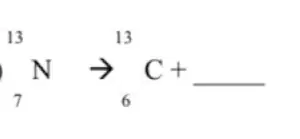
Predict the decay particle which forms from the given nuclear reaction.
a)
positron
b)
neutron
c)
beta particle
d)
alpha particle
100 %

