
 Worksheets
Population Studies - Review
Total questions: 81
Worksheet time: 43mins

Birth Rate is
Number of births per hour
Number of live births per 1000 people
Number of births
Number of births per 1000 people

Death rate is defined as
Number of deaths per 1000 people
Number of deaths in a year
Number of deaths per month
Number of deaths per week

The population growth rate is
The Birth rate plus the death rate
The Birth rate minus the death rate
The Death rate minus the Birth rate
The Birth rate divided by the death rate
Population Density means
the number of goats per square kilometre
the number of people
the number of people per square kilometre
the change in population over time.

What factors would affect the birth rate and death rate?
Medicine
Vaccinations
Education
All of the above
Which is NOT shown on a population pyramid?
Age
Sex (male/female)
Ethnicity
Population size
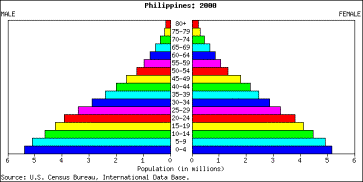
According to the population pyramid of this country, its population is most likely...
growing slowly.
growing rapidly.
decreasing.
not changing.
A diagram that shows the age and male/female distribution of a population, where the youngest are at the base and the oldest at the top
dependent population
population pyramid
food pyramid
population density distribution

According the population pyramid Canada's population is _______________
rapidly increasing
gradually decreasing
staying the same
gradually increasing


Which type of population is illustrated by this population pyramid?
Fast growing
Slow growing
Stationary (not growing or shrinking)
Negative growth (shrinking)

Which type of population is illustrated by this population pyramid?
Fast growing
Slow growing
Stationary (not growing or shrinking)
Negative growth (shrinking)

Which type of population is illustrated by this population pyramid?
Fast growing
Slow growing
Stationary (not growing or shrinking)
Negative growth (shrinking)

Which type of population is illustrated by this population pyramid?
Fast growing
Slow growing
Stationary (not growing or shrinking)
Negative growth (shrinking)
True or False: On a population pyramid, the youngest age groups are at the top and the oldest age groups are at the bottom.
True
False
True or False: On a population pyramid, males are on the left and females are on the right.
True
False

This 1950 U.S. population pyramid illustrates a:
Baby Boom
Baby Boomlet
Baby Bust
Baby Bustlet
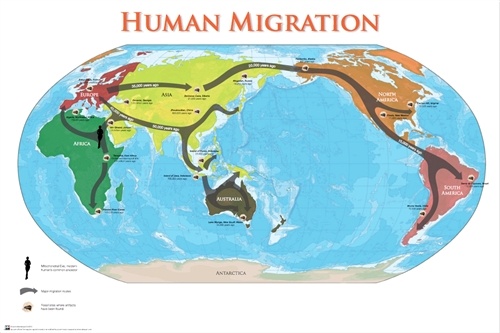
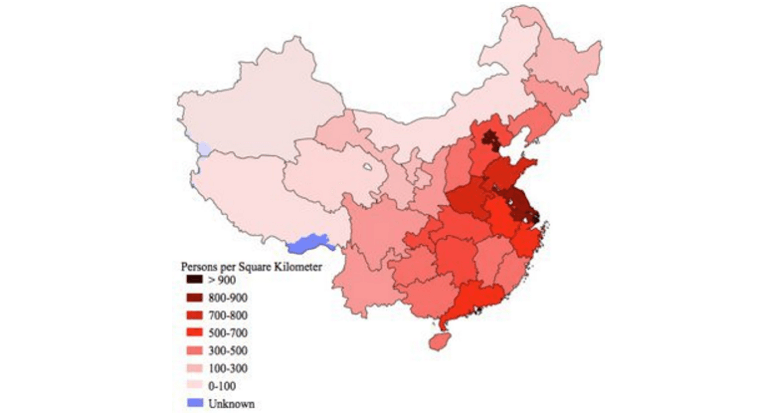


The approximate population of the world today is..
6.7 billion
8.7 billion
9 billion
7.8 billion
This stage of the DTM is characterised by a low and declining CDR, rapidly decreasing CBR, and a continued increase in the population.
Stage 1
Stage 2
Stage 3
Stage 4
This stage of the DTM is characterised by rapid population increase, declining CDR, and high CBR.
Stage 1
Stage 2
Stage 3
Stage 4
Continued medical advancements, enhanced welfare provisions, economic independence of women, and improved access to contraceptives is seen in this stage of the DTM.
1
2
3
4
Little medical care, no birth control, children seen as an asset, plagues and famines are characteristics of this stage of the DTM.
1
2
3
4
Nutritional developments, improved education, some availability of contraceptives, and increased urbanisation are characteristics of this stage of the DTM.
1
2
3
4
Improved sanitation, children seen as an asset, mechanisation, and population explosion are characteristics of this stage of the DTM.
1
2
3
4

In which stage of the demographic transition does a country experience the highest death rate?
Stage 3
Stages 1 & 4
Stage 2
Stage 1
In which stage of the demographic transition do countries experience the greatest population growth?
Stage 4
Stage 3
Stage 2
Stage 1

Which correctly describes the term demographic transition?
The transition from low birth rates and death rates to high birth rates and death rates as a country develops.
The transition from high birth rates and death rates to low birth rates and death rates as a country develops.
The transition from high birth rates to low death rates as a country develops.
The transition from low birth rates to high death rates as a country develops.

VOCAB: The average number of children a female member of a population has during her lifetime
total fertility rate
replacement fertility rate
growth rate
death rate

Which of the following leads to a decrease in birthrates among women?
Higher Education
High Infant Mortality Rate
No Prenatal Care
No contraceptives

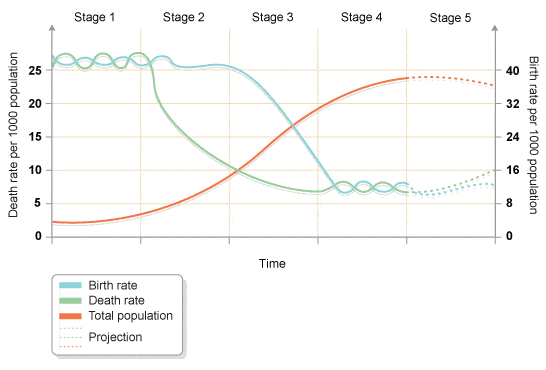


This country most likely is in which stage of the Demographic Transition Model?
stage 4
stage 2
stage 3
stage 5

When women in developing countries become educated...
The death rate increases
the country enters stage 5 of the Epidemiological Transition Model
the agricultural density increases
Fertility rates decrease


The population pyramid shown is most likely which country?
Nigeria
China
Germany
Japan
In what stage of the DTM are most European countries?
1
2
3
4
This stage is characterized by: a low and declining death rate, rapidly decreasing birth rate, and a continued increase in the population.
Stage 1
Stage 2
Stage 3
Stage 4
What is the term for the average number of years people in a population are likely to live?
age structure
demographic transition
life expectancy
migration pattern
In the demographic transition model, which stage would traditionally involve an agricultural society?
Stage 5
Stage 2
Stage 3
Stage 4

In which stage of the DTM is this population pyramid?
1
2
3
4
5

In which stage of the DTM is this population pyramid?
1
2
3
4
5

In which stage of the DTM is this population pyramid?
1
2
3
4
5
A country with an aging population is MOST LIKELY to face rapidly rising costs for which of the following?
refugees
pensions
pollution
unemployment
What is one reason that a population ages?
There is a rise in life expectancy.
There is a rise in the birth rate.
There is a drop in life expectancy.
There is a rise in the death rate.
What is one solution for pension costs?
Decrease the retirement age.
Decrease the number of young people entering the workforce.
Raise the amount of money given to the retired people.
Raise the retirement age.
What is one solution for decreasing health care costs for Europeans?
Providing preventative care.
Putting more people in nursing homes.
Paying pensions for people who can't care for family members.
Treating more health problems.
Which of the following factor does NOT lead to ageing population?
Lower death rate
Lower birth rate
Better education
Better standard of health care
Which is the correct calculation for Rate of Natural Increase (RNI)?
R.N.I. = (CBR - CDR)/10
R.N.I. = CBR - (CDR/10)
R.N.I. = (CBR / CDR) x 10
R.N.I. = (CDR - CBR)/10


Of the following 5 countries, the lowest crude birth rate is found in:
Uganda
Denmark
Indonesia
Nigeria

Of the following 5 countries, the highest natural increase is found in:
China
Denmark
Zimbabwe
Singapore


Why do women in more developed countries (MEDCs) have lower rates of fertility?
they are engaged in business and political activities
they have access to medical care and birth control
they pursue education opportunities, thus delaying child birth
all of the above
Which of the following is the formula for a population's doubling time?
70/natural increase
natural increase/70
(70/natural increase) x 100
(70 x natural increase)/10
The dependency ratio is calculated as:
(dependent population/independent population) x 100
(independent population/dependent population) x 100
dependent population/(independent population x 100)
independent population/(dependent population x 100)
Natural increase is calculated as
[(CBR - CDR +/- MR)/1000] X 100
[(CDR - CBR +/- MR)/1000] X 100
[(CBR - CDR +/- MR)/(1000 X 100)]
[(CDR - CBR +/- MR)/(1000 X 100)]

