
NEW
Font size
S
M
L
XL
 Worksheets
Two-Dimensional Geometry
Total questions: 40
Worksheet time: 1hrs 19mins
Name
Class
Date
1.

What type of angle is shown?
a)
acute
b)
obtuse
c)
right
d)
straight
2.

What type of angle is shown?
a)
acute
b)
obtuse
c)
right
d)
straight
3.
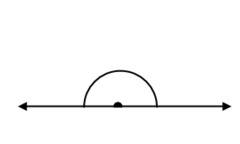
What type of angle is shown?
a)
acute
b)
obtuse
c)
right
d)
straight
4.

What type of angle is shown?
a)
acute
b)
obtuse
c)
right
d)
straight
5.

The angle relationship shown is -
a)
complementary angles
b)
supplementary angles
c)
vertical angles
d)
angle bisector
6.

∠1 and ∠3 can best be described as -
a)
complementary angles
b)
supplementary angles
c)
vertical angles
d)
adjacent angles
7.

The angle relationship shown is -
a)
complementary angles
b)
supplementary angles
c)
vertical angles
d)
adjacent angles
8.

∠XOZ is bisected by ray OY. Which statement is true?
a)
∠XOZ ≅ ∠XOY
b)
∠XOZ ≅ ∠ZOY
c)
∠XOY ≅ ∠ZOY
d)
∠OXY ≅ ∠OZY
9.

If m∠1 = 30°, then m∠3 =
a)
30°
b)
60°
c)
150°
d)
undetermined
10.
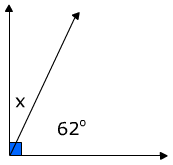
Find the value of x.
a)
18°
b)
28°
c)
38°
d)
118°
11.

State the angle relationship and find the measure of angle 1
a)
Corresponding
110
110
b)
Alternate Exterior
110
110
c)
Corresponding
70
70
d)
Alternate Exterior
70
70
12.

State the angle relationship and find the measure of angle 3
a)
Alternate Interior
50
50
b)
Alternate Interior
130
130
c)
Corresponding
130
130
d)
Corresponding
50
50
13.

State the angle relationship and find the measure of angle 2
a)
Alternate Interior
90
90
b)
Alternate Exterior
90
90
c)
Corresponding
90
90
d)
Same Side Interior
90
90
14.

State the angle relationship and find the measure of angle 1
a)
Alternate Interior
37
37
b)
Alternate Interior
143
143
c)
Corresponding
143
143
d)
Corresponding
37
37
15.

State the angle relationship and find the measure of angle 2
a)
Alternate Exterior
127
127
b)
Alternate Exterior
52
52
c)
Alternate Interior
127
127
d)
Alternate Interior
52
52
16.
If lines are parallel, then alternate interior angles are _____________
a)
congruent
b)
parallel
c)
complementary
d)
supplementary
17.
If lines are parallel, then alternate exterior angles are _____________
a)
congruent
b)
parallel
c)
complementary
d)
supplementary
18.

Which are pairs of vertical angles?
a)
∠COB & ∠COA
b)
∠AOD & ∠AOC
c)
∠COB & ∠AOD
d)
∠BOD & ∠AOD
19.
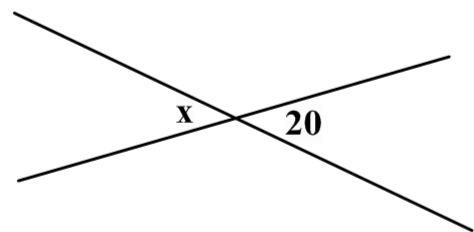
Find the missing angle. Find x.
a)
20o
b)
70o
c)
160o
d)
180o
20.
Vertical angles are always
a)
acute
b)
total 180 degrees
c)
congruent (equal measures)
d)
adjacent angles
21.

Find what the value of x.
a)
118
b)
108
c)
28
d)
58
22.

a)
15
b)
16
c)
18
d)
19
23.

Find the value of x
a)
16
b)
8
c)
32.8
d)
39.2
24.
In a triangle, how many total degrees are there?
a)
100%
b)
180 degrees
c)
it varies
d)
360 degrees
25.

.
.
.
.
What is the name of this kind of triangle?
.
.
.
What is the name of this kind of triangle?
a)
Right
b)
Isosceles
c)
Scalene
d)
Equilateral
26.
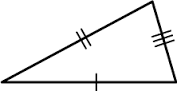
.
.
.
.
What is the name of this kind of triangle?
.
.
.
What is the name of this kind of triangle?
a)
Right
b)
Scalene
c)
Isosceles
d)
Equilateral
27.

.
.
What kind of triangle is this?
.
What kind of triangle is this?
a)
Acute
b)
Right
c)
Obtuse
d)
Robot
28.

What kind of triangle is this?
a)
Acute
b)
Super
c)
Right
d)
Obtuse
29.
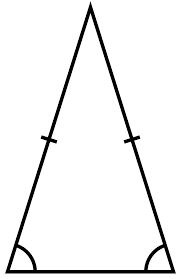
.
.
.
What is the name of this kind of triangle?
.
.
What is the name of this kind of triangle?
a)
Right
b)
Scalene
c)
Isosceles
d)
Equilateral
30.

Find the measure of the indicated angle.
a)
95
b)
85
c)
35
d)
45
31.
What formula would you use to show lengths are equal?
a)
Slope Formula
b)
Distance Formula
c)
Midpoint Formula
32.

Which formula is shown?
a)
Slope
b)
Distance
c)
Midpoint
33.
What is the formula for midpoint?
a)
b)
c)
d)
a2+b2=c2
34.

What formula is shown?
a)
slope
b)
distance
c)
midpoint
d)
Pythagorean Theorm
35.
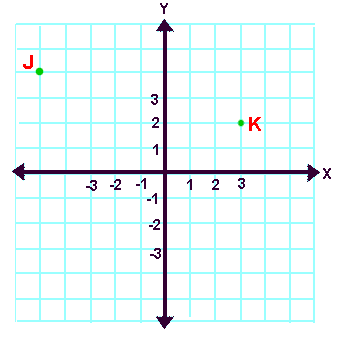
Find the distance between J and K.
a)
8.2
b)
7.7
c)
9
d)
10.2
36.
What is the midpoint between (-4,4) and (-2,2)?
a)
(3,2)
b)
(-3,3)
c)
(4,5)
d)
(6,7)
37.
What shape has one pair of parallel sides and non parallel sides are congruent?
a)
Trapazoid
b)
Rhombus
c)
Rectangle
d)
Isosceles trapezoid
38.
The points A (9, 0), B (9, 6), C (–9, 6) and D (–9, 0) are the vertices of a
a)
Square
b)
Rectangle
c)
Rhombus
d)
Trapezium
39.
The points (–4, 0), (4, 0), (0, 3) are the vertices of a
a)
right triangle
b)
equilateral triangle
c)
isosceles triangle
d)
scalene triangle
40.
The fourth vertex D of a parallelogram ABCD whose three vertices are A (–2, 3), B (6, 7) and C (8, 3) is
a)
(0, 1)
b)
(0, –1)
c)
(–1, 0)
d)
(1, 0)
Reset

