wayground logo

Free Printable Worksheets

NEW

Font size

S
M
L
XL
Worksheets

Cellular Reproduction

Total questions: 35

Worksheet time: 9hrs 45mins

Name
Class
Date
1.
When an area of a chromatid is exchanged with the matching area on a chromatid of its homologous chromosome, _________________ occurs
a)
crossing over
b)
mutagenesis
c)
hybridization
d)
fertilization
2.
Is the following cell diploid or haploid?
a)
Diploid
b)
Haploid
3.
What phase is represented?
a)
metaphase 1
b)
metaphase 2
c)
anaphase 1
d)
anaphase 2
4.
Body cells may produce additional body cells by means of _________. Organisms that reproduce sexually produce gametes by means of the process of _________.(DOK2). 
a)
mitosis; meiosis
b)
meiosis; mitosis
c)
mitosis; conjugation
d)
meiosis; gametogenesis
5.
The organism shown in the drawing below usually reproduces through the __________ process called binary fission.
a)
asexual
b)
heterosexual
c)
isosexual
d)
sexual
6.
Meiosis makes four __________ cells.(DOK2)
a)
diploid
b)
haploid
c)
metabolic
d)
prokaryotic
7.
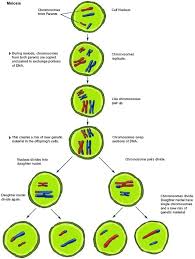
This diagram  shows which cellular process that occurs in organisms?
a)
endocytosis
b)
mitosis
c)
meiosis
d)
phagocytosis
8.
Which of these correctly distinguishes mitosis from meiosis?(DOK3)
a)
Mitosis occurs in germ cells and meiosis occurs in somatic cells.
b)
Crossing over takes place in mitosis and not in meiotic cell division.
c)
Meiosis produces four 2N daughter cells; mitosis produces two 2N daughter cells.
d)
The number of chromosomes remains the same in mitosis and is reduced by half in meiosis.
9.
This picture shows which process? 
a)
mitosis
b)
meiosis
c)
the cell cycle
d)
binary fission
10.
A human body cell has 46 chromosomes. How many chromosomes does a female egg cell have?
a)
23
b)
24
c)
46
d)
48
11.
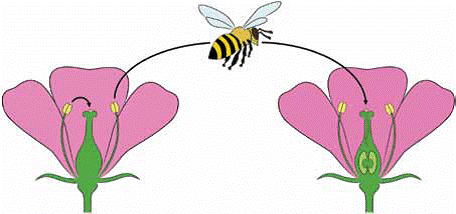
The bee is accidentally responsible for transferring pollen from the anther to the stigma. Following the bee's visit, what takes place NEXT in the life cycle of a flowering plant? (DOK3)
a)
Germination
b)
Pollination
c)
Fertilization
d)
Seed production
12.

In asexual reproduction, all of the offspring are:

a)

Physically Identical

b)

Genetically Identical

c)

Physically and Genetically Identical

d)

Not Identical

13.

During mitosis the parent cell produces:

a)

2 daughter cells with the same number of chromosomes as the parent cell.

b)

2 daughter cells with the half the number of chromosomes as the parents cell.

c)

4 daughter cells with the same number of chromosomes as the parent cell.

d)

4 daughter cells with half the number of chromosomes as the parent cell.

14.

During meiosis the parent cell produces:

a)

2 daughter cells with the same number of chromosomes as the parent cell.

b)

2 daughter cells with the half the number of chromosomes as the parents cell.

c)

4 daughter cells with the same number of chromosomes as the parent cell.

d)

4 daughter cells with half the number of chromosomes as the parent cell.

15.

What is the type of reproduction that only requires one parent?

a)

Asexual

b)

Sexual

16.

Which type of reproduction results in diversity because the offspring are a combination of the parents and genetically different?

a)

Asexual

b)

Sexual

17.
What phase of mitosis is shown in the picture?
a)
Prophase
b)
Anaphase
c)
Telophase
d)
Metaphase
18.
What phase of mitosis is shown in the picture?
a)
Prophase
b)
Anaphase
c)
Telophase
d)
Metaphase
19.
What phase of mitosis is shown in the picture?
a)
Prophase
b)
Anaphase
c)
Telophase
d)
Metaphase
20.
What phase of mitosis is shown in the picture?
a)
Prophase
b)
Anaphase
c)
Telophase
d)
Metaphase
21.
How many daughter cells are produced in mitosis?
a)
1
b)
2
c)
4
d)
6
22.
Identify the phase.
a)
Metaphase I
b)
Metaphase II
c)
Anaphase I
d)
Anaphase II
23.
Identify the process.
a)
Mitosis
b)
Meiosis I
c)
Meiosis II
d)
Interphase
24.
Identify the phase.
a)
Telophase I
b)
Telophase II
c)
Metaphase I
d)
Metaphase II
25.

This type of asexual reproduction occurs when pieces of the parent divide to form new organisms.

a)

Regeneration

b)

Binary Fission

c)

Budding

d)

Runner

26.

Is this karyotype for a male or female?

a)

MALE

b)

FEMALE

27.

a photograph or picture of chromosomes grouped in ordered pairs is a ______________

a)

pedigree

b)

Punnett Square

c)

Venn Diagram

d)

Karyotype

28.

A normal human zygote should have _____ chromosomes inside.

a)

46

b)

23

c)

92

d)

64

29.
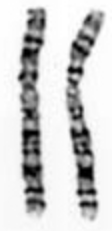
Which structure is labeled as B in the diagram?
a)
Centromere
b)
Chromosome
c)
Sister chromatids
30.
Which structure is labeled as A in the diagram?
a)
Centromere
b)
Chromosome
c)
Sister chromatids
31.
Which structure is labeled as C in the diagram?
a)
Centromere
b)
Chromosome
c)
Sister chromatids
32.
A pair of identical chromosomes shown in a karyotype, one inherited from mom, and one inherited from dad are called
a)
sister chromotids
b)
centromeres
c)
homologous chromosomes
d)
autosomes
33.
The haploid number of human chromosomes is
a)
11
b)
12
c)
23
d)
46
34.
Chromosome pairs 1-22 are referred to as
a)
sex chromosomes
b)
sister chromatids
c)
a karyotype
d)
autsomes
35.
Females have ____ and males have _____ chromosomes.
a)
XX, XY
b)
XY, XX
c)
XX, XX
d)
XY, XY