
 Worksheets
CCA: Mid Year Review
Total questions: 52
Worksheet time: 5hrs 30mins
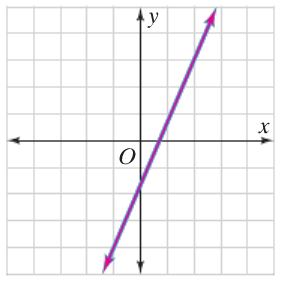
y = 4x+1
3x + 2y = 13
2x + 4y = 450
2x + 4y = 315
3x + 4y = 450
y = 8.40 + x
y = 8.40x + 58
y = 8.40x
y = 8.40x - 58
y = 2/3x - 2
y = -x + 3

Write an equation for the line shown by counting the slope and identifying the y-intercept.
y = -2x + 2
y = 2x + 2
y = 1/2x- 2
y = -1/2x + 2

--
r6
--
r
(x³ ⋅ y⁴ ⋅ z)³ ⋅ (x⁵ ⋅ y ⋅ z³)²
xy2x2y4
xy2
x3y6
y2x2
y2x

8x4
8x8
6x4
6x8
x = -6
x = -12
x = -12

(p − 8)2
Hint: (p − 8)2 = (p − 8)(p − 8)
(x-7)2
(3x – 1)(x + 5)

8x + 4y= 16

dx + e = f


To find the next term in a geometric sequence…
add the common difference d
multiply by the common ratio r multiply by the common ratio r
To find the next term in an arithmetic sequence…
add the common difference d
multiply by the common ratio r
-21, -16, -11, -6, ...
Is this sequence arithmetic, geometric, or neither?
arithmetic (common difference d = 5)
geometric (common ratio r = 5)
neither (no common difference OR common ratio) neither (no common difference OR common ratio)
Which of the following is not an arithmetic sequence?
1/2, 1, 3/2, 2
11, 14, 17, 20
2, 4, 8, 16
5, 2, -1, -4
Write the explicit formula for the sequence shown below.
3, -3, -9, -15
an=3+6(n-1)
an=3−6(n-1)
an=6−3(n-1)
an=6+3(n-1)
3x + 2y = 16
7x + y = 19
y = 2x + 1
y = 4x - 1
y = 4x+1
3x + 2y = 13

