wayground logo

Free Printable Worksheets

Font size

S
M
L
XL
Worksheets

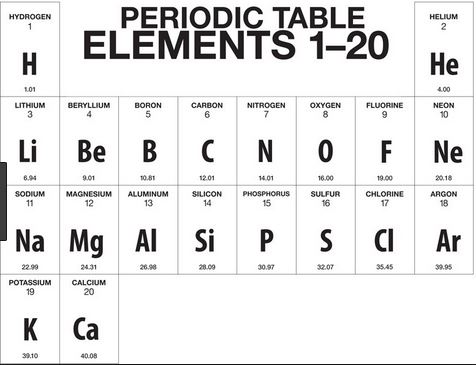
Atoms/Periodic Table Test Review Game

Total questions: 33

Worksheet time: 33mins

Name
Class
Date
1.
Which two subatomic particles are found in the NUCLEUS of at atom?
a)
protons & nuetrons
b)
protons & electrons
c)
neutrons & electrons
d)
electrons & protons
2.
The subatomic particle with a neutral charge is:
a)
protons
b)
electrons
c)
neutrons
d)
cloud
3.
What type of subatomic particles are found in the cloud?
a)
neutrons
b)
electrons
c)
protons
d)
reactions
4.
If an atom has 24 protons and 24 electrons, what is the atomic number of this element?
a)
24
b)
48
c)
0
d)
42
5.
How many protons does this element have?
a)
40
b)
21
c)
20
d)
41
6.
Elements in the same ________ are more chemically similar.
a)
group
b)
period
c)
club
d)
table
7.
What element is this model showing?
a)
Lithium
b)
Boron
c)
Carbon
d)
Neon
8.

Which of the following element in period 3 would be classified as a metal?

a)

Boron (B)

b)

Sodium (Na)

c)

Argon (Ar)

d)

Silicon (Si)

9.
What is the atomic mass of "F"
a)
9
b)
18
c)
17
d)
19
10.
How do you find out the number of neutrons in an atom?
a)
atomic number
b)
atomic mass
c)
charge
d)
atomic mass - atomic number
11.
The part of the atom that determines the identity of the atom is the ____________.
a)
proton
b)
nucleus
c)
electron
d)
neutron
12.
How many neutrons are in the atom "K"?
a)
7
b)
19
c)
39
d)
20
13.
Which is a neutron?
a)
A
b)
B
c)
C
14.
Which is an electron?
a)
A
b)
B
c)
C
15.

Which color on the image of the periodic table corresponds with the noble gases.

a)

red

b)

black

c)

blue

d)

orange

16.
Matter can not be created nor destroyed: it can only be
a)
Destroyed a little bit
b)
Invisible
c)
Transformed, changed
d)
None of the above
17.
In a reaction A + B ----> C,  reactant A has 5g and product  C has 9g. How many grams does reactant B should have? 
a)
4g
b)
5g
c)
9g
d)
14g
18.
If a reaction starts with a total 75g of reactants it should produce 
a)
a total of 40g of products
b)
a total of 75g of products
c)
a total of 180 g of products
d)
None of the above
19.

How many valence electrons does Hydrogen Have?

a)

1 Valence electron

b)

2 Valence electron

c)

3 Valence electron

d)

4 Valence electron

e)

5 Valence electron

20.

How many valence electrons does Helium Have?

a)

1 Valence electron

b)

2 Valence electron

c)

3 Valence electron

d)

4 Valence electron

e)

5 Valence electron

21.

How many valence electrons does Nitrogen Have?

a)

1 Valence electron

b)

2 Valence electron

c)

3 Valence electron

d)

4 Valence electron

e)

5 Valence electron

22.

What are the three main groups of the periodic table?

a)

groups

b)

metal

c)

nonmetals

d)

metalloids

e)

periods

23.

How many valence electrons does the element have?

a)

1

b)

2

c)

3

d)

4

24.

Who discovered the electrons?

a)

Rutherford

b)

Bohr

c)

Thomson

d)

Dalton

25.
This type of system allows matter to flow freely in and out...
a)
Closed System
b)
Open System
26.
A boiling pot with a lid on it to keep in the energy is what type of system?
a)
Closed System
b)
Open System
27.
Suppose a reaction were to happen in an open container in a lab.  During the reaction, the scientist observes the chemicals bubble, and produce a gas.   During the analysis the scientist notices that the reactants weighed 20 g when he started, and the product weighed 18 g.  Explain what happened.  
a)
His chemical reaction defied the law of conservation of mass
b)
The product destroyed mass during the reaction
c)
The reactants created matter during the reaction
d)
The gas that was produced was not able to be weighed since the container was open.  
28.

This type of element is dull, brittle solids and gases, insulators, poor conductors of heat and electricity, as well as having low melting points.

a)

metals

b)

metalloids

c)

nonmetals

29.
Which is a metal?
a)
Rhodium (Rh)
b)
Arsenic (As)
c)
Hydrogen
d)
Argon (Ar)
30.

Vertical columns on the periodic table are called ___?

a)

groups

b)

periods

c)

rows

d)

families

31.

Horizontal rows on the periodic table are called ___?

a)

groups

b)

periods

c)

rows

d)

families

32.

Which family of elements does not combine with other elements unless under special conditions in a laboratory?

a)

Noble gases

b)

Halogens

c)

Metalloids

d)

Alkaline earth metals

e)

Actinides

33.

where are the metaloids found

a)

far left, vertical

b)

stair step/diagonal

c)

far right horizontal

d)

at the bottom