
NEW
Font size
 Worksheets
ELC B3defg Ecosystems & Natural Cycles
Total questions: 28
Worksheet time: 1hrs 6mins
A community
is an area including all the organisms that live there and the environment that affects them.
is a group of individuals of the same species living in the same area.
is all the organisms that live in the same ecosystem.
A population
is an area including all the organisms that live there and the environment that affects them.
is a group of individuals of the same species living in the same area.
is all the organisms that live in the same ecosystem.
An ecosystem
is an area including all the organisms that live there and the environment that affects them.
is a group of individuals of the same species living in the same area.
is all the organisms that live in the same ecosystem.
Organisms in a community are affected by abiotic factors. Examples of abiotic factors are:
predation and competition.
temperature, light, water and pollutants.
Biotic factors are factors affecting organisms which are caused by other organisms. Example of biotic factors are:
predation and competition.
temperature, light, water and pollutants.
If the number of one species in a community changes, this may affect other species in the community. This means the species are
interdependent.
independent
infradependent
Predation affects communities by reducing the number of prey. Predation is when:
an animal (predator) kills and eats animals of other species (prey).
when organisms struggle with each other to get a resource (e.g. food, shelter) they need.
an animal (prey) kills and eats animals of other species (predator).
Competition affects communities if one species is better at getting the resource than another. The species that loses out might decrease in number. Competition is when:
an animal (predator) kills and eats animals of other species (prey).
when organisms struggle with each other to get a resource (e.g. food, shelter) they need.
an animal (prey) kills and eats animals of other species (predator).
Parasitism is a close relationship between two species where:
both partners benefit.
the parasite benefits from the relationship, for example by getting food. The host is harmed by the parasite.
the host benefits from the relationship, for example by getting food. The parasite is harmed by the host.
Mutualism is a close relationship between two species where
both partners benefit.
the parasite benefits from the relationship, for example by getting food. The host is harmed by the parasite.
the host benefits from the relationship, for example by getting food. The parasite is harmed by the host.
Conservation
means protecting something from harm or damage.
is the planting of trees where they grew before but have been cut down.
Reforestation
means protecting something from harm or damage.
is the planting of trees where they grew before but have been cut down.
Fish farming can benefit biodiversity
because we catch fewer wild fish to eat.
because waste and parasites can get into the environment and harm organisms.
Fish farming can harm biodiversity in the area near the fish pens,
because we catch fewer wild fish to eat.
because waste and parasites can get into the environment and harm organisms.
Plants and animals contain nitrogen. When they die, how does the nitrogen return to the soil?
evaporation
precipitation
condensation
decompostion
How do animals get the nitrogen they need?
From the air
From water
From plants they eat
From the sun
Carbon that is buried deep in the earth and later dug up to be burned as coal or oil is called
Respiration
Decomposition
Fossil Fuels
Photosynthesis
Which of the following takes carbon from the atmosphere and produces oxygen for humans to breathe?
Combustion
Respiration
Photosynthesis
Fossil Fuels
The process of humans and animals breathing in oxygen and producing carbon dioxide is called
Photosynthesis
Decomposition
Combustion
Respiration

Snow, sleet, hail, and rain are all examples of ________________.
evaporation
condensation
transpiration
precipitation

What is it called when plants "sweat" water vapor through holes in their leaves?
condensation
transpiration
precipitation
evaporation
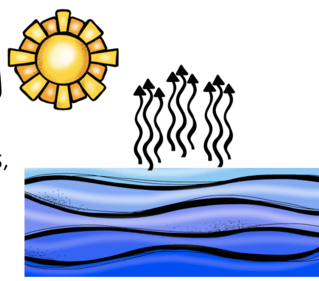
Evaporation happens when the sun ___________ water and turns it into vapor.
cools down
heats up
freezes
lights up
The continuous process by which water moves from Earth's surface to the atmosphere and back
Nitrogen Cycle
Carbon Cycle
Water Cycle
Rock Cycle

All of the living and non-living things in an area
Ecosystem
Population
Biome
Forest
Which process does NOT contribute to carbon dioxide in the atmosphere?
animals respiring
glaciers melting
burning of fossil fuels
decaying organisms
Potable (drinking) water can be produced from salty water (e.g. seawater) by ___________________ to remove most of the salts. This provides drinking water in areas of drought (where there is little rain).
desalination
decomposition
decision
Crop rotation usually includes a legume crop. Legumes have root nodules that contain
nitrogen-removing bacteria.
nitrogen-filling bacteria.
nitrogen-fixing bacteria.

