wayground logo

Free Printable Worksheets

Font size

S
M
L
XL
Worksheets

PLTW IED Sem 1 Review

Total questions: 72

Worksheet time: 51mins

Name
Class
Date
1.
Which of these best completes the conversions below?
1 kg = ? g
1 m  = ? cm
a)
1 kg = 1000 g
1 m  = 100 cm
b)
1 kg = 0.001 g
1 m  = 0.01 cm
c)
1 kg = 100 g
1 m  = 10 cm
d)
1 kg = 0.01 g
  1 m = 0.001 cm
2.
Convert 12 km to m
a)
120 m
b)
1,200 m
c)
12,000 m
d)
120,000 m
3.

What SI unit is used to measure length?

a)

meters

b)

liters

c)

centimeters

d)

kilograms

4.
This is an example of what kind of sketch?
a)
Isometric 
b)
Full 
c)
Dimensioned 
d)
Multiview 
5.
A group technique for solving problems, generating ideas, stimulating creative thinking, etc. by unrestrained spontaneous participation in discussion.
a)
System
b)
Brainstorm
c)
Assess
d)
Prototype
6.
What type of drawing is this?
a)
Planometric
b)
Isometric
c)
One-point perspective
d)
Two-point perspective
7.
What type of drawing is this?
a)
Planometric
b)
Isometric
c)
One-point perpective
d)
Two-point perspective
8.
What type of drawing is this?
a)
Planometric
b)
Isomteric
c)
One-point perspective
d)
Two-point perspective
9.
Which view is the front face of the object?
a)
Top right
b)
Top left
c)
Bottom right
d)
Bottom left
10.

The step in the design loop before presenting is....

a)

generate concepts

b)

construct and test prototype

c)

develop a solution

d)

evaluate

11.

If shading a concept sketch you don't need to consider where the light may be coming from:

a)

False

b)

True

c)

it depends

12.

After you generate concepts you should

a)

build a prototype

b)

develop a solution

13.
Which of the four Inventor Base environments and file extension names is .idw?
a)
Part
b)
Assembly
c)
Drawing
d)
Presentation
14.
What must you do first before you can create a 3D object?
a)
create 2D sketch
b)
click extrude
c)
type in measurement
d)
none of the above
15.
Limits or restrictions that are placed on geometry to define a model’s shape and size are ____________.
a)
geometric entities
b)
constraints
c)
sketch planes
d)
regions
16.
To create a solid model by giving depth to a 2D profile, use the __________ command.
a)
thicken
b)
offset
c)
extrude
d)
protrude
17.
Dial calipers can be used to measure what type of dimensions?
a)
Inside diameter
b)
Outside diameter
c)
Depth
d)
All of the above
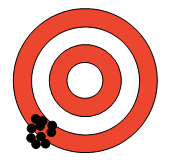
18.
This bullseye demonstrates...
a)
High Accuracy & High Precision
b)
High Accuracy & Low Precision
c)
Low Accuracy & High Precision
d)
Low Accuracy & Low Precision
19.
Identify the Symbol.
a)
Radius
b)
Diameter
c)
Depth
d)
Circles
20.
The basic tools to create the geometry that will be used to create features and parts are located in the ____________.
a)
2D sketch panel
b)
graphics window
c)
status bar
d)
navigation bar
21.
To cancel a command, press the ____________.
a)
ENTER key
b)
F6 key
c)
DEL key
d)
ESC key
22.
The purpose of the middle mouse button or wheel is to ___________.
a)
bring up additional options.
b)
select points, navigation menus, and enter commands.
c)
change the drawing magnification and move around the drawing.
d)
serve as an alternative to the ENTER key.
23.
What is the file extension for Autodesk Inventor Part Files?
a)
.ipt
b)
.ipn
c)
.iam
d)
.idw
24.
What is the file extension for Autodesk Inventor Assembly Files?
a)
.ipt
b)
.ipn
c)
.iam
d)
.idw
25.
TRUE OR FALSE
The Concentric constraint forces two circles, arcs, or ellipses to share a common center point.
a)
True
b)
False
26.
The constraint that forces two selected lines or curves to lie at right angles to one another is ___________.
a)
parallel
b)
vertical
c)
perpendicular
d)
coincident
27.
The constraint that indicates a set of curves or lines are touching without overlapping.
a)
equal
b)
smooth
c)
tangent
d)
symmetric
28.
What does the label #2 represent
a)
Navigation Bar
b)
Home View
c)
ViewCube
29.
Which Autodesk Inventor command will create the 3D image in red?
a)
Extrude
b)
Copy
c)
Mirror
d)
Magic
30.
Which Autodesk Inventor command will create the blue feature on the 3D part?
a)
round
b)
fillet
c)
sweep
d)
cut
31.

What is the definition of a "constraint" in inventor?

a)

Restrictions and associations that are applied to 2D geometry (shapes, points, lines) to make them line up or connect in a certain way

b)

The limits and restrictions a designer must consider at the beginning of a project

c)

Devices that keep a person from moving

d)

Specifications for the size of a design, 2D or 3D

32.

Which constraint symbol matches coincident: occurring together in space or time. For example, the ends of the lines were coincident - they were on top of each other.

a)
b)
c)
d)
e)
33.

Which symbol matches the constraint that will make two lines co-linear (line up with each other)?

a)
b)
c)
d)
e)
34.

Which constraint will force points to line up horizontally (side by side) and/or make lines parallel to the x-axis (horizontal axis)?

a)
b)
c)
d)
e)
35.

Which constraint will make lines parallel? In math terms, it makes them have the same slope.

a)
b)
c)
d)
e)
36.
What does the label #1 represent
a)
Feature
b)
Sketch
c)
Part
d)
Constraint
37.
Identify the linetype.
a)
Leader Line
b)
Arrow Line
c)
Extension Line
d)
Dimension Line
38.

Where do we find the history of all the steps we have taken while modelling?

a)

To the LEFT of the screen in the Model tool bar

b)

At the TOP of the screen in the RIBBON tool bar

c)

Under the SKETCH TAB

d)

You have to go online to find that information

39.
Identify the linetype.
a)
Dimension Line
b)
Extension Line
c)
Section Line
d)
Leader Line
40.

To switch to the isometric/home view of a model quickly, press the __________ key on the keyboard.

a)

F6

b)

F7

c)

F8

d)

F9

41.
Which navigation tool allows for lateral movement (left, right, up, or down) within the graphics window?
a)
zoom
b)
pan
c)
scale
d)
rotate
42.

Which of the following are 2D commands

a)

Line

b)

Extrude

c)

Hole

d)

Circle

e)

Slot

43.
The image to the right is an example of a(n) ______________________.
a)
A.  Project Portfolio
b)
B. Design Brief
c)
C.  Technical Report
d)
D.  Engineer’s Notebook
44.
The precision measuring tool pictured is called a(n)?
a)
Engineer's Scale
b)
Dial Caliper
c)
Digital Micrometer
d)
Scientific Ruler
45.
What method did the designer use to create this part?
a)
Additive
b)
Skeletal
c)
Subtractive
d)
Assembly
46.
A(n) _______ sketch is a sketch with text added to enhance the communication of the ideas/thoughts of the designer.
a)
Thumbnail
b)
Preliminary
c)
Documented
d)
Annotated
47.
This image is called a _______?
a)
Working Drawing
b)
Prototype
c)
Exploded View
d)
Pictorial
48.

What term best describes the list of items below?

> Must be made out of 4 to 6 pieces

> Must be "interlocking"

>Part cannot extend mores than 3 units in any direction

>No two parts can be the same

a)

Client

b)

Deliverables

c)

Design Constraints

d)

Problem Statement

49.

Choose the major discipline of engineering.

a)

civil engineering

b)

military engineering

c)

aerospace engineering

d)

reverse engineering

50.

Choose the major discipline of engineering.

a)

forensic engineering

b)

computer engineering

c)

mechanical engineering

d)

biomedical engineering

51.

Choose the major discipline of engineering.

a)

structural engineering

b)

computer engineering

c)

software engineering

d)

electrical engineering

52.

Choose the major discipline of engineering.

a)

military engineering

b)

chemical engineering

c)

aerospace engineering

d)

environmental engineering

53.

This is a person who is trained in and uses technological and scientific knowledge to solve practical problems.

a)

Engineer

b)

Scientist

c)

Technician

d)

Designer

54.

The rate with respect to time at which an object travels over distance. It is a scalar quantity.

a)

velocity

b)

average speed

c)

distance

d)

displacement

55.
1. When used in the context of design: the use of a computer to assist in the process of designing a part, circuit, building, etc. 2. When used in the context of drafting: the use of a computer to assist in the process of creating, storing, retrieving, modifying, plotting, and communicating a technical drawing.
a)
concept modeling
b)
component
c)
computer aided design or computer aided drafting (CAD)
56.

Listing or mapping the concepts involved in a design or process under investigation.

a)

concept modeling

b)

computer modeling

c)

mathematical modeling

57.
The change in position of an object from its starting position to its final position. Displacement is described by a magnitude and direction. Displacement is a vector quantity.
a)
domain
b)
displacement
c)
function
58.
A measure of how far an object has traveled from its starting point regardless of its starting or ending position. Distance is a scalar quantity.
a)
domain
b)
distance
c)
follower
59.

The set of input values of a function.

a)

domain

b)

range

c)

slope

60.

1. A relationship of one set (called the domain) to another set (called the range) that assigns to each element of the domain exactly one element of the range. 2. The action or actions that an item is designed to perform.

a)

equation

b)

function

c)

graphical modeling

61.
Representing information in the form of charts, graphs, maps, or geometric figures.
a)
model
b)
mock-up
c)
graphical modeling
62.

The process of choosing and using appropriate mathematics and statistics to analyze empirical situations, to understand them better, and to improve decisions.

a)

mathematical modeling

b)

computer modeling

c)

concept modeling

63.

A model or replica of a machine or structure for instructional or experimental purposes. Also referred to as an "appearance model".

a)

prototype

b)

scale model

c)

mock-up

64.
A visual, mathematical, or three-dimensional representation in detail of an object or design, often smaller than the original.
a)
function
b)
model
c)
pattern
65.
The set of output values of a function.
a)
function
b)
range
c)
origin
66.
Drawings that convey all of the information needed to manufacture and assemble a design.
a)
working drawings
b)
physical model
c)
prototype
67.
a)
0.670 in
b)
0.670 cm
c)
0.600 in
d)
0.700 in
68.
What is the measurement?
a)
13 cm
b)
12 cm 9 mm
c)
12.9 cm
d)
green
69.
How many mm?
a)
2
b)
2.0
c)
20
d)
200
70.
Scott travels north 5 miles and then goes west 3 miles before coming straight back south 2 miles. What is his distance?
a)
10
b)
7
c)
8
d)
6
71.
What kind of quantity has both a magnitude and a direction?
a)
scalar
b)
vector
c)
frame of reference
d)
time
72.
1.  Ray runs 30 feet north, 30 feet west, and then 30 feet south. What is the displacement?
a)
30 feet west
b)
90 feet 
c)
30 feet south
d)
0 feet