
NEW
Font size
 Worksheets
Midterm Review
Total questions: 35
Worksheet time: 32mins
What's the dependent variable?
How can an experiment become more valid?
Repeat the experiment
Add a second independent variable
Add another dependent variable
change the hypothesis
Which answer choice shows what the control group would be?
Which of the following should be the first step a student takes before starting the days experiment?
Gather all materials they will need
Put on a lab coat and goggles
Read the directions and wait for a teachers instructions
Ask a classmate what to do and perform the experiment

What is the length of the object in centimeters?
3.4 cm
4.3 cm
3.5 cm
1 1/4 inches
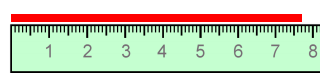
What is the length in centimeters (cm)?
7.2 cm
8.0 cm
7.4 cm
7.7 cm
All matter is made up of
cells
atoms
compounds
molecules
Which of the following is the unit for temperature of the metric system?
Fahrenheit
Meter
Celsius
Milliliter

Which point has the highest potential energy?
A
B
C
D
Which point has the highest kinetic energy?
A
B
C
D
Which phase of matter contains molecules that are the closest together?
solid
liquid
gas
What phase change occurs when heat is added to a solid and the substance turns to liquid?
evaporation
melting
condensation
freezing
Which of the following is not a noble gas?
Fluorine
Argon
Neon
Krypton
Which piece of equipment would you use to separate iron filings from sand?
triple-beam balance
magnet
filter paper
sieve
Which form of energy is considered the energy of motion?
Nuclear
Mechanical
Chemical
Electrical
Identify the name of the process when a liquid turns to ice?
freezing
melting
condensation
evaporation
Identify the process (Gas to Liquid) in which clouds are made?
condensation
evaporation
melting
deposition
What happens to the motion of molecules of a substance when heat is added?
increases
decreases
remains the same
Which type of atmospheric condition refers to the average conditions from year to year or season to season?
weather
climate
equilibrium
ecological succession
What is the main causes of local weather changes?
earthquakes
movement of air masses over Earth's surface
global warming
ecological succession
Elements that belong to the same group will
be metals
react in similar ways
be the same size
contain the same number of protons




Where does precipitation occur along?
fronts
warm fronts only
cold fronts only
in high pressure systems
Elements to the left side of the stair case are considered
metals
metalloids
nonmetals
nobel gases
Elements to the right side of the stair case are considered
nonmetals
metals
metalloids
alkaline earth metals
Which of the following is a result of increased greenhouse gases?
melting of polar caps
decrease in Earth's temperature
increase in heat released from Earth's atmosphere
decreased CFC levels

