
Font size
 Worksheets
Practice Quiz Electromagnetic Spectrum and Space Technology
Total questions: 32
Worksheet time: 25mins
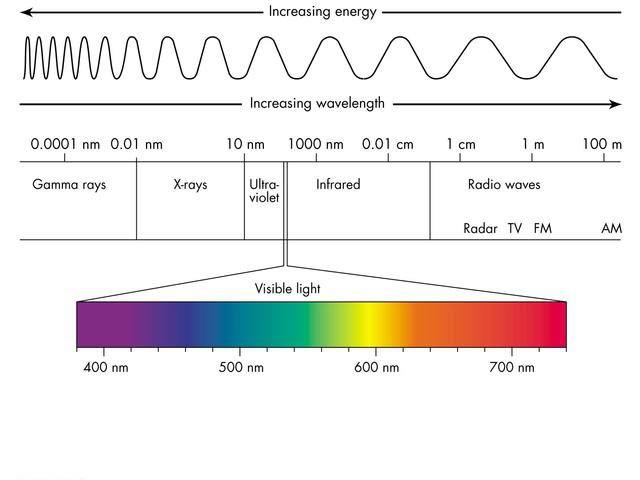
What is the correct order of the visible light spectrum starting with the longer wavelength?
Red, yellow, orange, blue, violet, indigo
Violet, indigo, blue, green, yellow, orange, red
Green, yellow, blue, indigo, red, orange
Red, orange, yellow, green, blue, indigo, violet

Nora is working in a chemistry lab and is given an unknown gas mixture to analyze. She uses a spectroscope to compare the emission spectra of the unknown mixture with those of four known gases: Gas A, Gas B, Gas C, and Gas D. Based on the spectral lines shown, which gases are present in the unknown mixture?
Gas B & Gas D
Gas C & Gas B
Gas A & Gas D
Gas D & Gas C

Black holes emit tremendous amounts of energy which result in astronomers using many different means of technology to gather information. Instruments such as the GALEX satellite and Spitzer Space Telescope use different parts of the electromagnetic spectrum to gather data about these strange celestial objects. To view black holes, the GALEX typically operates at a frequency of about 1.3 X 10¹⁵ Hz while the Spitzer Space Telescope operates at 2.2 X 10¹² Hz.
Which two portions of the electromagnetic spectrum are astronomers using to detect information about black holes?
Ultraviolet and X-Ray
Gamma Ray and X-Ray
Ultraviolet and Infrared
Infrared and Radio

Aria, a scientist, observed a celestial object emitting a wavelength of 3 x 10⁻¹⁰m. What type of telescope did Aria have to use to view this?
Radio wave
Infrared ray
X-ray
Gamma Ray
In 1965, two Bell Labs engineers used a microwave receiver to receive radio transmissions but were unable to eliminate a persistent background noise that seemed to affect the receiver no matter where they pointed it in the sky, day or night. After cleaning the receiver and ruling out other possibilities, they realized their discovery was cosmic background radiation (like heat left over from an explosion) from the Big Bang. They eventually received the Nobel Prize for Physics in 1978.
What does this story show about the development of scientific theories?
Scientific discoveries are rarely rewarded
Accidents almost always happen
Scientist compete with one another and rarely cooperate
New technology can lead to new discoveries

Maya wants to observe distant stars and galaxies, so she decides to use a reflecting telescope like the one shown in the diagram. What is an advantage of using this type of telescope?
It can gather more light
It can focus images perfectly
It can detect very small objects
It can use very small lenses
Grace is an astronomer who needs to place a telescope in a location which will avoid all atmospheric interference. What would be the best location for her telescope?
In deserts
In valleys
In cities
In space
Arjun is learning about electromagnetic waves in his science class. He wants to know which type of electromagnetic wave has the HIGHEST energy. Can you help him choose the correct answer?
gamma
microwave
radio
x-ray
What type of spacecraft is the Hubble Space Telescope?
space station
space shuttle
space probe
artificial satellite
Which type of electromagnetic radiation travels the fastest?
radio waves
visible light
gamma rays
they all travel at the speed of light
Astronomers often scan the sky using devices called radio telescopes. What can you conclude about these devices?
a. They send radio broadcasts out to distant stars and planets. b. c. d.
They pick up the radio waves emitted by stars.
They are less powerful than optical telescopes.
They can detect ultraviolet radiation.
Pictures taken by the Cassini spacecraft show that the rings surrounding Saturn have dark and light bands. Until these pictures were taken, scientists on Earth did not know about this difference in color. Why was the Cassini spacecraft able to take pictures of the dark and light bands in Saturn’s rings while they are not visible from Earth?
The rings around Saturn are covered by thick, dark clouds made of toxic gases.
Bright sunlight makes it difficult to see colors the farther it travels in the solar system.
The differences between the light and dark bands are the result of minerals not found on Earth.
Telescopes on Earth are not powerful enough to see these differences at the great distance.
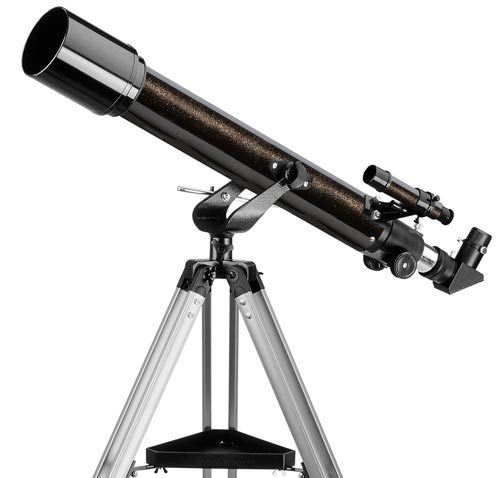
Daniel wants to observe the stars using a refracting telescope. He wonders what the telescope uses to focus light. A refracting telescope uses _______ to focus light.
Lenses
Mirrors
Lasers
Water
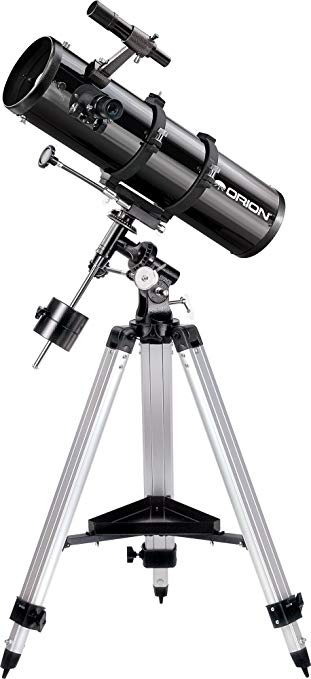
Samuel wants to observe distant stars using his new reflecting telescope. He wonders what component this type of telescope uses to focus light. Reflecting telescopes use _______ to focus light.
Lenses
Flat mirrors
Curved Mirrors
A lens and lasers
Evelyn is planning to build a large optical telescope and is considering different locations. Why might she choose to build it on a mountain?
to be closer to the stars
to be above part of the atmosphere
because it is easier to build telescopes on mountains
to be closer to city lights

Which EM waves are invisible? (more than one correct answer)
radio
visible
ultraviolet
gamma rays
Which EM waves have a SHORTER wavelength than visible?
radio
none
infrared
x-rays
Which EM waves are have the highest energy & are the most dangerous?
radio
gamma rays
infrared
x-rays
Which color waves have the lowest frequency?
red
yellow
green
violet
Which type of electromagnetic wave travels fastest through a vacuum?
radio
gamma rays
visible light
They all travel at the same speed.
Samuel is curious about how different space telescopes work. He learns that the James Webb Telescope is different than the Hubble Telescope in that it
uses visible light to study space.
uses infrared radiation to study space.
uses ultraviolet radiation to study space.
uses radio waves to study space.

The first major optical space telescope that uses visible light to be put into space was the
Hubble Telescope
Spitzer
James Webb Space Telescope
Voyager
This telescope was designed to detect infrared radiation to study objects ranging from our solar system to distant universe regions. It also orbits the Sun.
Spitzer Telescope
Hubble Telescope
James Webb Telescope
Radio Telescopes
Match the following
a spacecraft without a crew that is sent to explore far places.
space probe
allows us to better see objects that are far away and takes pictures of them.
telescope
man-made technology put into orbit around Earth. Can take pictures and assist with navigation and communication on Earth.
satellite


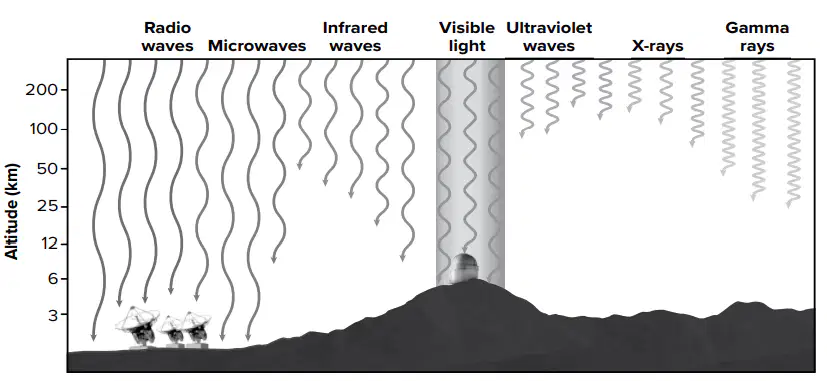
Electromagnetic Radiation from Space Objects in space emit radiation in wavelengths of the entire electromagnetic spectrum. Extremely hot objects are the sources of gamma rays and X-rays. Stars emit most of their radiation in the infrared, visible, and ultraviolet ranges. Cooler objects, such as gas clouds and non-luminous bodies, can be observed using radiation in the radio, microwave, and infrared regions. These objects also tend to reflect visible light from other sources.
As shown in this illustration, not all of the electromagnetic radiation that reaches Earth from space makes it to the surface. Many high-energy waves are blocked by the planet’s magnetic field. Much of the radiation that does reach the atmosphere is absorbed by atoms and molecules.
What part of the electromagnetic spectrum can be observed using optical telescopes on the surface of Earth?
radio waves
infrared waves
visible light
ultraviolet waves

Objects in space emit radiation in wavelengths of the entire electromagnetic spectrum. Extremely hot objects are the sources of gamma rays and X-rays. Stars emit most of their radiation in the infrared, visible, and ultraviolet ranges. Cooler objects, such as gas clouds and non-luminous bodies, can be observed using radiation in the radio, microwave, and infrared regions. These objects also tend to reflect visible light from other sources.
As shown in this illustration, not all of the electromagnetic radiation that reaches Earth from space makes it to the surface. Many high-energy waves are blocked by the planet’s magnetic field. Much of the radiation that does reach the atmosphere is absorbed by atoms and molecules.
What part of the electromagnetic spectrum can be observed using optical telescopes on the surface of Earth?
radio waves
infrared waves
visible light
ultraviolet waves
The illustration shows that much of the electromagnetic radiation from space cannot be observed from Earth’s surface. Space telescopes, satellites, and other types of space technology are required to observe this radiation. Which of these reasons does NOT describe why governments and other agencies would make the investment to build and use this technology?
to support industries that provide jobs to people
to provide scientific knowledge and an understanding of the universe
to develop new technologies that can be applied to make new materials
to find ways to prevent harmful solar radiation from reaching Earth’s surface
The illustration shows that visible light reaches Earth’s surface through the atmosphere. Why are optical telescopes often built at high mountain elevations?
It is less expensive to buy land and build in remote areas on top of mountains.
Mountaintops are closer to the source of the light, so they provide better observations.
Even though the light reaches the surface, it can be affected by gases in the atmosphere.
More wavelengths of visible light reach the tops of mountains than areas at lower elevations.
Space telescopes are very expensive to build and place into orbit. Why do space agencies most likely need many different space telescopes?
The telescopes can only be used at night, so they need to be located in many places.
Each telescope obtains information from specific parts of the electromagnetic spectrum
Because of conditions in space, they do not last very long, and they have to be replaced frequently.
A large network of space telescopes is needed in order to transmit data from space to receivers on Earth.
![M2_Science_Revision [Density, Buoyancy,Force,Speed,Velocity]](https://cf.quizizz.com/image/image-loader.svg)
