
NEW
Font size
 Worksheets
Meteorology
Total questions: 48
Worksheet time: 25mins

The layer of the atmosphere where weather occurs is the ________________.
thermosphere
stratosphere
mesosphere
troposphere
The amount of water vapor in the air is known as ________________.
dew point
humidty
relative humidity
rain
Which will hold more water, warm air or cold air?
Warm Air
Cold AIr
Hot air or water rises, cools and then sinks...
high pressure
convection current
low pressure
stratospheric pressure
Moving ____________ is called wind
rain
force
vapor
air
Because the earth is spinning on its axis, the global winds appear to curve. This is known as the ____________________.
Coriolis Effect
Greenhouse Effect
Climate Effect
Atmosphere Effect
What kind of weather is usually associated with a high pressure system?
Clear skies & sunny weather
Clouds & precipitation (rain, snow, etc.)
Warm air rises because it is _____________ dense then cold air.
More
Less

How many major ocean gyres are there?
4
5
6
12

The convection current described in this model?
Hadley cell
Polar cell
Doldrums
Ferrel cell


Which is a factor that drives oceans currents?
Tidal motion
Wind
Thermohaline circulation (brine)
All of the above

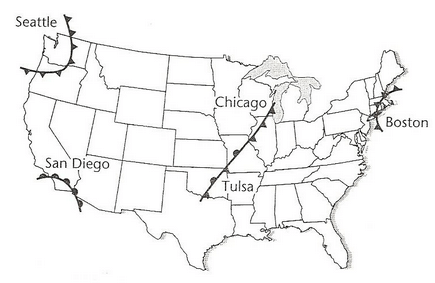
Which type of front is located near Boston?
warm front
cold front
stationary front
occluded front
What is climate?
Long-term average temperature and precipitation
Day-to-day conditions
Effects on space
None of the above

A _____________ weather front occurs when a cold air mass moves forward, pushing the warm air mass up.
Cold
Warm
Stationary
Occluded

A _____________ weather front occurs when a cold air mass and a warm air mass meet, but cannot move one another so they both stay still for several days.
Cold
Warm
Stationary
Occluded

Which air mass would you expect to find here in Chad?
Continental Polar
Continental Tropical
Maritime Polar
Maritime Tropical
What causes global convection currents
Forests
greenhouse gases
more land forms
uneven heating of the Earth's surface
How to warm waters contribute to hurricane development
evaporating water adds heat to the atmosphere
rising tides cause the ocean level to rise
waves cause the hurricane to develope
currents carry the warm water to the hurricane
Warm Fronts bring
violent storms followed by cool dry air
clear skies
steady rain followed by hot humid air
High Pressures are associated with what type of weather
fair weather
cold weather
warm weather
rainy weather
Which of the following air masses would be characterized as cold and dry?
Maritime Tropical
Continental Tropical
Maritime Polar
Continental Polar
The result of the weight of a column of air pushing down on an area is called _________________.
altitude
pressure
density
air pressure
Which air mass produces Seattle's heavy winter precipitation?
continental polar
continental tropical
maritime polar
maritime arctic
Which gas makes up the largest component of the Earth’s atmosphere?
argon (Ar)
oxygen (O2)
nitrogen (N2)
carbon dioxide (CO2)
Which statement best describes the ozone layer of Earth?
It helps reduce the amount of ultraviolet radiation reaching the surface of earth
It prevents the formation of severe storms in the stratosphere of Earth.
It increases the amount of nitrogen in the troposphere of Earth.
It forms a magnetic field in the mesosphere of Earth.
Generally, as altitude increases, temperature ___.
Increases
Decreases
Fluctuates
Stays constant (the same)

What percentage of the Sun's energy is reflected back into space?
100%
About 50%
About 30%
It depends on the weather.


What has the highest albedo?
the oceans
Ice in the Arctic or Antarctic
the ground
roads

Is this showing an area of high pressure or area of low pressure?
high pressure
low pressure
At what point do scientists classify an area's weather as its climate?
1 year
5 years
15 years
30 years
Frigid air that travels southward from Canada would be what type of air mass?
continental polar
continental tropical
maritime polar
arctic

If the jet stream moved south of the Great Lakes, you would expect
warmer weather in the Great Lakes region.
cooler weather in the Great Lakes region.
the Jet Stream doesn't impact the weather of a place
it is impossible to make a hypothesis about this question.

