Wayground logo

Free Printable Worksheets

Font size

S
M
L
XL
Worksheets

Pathophysiology of the heart - I

Total questions: 41

Worksheet time: 44mins

Name
Class
Date
1.
Name this part.
a)
Superior vena cava
b)
Right ventricle
c)
Inferior vena cava
d)
Pulmonary vein
2.
Name this part.
a)
Pulmonary veins
b)
Left atrium
c)
Aorta
d)
Pulmonary artery
3.
Name this part.
a)
Right atrium
b)
Left ventricle
c)
Right ventricle
d)
Left atrium
4.
Name this part.
a)
Left ventricle
b)
Pulmonary artery
c)
Right atrium
d)
Pulmonary veins
5.
Name this part.
a)
Superior vena cava
b)
Right ventricle
c)
Right atrium
d)
Inferior vena cava
6.
Name this part.
a)
Right ventricle
b)
Pulmonary artery
c)
Left ventricle
d)
Right atrium
7.
Which side of the heart pumps oxygen-rich blood to the rest of the body?
a)
Right
b)
Left
8.
Which side of the heart pumps blood into the lungs?
a)
Right
b)
Left
9.
______ carry blood to the heart.
a)
Arteries
b)
Veins
c)
Capillaries
d)
Vena Cava
10.
_____ carries blood away from the heart.
a)
Blood cells
b)
Veins
c)
Capillaries
d)
Arteries
11.
The arteries that feed the heart muscle
a)
Capillaries
b)
Coronary
c)
Chordae teindineae
d)
Coronary sinus
12.
Which valve(s) prevents backflow from of blood into the ventricles?
a)
Semilunar Valves
b)
Cardiac Valve
c)
Mitral Valve
d)
Tricuspid Valve
13.
The _____ valve lies between the right atrium and right ventricle.
a)
bicuspid
b)
aortic semilunar
c)
pulmonary
d)
tricuspid
14.
Valve that blood is forced through from right ventricle into pulmonary arteries.
a)
pulmonary valve
b)
aortic valve
c)
mitral valve
15.
Build up of plaque causing the narrowing of the walls of the arteries of the heart. 
a)
Atherosclerosis
b)
Arrhythmia
c)
Stroke
16.
Abnormal rhythm of the heart.
a)
Arrhythmia
b)
Rap
c)
Stroke
17.

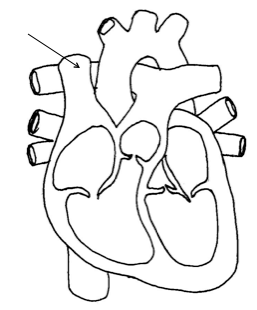
What is the arrow pointing to?

a)

vena cava

b)

mitral valve

c)

tricuspid valve

d)

aorta

18.
The sac of tissue that protects the heart is the 
a)
mediastinum
b)
pericardium
c)
interventricular septum
d)
myocardium
19.
Contraction of the heart is done by the 
a)
epipericardium
b)
visceral pericardium
c)
pericardium
d)
myocardium
20.
Condition characterized by severe, constricting pain or pressure in the chest.
a)
angina
b)
fibrillation
c)
flutter
d)
mitral valve prolapse
21.
When the ventricles contract, the bicuspid (mitral) valve prevents blood from flowing from the ________.
a)
right ventricle to right atrium
b)
left ventricle to left atrium
c)
left atrium to the right atrium
d)
right atrium to the left atrium
22.
Which one of the following represents the correct path for the transmission of an impulse in the intrinsic conduction system of the heart?
a)
AV node, Bundle of His, SA node, Purkinje fibers, bundle branches
b)
SA node, AV node, Bundle of His, bundle branches, Purkinje fibers
c)
SA node, Bundle of His, AV node, Purkinje fibers, bundle branches
d)
SA node, Bundle of His, bundle branches, Purkinje fibers, AV node
23.
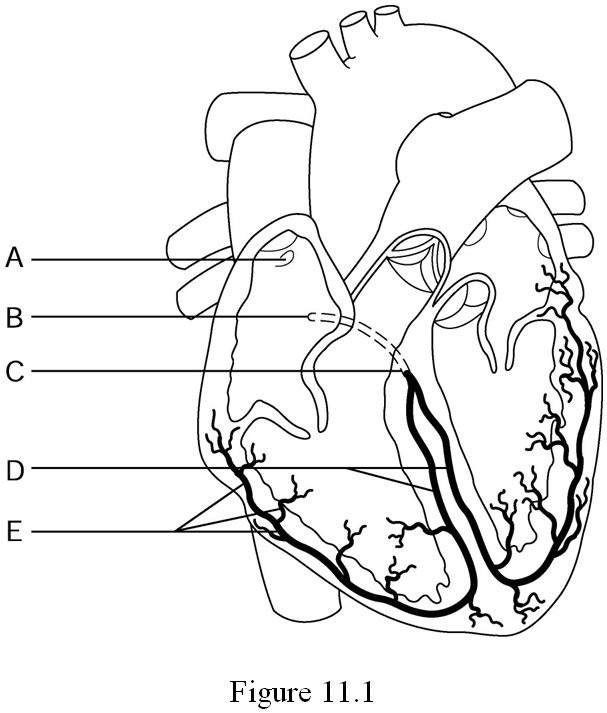
Which label is representing the Purkinje fibers?
a)
A
b)
C
c)
D
d)
E
24.

The heart layer that lines and covers valves to reduce the friction

a)

endocardium

b)

pericardium

c)

myocardium

d)

epicardium

25.

What area of the heart's electrical conduction is known as the "pacemaker" of the heart?

a)

Purknife fibers

b)

SA node

c)

Bundle of his

d)

Bachmann's bundle

26.
Which of the following define diastole and systole
a)
systole is the contraction of the heart and diastole is the relaxation of the heart
b)
diastole is the contraction of the heart and systole is the relaxation of the heart
c)
diastole and systole are both contractions of the heart
d)
diastole and systole are both relaxation phases of the heart
27.
Which of the following lists the valves in the order through which the blood flows from the vena cava through the heart?
a)
tricuspid, pulmonary, bicuspid, aortic
b)
mitral, pulmonary, bicuspid, aortic
c)
bicuspid, aortic, tricuspid, pulmonary
d)
aortic semilunar, pulmonary, tricuspid, bicuspid
28.
One complete heartbeat
a)
ECG
b)
systole
c)
diastole
d)
cardiac cycle
29.
The fibrous chords that attach to the cusps of the valves
a)
Purkinje fibers
b)
chordae tendineae
c)
papillary muscles
d)
cusps
30.
recording of electrical changes that occur during the cardiac cycle
a)
blood pressure reading
b)
ECG
c)
QRS wave
d)
t Wave
31.

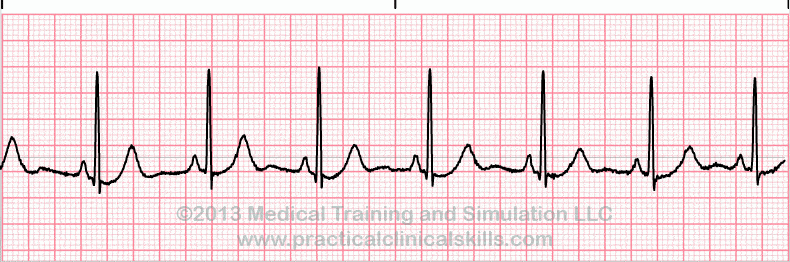
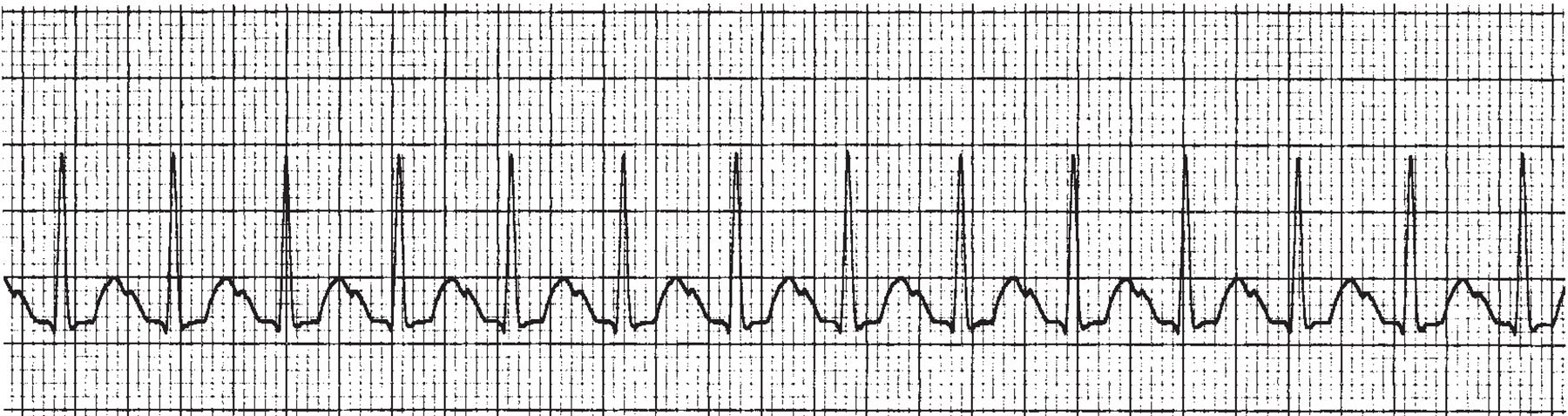
Identify the tracing

a)

Atrial Flutter

b)

AV block: 1st degree

c)

Atrial Fibrilattion

d)

Sinus Tachycardia

32.

Identify the tracing

a)

Ventricular Fibrillation

b)

PEA

c)

Ventricular Tachycardia

d)

Asystole

33.

What is the ECG showing

a)

Atrial Fibrillation

b)

Ventricular Fibrillation

c)

normal

d)

Premature Ventricular Contraction

e)

Heart Block

34.

Which of the following will cause a heart murmur to be heard?

a)

cardiac tamponade

b)

pericarditis

c)

mitral valve prolapse

d)

angina

35.

Which of the following would be the thickest?

a)

right atrial wall

b)

left atrial wall

c)

right ventricular wall

d)

left ventricular wall

36.

The PCT is reviewing a patient’s electrocardiogram. Which wave should the PCT recognize as being the first positive wave in a normal cardiac cycle?

a)

P wave

b)

Q wave

c)

R wave

d)

S wave

37.

This ECG strip illustrates ____________.

a)

Premature Atrial Contraction

b)

Premature Ventricular Contraction

c)

Atrial Fibrulation

d)

Tachycardia

38.

Which wave form is not always seen on the ECG

a)

T

b)

P

c)

QRS

d)

U

39.
What do the letters EKG stand for?
a)
Electrocardiograph
b)
Electromagneticgraph
c)
Electrocardiogram 
d)
Electrolytes
40.
The AV node is located at...
a)
A
b)
B
c)
C
d)
D
41.
The Purkinje fibers are located at...
a)
F
b)
G
c)
H
d)
I