wayground logo

Free Printable Worksheets

NEW

Font size

S
M
L
XL
Worksheets

Review of Heredity

Total questions: 40

Worksheet time: 36mins

Name
Class
Date
1.
The type of inheritance shown when a red-flowered plant is crossed with a white-flowered plant and only pink flowers are produced is _____.
a)
inbreeding
b)
incomplete dominance
c)
polygenic inheritance
d)
multiple alleles
2.
What are the blood types of the possible children that a woman (type O) and man (type AB) can have?
a)
O and AB
b)
O and A
c)
O and B
d)
A and B
3.
There are multiple alleles for the ABO blood group.  Why are only two of these alleles present in any one individual? 
a)
Each parent contributes only one allele for the ABO blood group to the offspring.
b)
There are not enough nucleotides in a red blood cell to produce a third allele. 
c)
Each allele in the ABO group must be dominant or recessive
d)
Blood group alleles are not segregated during meiosis. 
4.
How many alleles does an individual have for each trait?
a)
1
b)
2
c)
3
d)
4
5.

A roan cow shows co-dominance in fur color (orange and white). What is the phenotype ratio expected if a roan cow and a roan steer mate together?

a)

4: Orange and White

b)

1: Orange : 1 White

c)

2 Orange: 2 Orange and White: 0 White

d)

1: Orange: 2 Orange and White: 1 White

6.
In a flowering plant species, red flower color (R) is dominant over white flower color (r). What is the genotype of any red-flowering plant resulting from this species?
a)
rr
b)
R
c)
RR
d)
RR or Rr
7.
How many alleles (letters) does a child get from each parent for each trait?
a)
1
b)
2
c)
3
d)
4
8.
A woman has type B blood and her husband has type O blood.  What must be the woman's genotype, if they have a child with type O blood?
a)
BO
b)
BB
c)
OO
d)
type B
9.
A man has blood type A (heterozygous) and a woman has blood type B (heterozygous). What are the possible blood types of their kids?
a)
A or B only
b)
AB only
c)
A, B, AB only
d)
A, B, AB, or O
10.

If the offsprings have the blood groups O and A the genotype of parents would be

a)

IAIA and IAi

b)

IA i and ii

c)

IAIA and IAIA

d)

IA i and IBi

11.

Physical expression of a gene is called

a)

Genotype

b)

Phenotype

c)

Allele

d)

Hetrozygous

12.

An Allele that does not express when present along with a dominant allele

a)

Recessive

b)

Dominant

c)

Heterozygouz

d)

Homozygous

13.

Which allele od IA and IB in blood groups is present

a)

IA

b)

IB

c)

Both

d)

None

14.
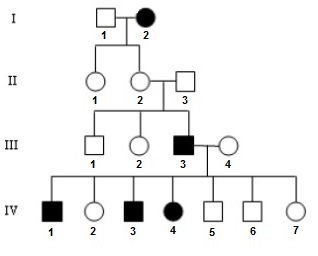
Huntington's Disease is a dominant trait.
What is the correct genotype for individual I-2?
a)
HH
b)
Hh
c)
hh
d)
H_
15.
Does this pedigree show a dominant or recessive trait?
a)
Dominant
b)
Recessive
16.

If this pedigree shows a recessive disorder, what MUST the genotype of individual 4 be?

a)

HH

b)

Hh

c)

hh

17.

If this pedigree shows the inheritance of a dominant trait, then what must be the genotype of the two affected kids in the 3rd generation?

a)

DD

b)

Dd

c)

dd

18.

A parent with genotype YyRR could produce which gametes?

a)

YR, YR, yR, yR

b)

Yy, Rr, yy, rr

c)

Yr, Yr, yr, yR

d)

YR, YR, yr, yr

19.
In the second generation-how many people are carriers of the trait?
a)
2
b)
3
c)
5
d)
6
20.
a)
Not Affected Male
b)
Not Affected Female
c)
Affected Male
d)
Affected Female
21.
What do we use pedigrees for?
a)
To look at families
b)
To make determinations about the offspring
c)
To track traits in families
d)
Nothing
22.
How many kids did the mother and father from the first generation have?
a)
2
b)
4
c)
5
d)
6
23.
This pedigree represents the inheritance of hemophilia in this family. How many of the females have the hemophilia trait?
a)
8
b)
5
c)
2
d)
3
24.
What do half colored symbols represent?
a)
The individual is a carrier (heterozygous).
b)
The individual expresses the trait.
c)
The individual has both recessive alleles.
d)
The individual has both dominant alleles.
25.

What goes in box 3

a)

Aabb

b)

AABB

c)

AAbb

d)

aaBb

26.
What gamete possibilities could come from this parent's genotype?
a)
AB, AB, aB, aB
b)
Ab, AB, Ab, ab
c)
Ab, Ab, Ab, Ab
d)
AB, aB, ab, aB
27.
Based off this punnett square, what fraction of the offspring will have wrinkled, yellow seeds?
a)
9/16
b)
3/16
c)
1/16
d)
16/16
28.
A male beetle has the genotype Ttbb. If this beetle mates with a female with genotype TTBb, what is the chance their offspring will have the genotype TtBb?
a)
3/16
b)
4/16
c)
8/16
d)
12/16
29.
Aa, DD, bB, yy are all examples of
a)
genotypes
b)
phenotypes
30.
Which of the following genotypes is homozygous dominant?
a)
A
b)
Aa
c)
AA
d)
aa
31.

This image is an example of a _____________ cross.

a)

Monohybrid

b)

Dihybrid

c)

Purebred

d)

Pure Breeding

32.
An organism’s genetic makeup, or allele combinations
a)
Recessive
b)
Genotype
c)
Phenotype
d)
Heterozygous
33.

A white mouse with red eyes is crossed with a black mouse with brown eyes. The white mouse is recessive for both of its traits. The black mouse is dominant for both of its traits.

This cross would be

a)

BBEE x bbee

b)

BBEe x BbEe

c)

BbEE x BbEe

d)

BBee x BBEE

34.

A hawk has the genotype Ttbb. If this hawk mates with a female with genotype TTBb, what is the chance their offspring will have the genotype Ttbb?

a)

12.5%

b)

25%

c)

50%

d)

75%

35.
Why did Mendel choose to study pea plants in order to learn how traits are passed from parent to offspring?
a)
Pea plants grow quickly
b)
Pea plants are ultraviolet
c)
Pea plants are rare and expensive
d)
Pea plants are take years to grow
36.

______________________ is the mathematical chance that something will happen

a)

division

b)

percentage

c)

ratio

d)

probability

37.

_____________________ are cells that join to make offspring

a)

somatic cells

b)

gametes

c)

autosomal

d)

basal cells

38.
When humans breed purebred dogs to look a certain way and have traits that they like, this is an example of ___________________________
a)
Probably Breeding
b)
Sectional Breeding
c)
Selective Breeding
d)
Suspended Breeding
39.

__________________ is a tool for tracing through generations of family members.

a)

Pedigree

b)

Probability

c)

Test Cross

d)

Punnett Square

40.

Which of the following is a true statement?

a)

A gene is a code that determines the trait of an organism.

b)

A trait is a code that determins the gene of an organism.

c)

A trait is found in DNA and the gene is where DNA is tightly compacted.

d)

A gene is composed of chromosomes that carry traits we get from our parents.