
Font size
 Worksheets
2 of 2 Practice Quizzes for Final
Total questions: 60
Worksheet time: 39mins
What do animals have to do with Guns, Germs and Steel?
They have nothing to do with it.
They provide written evidence of what happened.
They were another resource the Eurasians had which provided an advantage over other cultures.
They ruled the world before the human revolt over thru them.
How did diseases give Eurasians an advantage?
Diseases don't exist so it didn't give them an advantage.
Actually diseases provided Native Americans with an advantage.
Early exposure helped Eurasians build up an immunity.
It didn't give them an advantage, everyone died the same.
What is globalization?
the process of different cultures sharing their foods, religions and knowledge.
the process of different cultures sharing their comic books
the process of different cultures sharing their chairs
the process of sharing our culture with the mole people


What did the Belgians do to the Africans?
Made friends and worked together with them
Made them into slaves and exploited them
Traded technology for the Tribe's cattle
Killed them
Which of the following descries the Columbian Exchange?
The exchange of people, plants, animals, diseases and ideas from Old World to New World and from New World to Old World
The sending of people, plants, animals, diseases and ideas from the Old World to New World only
The sending of people, plants, animals, diseases and ideas from the New World to Old World only
The sending of people, plants, animals, diseases and ideas from South America to North America only
What happened to the population of many indigenous Americans due to Europe's invasion and colonization of Latin America?
The population decreased significantly due to diseases and warfare
The population increased significantly due to diseases and warfare
The population didn't change much
The population increased significantly due to the new crops and animals

Based on the data, how were MOST Africans enslaved?
taken in a war
kidnapped or seized
through a judicial process
sold / tricked by a relative, friend, etc.
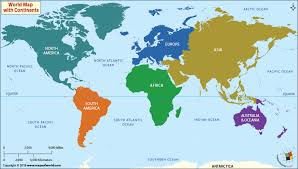
What continents are in the New World?
North America
South America
Europe
Asia
Africa
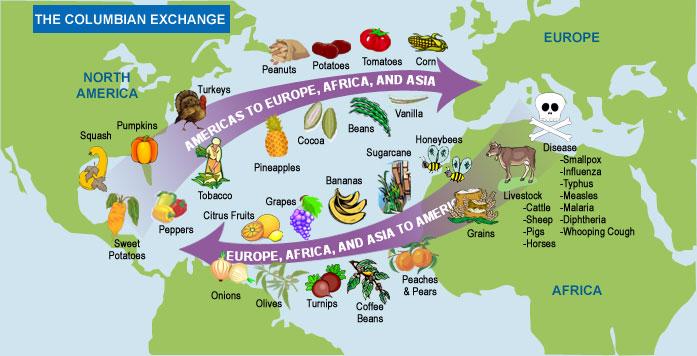
What items are from the Old World?
Peanuts
Barley
Horses
Rice
Pineapples
Who funded Columbus's voyage?
Queen Elizabeth of England
King Henry and Queen Maria of Portugal
King Ferdinand and Queen Isabella of Spain
King Charles and Queen Antoinette of Italy
This group of explorers were seeking "gold, god, and glory"
Native Americans
Knights
Vikings
Conquistadors
During the Age of Absolutism, European monarchs looked to
Develop better relations with muslim rulers
Centralize political power in their nations
Encourage the growth of political farms
Increase human rights for citizens
Elizabeth belonged to what royal family?
Windsor
Stuart
Tudor
Plantagenet
Which of the following statements best describes Elizabeth's Religious Settlement?
A chance to ban the Catholic faith for good.
A chance to give complete equality between Catholics and Protestants.
A chance to scrap the idea of Catholics and Protestants to avoid conflict.
A chance to allow the Catholics to worship without being persecuted/punished.
Which family ruled the Holy Roman Empire during the Age of Absolutism?
Bourbons
Tudors
Hapsburgs
Stuarts
This began as a religious war between Protestants and Catholics
War of the Austrian Succession
Thirty Years War
War of the Spanish Succession
French and Indian War
Which of the following is true of the Peace of Westphalia?
Germany emerges as a major European power
Hapsburg states are strengthened
Holy Roman Empire is divided and weak
German princes now had to follow the religion of the HRE
Who was the most famous Bourbon king in France?
Louis XIV
Henry IV
Louis XIII
Charles v
What event does Louis XIV set the stage for in France with extravagant spending and war debt?
American Revolution
World War I
French Revolution
World War II
What is the root cause of the Thirty Years War?
Political fallout from the Crusades
Conflict between Orthodox and Catholics
Conflict between Protestants and Catholics
The Hapsburg attempt to conquer France
Catherine the Great is remembered has doing what for Russia.
Improving education for women.
Bringing literature, music, and art to the people.
Modernizing Russia long European lines.
All of the above.
The Glorious Revolution ended tensions between
The king, William of Orange and the Pope
Parliament, Catholics, and the King
Parliament, Mary Stuart, and France
The king, Parliament and Protestants


Identify the art style.
Rococo
Baroque
Neoclassical
High Renaissance
Hellenistic


What are the qualities of Baroque art?
Restraint
Motion
Ridget
Emotion

Painted by:
Jan van Eyck
Botticelli
Rembrandt
Caravaggio


In Rousseau's The Social Contract, he expressed his belief that
a child was a small adult with all the same abilities and obligations.
the individual's will is the most important.
government was necessary to protect the rights of its citizens, but may be overthrown.
government was an evil that should be totally eliminated.
What kind of leader was King Louis XVI?
very militaristic
weak and indecisive
powerful and well respected
friendly and well liked
About what portion of France's population belonged to the Third Estate?
2 percent
50 percent
75 percent
97 percent
Which estate did the clergy belong to?
1st Estate
2nd Estate
3rd Estate

What did the National Assembly promise to do in the Tennis Court Oath?
To execute the king
To write a new constitution
To stage a Coup d'etat
To make France independent
What violent event is considered the beginning of the French Revolution?
The Great Fear
The Women's March
Storming of the Bastille
The Reign of Terror
The Reign of Terror was a time when
Marie Antoinette was executed
The Committee of Public Safety used terror to keep the Republic safe
Thousands of French people were sent to the guillotine
all of these
The TERROR ended when...
Marie Antoinette was executed.
Louis XVI was executed.
Marat was murdered in his bath.
Robespierre was executed.
After the TERROR, some stability was achieved in 1795 when...
The Directory came to power
Napoleon took over the government
The Committee of Public Safety took over the government
All of these

A radical group of Parisian wage-earners and small shopkeepers who wanted a greater voice in government, lower prices and an end of food shortages.
Sans-Cullotes
Moderates
Emigres
Jacobins

Radical political club during the French Revolution that wanted to remove the king and establish a republic. Both middle class men and women joined.
Sans-Cullotes
Radicals
Emigres
Jacobins

A machine for beheading people used as a means of execution during the French Revolution.
Beheader
National Razor
Guillotine
Head chopper-offer 3000

Leader of the Committee of Public Safety, he and his followers tried to wipe out all traces of France's past monarchies.
Louis XVI
Maximillien Robespierre
Jean-Paul Marat
Napoleon Bonaparte


