
 Worksheets
Erosion
Total questions: 40
Worksheet time: 24mins
What is weathering?
The movement of sediment
The breaking of sediment
The dropping of sediment
What is erosion?
The movement of sediment
The breaking of sediment
The dropping of sediment
What is deposition?
The movement of sediment
The breaking of sediment
The dropping of sediment
Water carrying sediment down a hill is an example of...
weathering
erosion
deposition
Water freezing inside a rock and breaking it into smaller sediment is an example of...
weathering
erosion
deposition
All the water on Earth is known as...
sediment
lithosphere
hydrosphere
Small pieces of rock that have been weathered from a larger rock are known as...
sand
sediment
soil
The scientific term for land, crust or rock is...
hydrosphere
dirt
lithosphere

A landform made of sediment that is deposited where a river flows into an ocean or lake is called a...
sea cave
mountain
delta
How do plants in the soil affect how fast erosion happens?
It doesn't affect erosion.
It slows down erosion.
It speeds up erosion.
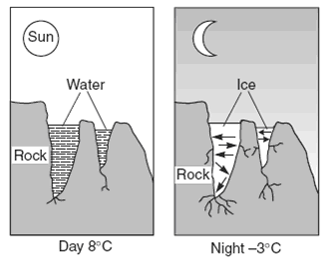
Which statement best explains why this process results in weathering?
Which of the following is NOT an element of erosion?
Water
Wind
Chemical
Electrical Current
Which of the following was formed through erosion?
Eiffel Tower
The Grand Canyon
Mt. Rushmore
The Pyramids of Giza


Fantasy Canyon, located in Uintah County, is a classic example of
weathering and erosion in mudstone and claystone have been stripped away by water and wind, leaving the slightly more durable sandstone to be carved into bizarre, melted wax-like forms.
organic erosion
plate tectonics
What type of changes does erosion cause?
Physical changes
Chemical changes
Electrical changes
Magnetic changes
Erosion occurs when natural forces alter the landscape. What does it mean to alter a landscape?
To blow dust around
To change what land looks like
To deposit silt at the mouth of a river
To create a floodplain
Which term BEST describes the rate at which glacial erosion takes place?
Quick
Short
Slow
Sudden
Why is it hard to see glacial erosion in action?
Because glaciers are so big
Because light from glaciers refracts too much
Because glaciers move very, very slowly
Because glacial erosion is usually very subtle

What do floodplains, sandbars, and river deltas have in common?
They've all been formed by water erosion
They've all been formed by glacial erosion
They've all been formed by wind erosion
They've all been formed by sandblasting

Based on the information presented in the video, what can you infer about the type of erosion that formed the Grand Canyon?
WInd erosion
Water erosion
Sandblasting
Glacial erosion
Based on the information presented in the video, what would be a simple way to prevent erosion?
Blocking the wind
Planting trees
Preventing rainfall
Preventing the flow of rivers

Which of the following statements describes how water can change river valleys?
Water can wear away the solid rock of river valleys NO MORE than several feet over many millions of years
Water can gradually wear away the solid rock of river valleys AS MUCH AS thousands of feet over millions of years.

Which of the following statements describes how wind can change valleys?
Wind can gradually wear away the solid rock of river valleys AS MUCH AS thousands of feet over millions of years.
Wind can wear away the solid rock of river valleys NO MORE than several feet over many millions of years.

Which statement describes how rock characteristics affect rates of weathering?
Rocks with GAPS AND CRACKS weather more quickly than rocks with smooth surfaces.
Rocks without minerals more quickly than rocks MADE UP of many minerals.

