wayground logo

Free Printable Worksheets

NEW

Font size

S
M
L
XL
Worksheets

Chromosomes, Meiosis, Genetics

Total questions: 45

Worksheet time: 25mins

Name
Class
Date
1.
 Cell created at the end of meiosis are best known as
a)
somatic cells
b)
gamete cells
c)
skin cells
d)
diploid cells
2.
If human body cells have 46 chromosomes, how many chromosomes will be in gamete cells after meiosis?
a)
92
b)
46
c)
23
d)
12
3.
The union of egg and sperm to form a new offspring is
a)
zygote
b)
fertilization
c)
homologous pairing
d)
meiosis
4.
If a diploid cell from a worm has 60 chromosomes, how many will be in one egg cell (gamete)?
a)
60 
b)
30 
c)
2
d)
120
5.
If a diploid cell of a beetle has 10 chromosomes, how many chromosomes will be in one stomach cell from this beetle?
a)
2
b)
5
c)
10
d)
20
6.
This cell is clearly in
a)
meiosis I
b)
meiosis II
c)
mitosis
d)
DNA replication
7.
The chromosome number for this species is
a)
2
b)
4
c)
8
d)
unknown
8.
Cell D is a
a)
has one copy of each chromosome from each parent cell
b)
Has twice as many chromosomes as the parent cells
c)
has half as many chromosomes as the parent cells
d)
has a homologous pair from cell A and the other homologous pair from cell B
9.
Process F which makes cell C from cell A is
a)
meiosis
b)
mitosis
c)
fertilization
d)
replication
10.
At the end of meiosis, this cell will have
a)
8 replicated chromosomes )(
b)
4 replicated chromosomes )(
c)
8 single chromosomes (
d)
4 single chromosomes (
11.
How many times in meiosis does the cell divided?
a)
2
b)
4
c)
3
d)
1
12.
What phase is  shown in the picture?
a)
anaphase 1
b)
anaphase 2
c)
metaphase 1
d)
telophase 1
13.
When two haploid sex fuse together during fertilization they become ______________ 
a)
haploid cells
b)
meiosis
c)
mitochondria
d)
diploid cells
14.
Sex cells are produced through the process of
a)
mitosis
b)
cytokinesis
c)
binary fission
d)
meiosis
15.

Which sex chromosome combination is for a female?

a)

XY

b)

XX

c)

YY

d)

XXY

16.

How many haploid daughter cells are produced after meiotic division of one cell?

a)

1

b)

2

c)

3

d)

4

17.

Are gametes (sex cells) haploid or diploid?

a)

Haploid

b)

Diploid

18.
Which of the following produces identical nuclei in cells?
a)
fertilization
b)
osmosis
c)
mitosis
d)
pollution
19.
Which statement best describes the importance of sexual reproduction?
a)
sexual reproduction produces variation in offspring
b)
sexual reprosuction provides regeneration of body parts
c)
sexual reproduction occurs between individuals of the same species
d)
sexual reproduction produces offspring that are identical
20.
Which of the following cell types is formed by meiosis?
a)
skin cells
b)
sperm cells
c)
blood cells
d)
muscle cells
21.
Which of the following statements correctly describes meiosis?
a)
Meiosis does not occur in reproductive cells.
b)
The cells produced at the end are identical 
c)
the cells produced at the end contain half the # of chromosomes
d)
cells divide only once during meiosis
22.
What process is necessary for the inherited traits of an organism to be passed along by sexual reproduction?
a)
meiosis
b)
mutation
c)
mitosis
d)
fission
23.
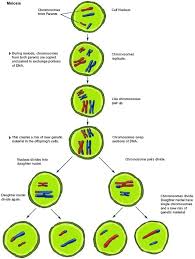
This diagram  shows which cellular process that occurs in organisms?
a)
endocytosis
b)
mitosis
c)
meiosis
d)
phagocytosis
24.
Which of the following sequences represents chromosome # during fertilization?
a)
2n-> n + n
b)
n + n -> 2n
c)
n -> n
d)
2n -> 2n
25.
If an intestinal cell in a butterfly contains 24 chromosomes, a butterfly egg cell would contain___________.
a)
12 chromosomes
b)
6 chromosomes
c)
3 chromosomes
d)
24 chromosomes
26.
Each body cell in an erthworm contains 36 chromosomes.  HOw many chromosomes are in each of its gametes?
a)
54
b)
36
c)
72
d)
18
27.
Which of the following normally results from meiosis in a human cell that contains 46 chromosomes?
a)
an egg cell with 46 chromosomes
b)
a liver cell with 23 chromosomes
c)
a sperm cell with 23 chromosomes
d)
a blood cell with 46 chromosomes
28.
Based only on the sex chromosomes in a human egg and sperm cells at fertilization, the probability of producing a female is 
a)
25%
b)
50%
c)
75% 
d)
90%
29.
Meiosis is the key process in the production of_________.
a)
body cells
b)
RNA
c)
white blood cells
d)
gametes
30.

Human gametes contain how many chromosomes?

a)

46

b)

23

c)

12

d)

28

31.
Trait or character that is passed down. 
a)
Purebred
b)
Inherited
c)
Mutation
d)
Genes
32.
This produces 2 identical cells.
a)
mitosis
b)
meiosis
33.
Goes through P.M.A.T two rounds 
a)
Mitosis
b)
Meiosis
c)
Osmosis
d)
Transcription
34.
A male shark has 40 chromosomes in each of its sex cells. How many would be present in its body cells?
a)
20
b)
40
c)
80
d)
160
35.

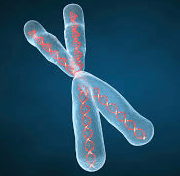
What term best fits what is represented in this image?

a)

Chromosomes

b)

Genetics

c)

Karyotype

d)

Autosomes

36.

Which of the following best defines an autosome?

a)

A chromosome that does things automatically

b)

A chromosome that is least common in a human set of chromosomes

c)

A non-sex chromosome

d)

A sex-determining chromosome

37.
Each identical side of a chromosome is the 
a)
centromere
b)
chromatin
c)
centriole
d)
chromatid
38.
The structure that holds two chromosomes together until they separate for cell division is the
a)
chromatid
b)
chromatin
c)
centromere
d)
cytoplasm
39.

What is the position of a specific gene on a chromosome called

a)

Genetic code

b)

Loci/locus

c)

Allele

d)

DNA

40.
Why do we need meiosis?
a)
To double the number of chromosomes going into sex cells
b)
To halve the number of chromosomes going into sex cells
c)
To triple the number of chromosomes going into sex cells
d)
To not change the number of chromosomes going into sex cells
41.

MEIOSIS

a)

REDUCES THE NUMBER OF CHROMOSOMES BY ONE HALF

b)

PRODUCES UNIQUE SEX CELLS-1N

c)

ALLOWS TRAITS TO BE PASSED TO OFFSPRING

d)

ALL ARE TRUE

e)

INCREASE GENETIC VARIATION

42.
a)

INCREASES GENETIC VARIATION

b)

TAKES PLACE IN PROPHASE I

c)

CROSSING OVER

d)

ALL ARE TRUE

43.

CROSSING OVER INCREASES

a)

LIFE SPAN

b)

GENETIC VARIATION

c)

THE NUMBER OF OFF-SPRING

d)

ALL ARE TRUE

44.

CROSSING OVER TAKES PLACE DURING

a)

PROPHASE II

b)

PROPHASE I

c)

INTERPHASE

d)

METAPHASE I

45.

__________-RE-ORDERS THE BASE SEQUENCE ;

EXAMPLE TO CREATE MORE GENETIC DIVERSITY

(ATA-CCG) TO (TTA-GGC)

a)

CROSSING OVER

b)

MITOSIS

c)

ASEXUAL REPRODUCTION