
 Worksheets
Metals and Non-Metals
Total questions: 30
Worksheet time: 2hrs 16mins
Name
Class
Date
1.
Which of these is a property of metals?
a)
It's malleable
b)
It can't conduct electricity
c)
They are used in food
d)
It's very brittle
2.
Brittle
a)
Metal
b)
Nonmetal
3.
Good conductor of heat
a)
Metal
b)
Nonmetal
4.
All of the following would classify an element as a metal except?
a)
Dull
b)
Luster
c)
Malleable
d)
Hard
5.

Which table below correctly lists the properties of metals and nonmetals? *
a)
A
b)
B
c)
C
d)
D
6.
Which of the following is a property of a non-metal?
a)
Conducts electricity and heats well
b)
Can be hammered into thin sheets
c)
Is brittle and breaks easily
d)
Has a shiny, metallic luster
7.
If a material can easily be drawn into the shape of a wire, it is
a)
Ductile
b)
Magnetic
c)
Malleable
d)
Reactive
8.
If a substance is magnetic it is most likely a
a)
metal
b)
non-metal
9.

When an object changes shape when struck by a hammer.
a)
luster
b)
malleable
c)
brittleness
d)
ductile
10.
Unlike non-metals, most metals tend to —
a)
conduct electricity and heat well.
b)
be gases at room temperature.
c)
break easily when hammered.
d)
have less luster and shine.
11.
Hydrogen
a)
Metal
b)
Non-metal
12.
Helium
a)
Metal
b)
Non-metal
13.
Lithium
a)
Metal
b)
Non-metal
14.
Carbon
a)
Metal
b)
Non-metal
15.
Sodium
a)
Metal
b)
Non-metal
16.
What side of the periodic table are nonmetals on?
a)
left
b)
right
c)
top
d)
bottom
17.
How are metal oxides formed?
a)
When metals react with oxide.
b)
When metals react with water.
c)
When metals react with air.
d)
When metals react with oxygen.
18.
Which of the following is the product of the reaction of aluminium and oxygen?
a)
aluminium oxide.
b)
metal oxide
c)
aluminium ore
d)
aluminium and oxygen
19.
Which of the following reactions produces calcium oxide?
a)
calcium and oxide
b)
calcium and water
c)
calcium and air
d)
calcium and oxygen
20.
Which of the following is an example of an oxidation reaction?
a)
Ca + O2 --> CaO
b)
Na2O + H2O --> NaOH
c)
Fe2O3 + CO --> Fe + CO2
d)
All of the choices are oxidation reactions.
21.
The rusting of iron is an example of
a)
a reduction reaction.
b)
an oxidation reaction.
c)
a reaction of iron with water.
d)
a reaction that dissolves iron.
22.

What conditions are required for rusting?
a)
water only
b)
oxygen only
c)
water and oxygen
23.
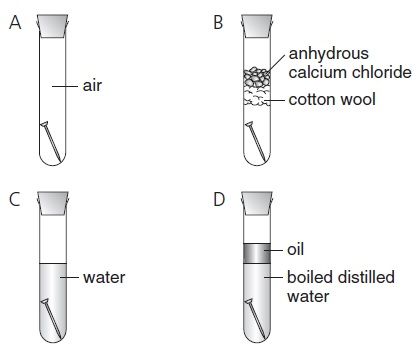
Which diagram shows the most favourable conditions for rust to appear on the nail?
a)
A
b)
B
c)
C
d)
D
24.
Iron rust in the presence of:
a)
Vacuum
b)
Moisture
c)
Oxygen
d)
Moisture and Oxygen
25.
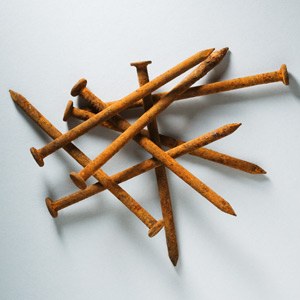
Is this an example of corrosion?
a)
Yes
b)
No
26.
To protect iron against corrosion, the most durable metal plating on it, is:
a)
Zinc plating
b)
Nickel plating
27.
Galvanizing is a process of:
a)
Applying a Zinc coating to bare steel
b)
Washing the body with the phosphate coating
c)
dipping a body in E-COAT
d)
Chemically etching primer to steel
28.
In this chemical reaction, which is the product/s?
Magnesium + Oxygen --> Magnesium oxide
a)
magnesium
b)
magnesium and oxygen
c)
magnesium oxide
d)
oxygen
29.
A mixture of different metals is known as
a)
Metal mix
b)
cement
c)
Alloy
d)
atom
30.

What is this image showing?
a)
Electroplating
b)
Anodising
c)
Galvanising
d)
Dip Coating
100 %

