
 Worksheets
Neurotransmitters
Total questions: 15
Worksheet time: 7mins
Name
Class
Date
1.
Which neurotransmitter is released in response to stress and trauma?
a)
Acetylcholine
b)
Endorphins
c)
Serotonin
d)
GABA
2.
Which neurotransmitter inhibits brain activity?
a)
Acetylcholine
b)
GABA
c)
Endorphins
d)
Dopamine
3.
Serotonin is a neurotransmitter that helps regulate:
a)
learning and memory
b)
pain and pleasure
c)
muscle movements
d)
sleep, moods/emotions
4.
What is a neurotransmitter?
a)
fatty covering of the axon
b)
nerve cell
c)
chemical messenger
d)
gap between neurons
5.
Which neurotransmitter is involved in muscle movements?
a)
Acetylcholine
b)
Endorphins
c)
Serotonin
d)
GABA
6.

The part of the neuron that receives messages from other neurons
a)
axon
b)
dendrite
c)
cell body
d)
Schwann cell
7.
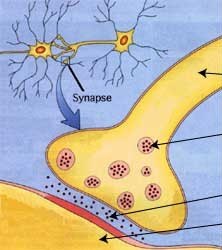
The location of neurotransmitters
a)
axon terminals
b)
dendrites
c)
Schwann cells
d)
cell body
8.

The tiny gap between neurons where nerve impulses are sent from one neuron to another.
a)
synapse
b)
axon terminal
c)
impulse
d)
myelin
9.
The proper name for brain chemicals
a)
Hormones
b)
Neurons
c)
Neurotransmitters
d)
Synapse
10.
The name of the specialised gap between 2 neurons
a)
Dendrites
b)
Terminal buttons
c)
Synaptic Vesicles
d)
Synapse
11.
Type of synapse which increases the chance of the next neuron firing
a)
Inhibitory
b)
Excitatory
c)
Neurotransmitters
d)
Neuron
12.
Type of synapse which decreases the chance of the next neuron firing
a)
Inhibitory
b)
Excitatory
c)
Neurotransmitters
d)
Neuron
13.
When a neuron is not engaged in an impulse.
a)
Resting potential
b)
Action potential
c)
Neural potential
d)
Synaptic potential
14.
Acetylcholine (ACh) is heavily involved with
a)
muscle movements
b)
making memories
c)
blocking pain
d)
elevating mood
15.
In order for a neuron to have an action potential, the neuron must receive more
a)
excitatory neurotransmitters
b)
inhibitory neurotransmitters
c)
agnostic neurotransmitters
d)
antagonistic neurotransmitters
100 %

