
 Worksheets
Science Spiral Review 1/31
Total questions: 52
Worksheet time: 4hrs 20mins
Which is the most responsible for the uneven heating of the air in the atmosphere?
radiation
convection
conduction
condensation
Which will most likely result from a low-pressure weather system?
warm temperatures
cloudy conditions
clear conditions
cool temperatures
On a cold, cloudy day, the local weather forecaster predicts that a high-pressure system will be moving into the area in the next 24 hours. Which weather conditions will this system most likely bring to the area?
stormy
sunny
stormy
hot
What must occur before clouds can form?
Water vapor must get warmer.
Water vapor must lose heat energy.
Precipitation must begin to fall and run off.
Transpiration must add water vapor to the atmosphere.
The weather forecast indicates that a warm front will be moving into the area in the next 24 hours. Which type of weather will most likely result?
clear skies and cold temperatures
clear skies and hot temperatures
cloudy skies and rainy weather
heavy snow and ice
What impact does the Gulf Stream have on North Carolina’s coastal climate?
The cold water from the Gulf Stream current cools the land.
The warm water from the Gulf Stream current warms the land.
The cold water from the Gulf Stream current decreases inland wind speeds.
The warm water from the Gulf Stream current increases inland wind speeds.
Which weather pattern most influences the weather in North Carolina?
polar easterlies
tropical easterlies
tropical westerlies
prevailing westerlies
A student gets a can of soda from the refrigerator. There is a thin film of moisture on the surface of the can. Which best describes the source of the moisture?
Ice from the refrigerator freezes onto the can.
Melted ice from the refrigerator form on the can.
Water from the can evaporated into the air.
Water from the air condensed on the can.
Tina is boiling water in a metal pot for a weather experiment. What is most likely the reason she would need to use a pot holder for moving the metal pot?
Radiation causes the pot to be hot.
Conduction causes the pot to be hot.
Convection causes the pot to be hot.
Transpiration causes the pot to be hot.
In heat transfer, heat always flows from the _______________ substance to the _______________ substance.
Hotter to colder
Colder to hotter
Hotter to hotter
Colder to colder
The kind of heat transfer that travels through space in electromagnetic waves is ______________________.
insulation.
Radiation
Conduction
Convection
When a SOLID changes to a LIQUID, it
Freezes
Boils
Melts
Water will _________ when it gets cold enough, changing it from a LIQUID to a SOLID
Melt
Freeze
Boil
When water turns into gas it is called...
Water Vapor
Darth Vapor
Melts

Any material that does not allow heat to pass through it easily
Friction
Conductor
Insulator
Magnet

What part of the water cycle does this picture show?
condensation
precipitation
evaporation
What is the water cycle?
the 3 forms of water
the movement of water on, above, or below the surface of the Earth
when water melts
when clouds form
Which of the following is a sign that a chemical reaction has occurred?
change in shape
melting
formation of a gas
dissolving
Which of the following is NOT an example of a physical change?
crumpled paper
pencil sharpening
shrunken clothing
rust
Is hammering wood together to build a house a chemical or physical change?
chemical
physical
A(n) __________ includes all living and non-living things in an environment.
population
niche
abitotic
ecosystem

Why do globes lean sideways?
To allow them to spin easier.
To demonstrate the tilt of Earth's axis.
To demonstrate the effects of gravity.
To demonstrate day and night.

Based on the picture, what type of front is present?
Warm front
Cold front
No front - After a warm front
No front - After a cold front
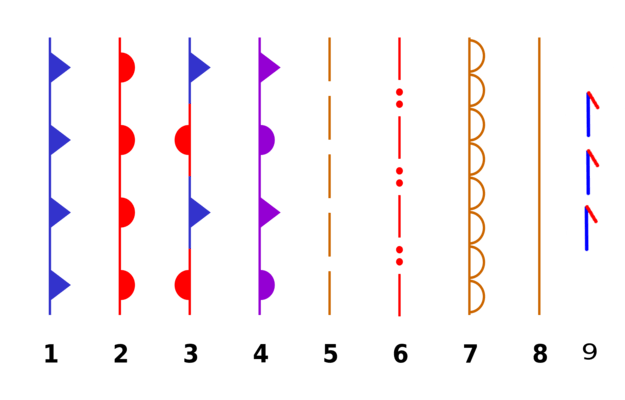
What does symbol # 3 mean?
stationary front
occluded front
warm front
cold front
A front is
where warm air is cooling at earth's surface
a line where hot and cold air are separating
a line where two different air masses meet
where cold air is rising and forming rain clouds
Is melting butter for popcorn a chemical or physical change?
chemical
physical
Fizzing, foaming, and burning are all examples of
Chemical change
Physical change
A change where one or more new substances are created.
Physical Change
Chemical Change

Water from rain or snow that flows over the surface of the land into streams, rivers, and lakes is called...
accumulation
runoff
ground water
surface water

The process by which plants release water through the pores in their leaves is called...
accumulation
dormancy
photosynthesis
transpiration

If a rain drop lands in the ocean, it will eventually _______, and return to the clouds.
condense
evaporate

Water vapor is the _______ form of water.
solid
liquid
gaseous

The higher water vapor rises in the atmosphere the _______ it gets.
warmer
colder

What can carry pollutants from the soil into rivers and streams?
runoff water
sunlight and heat
water vapor
What is the easiest type of mixture to seperate?
Liquids and Liquids
Gas and Liquids
Solid and Liquid
Solid and Solid
Solid and Gas

Which block has more mass?
M
L
Less dense means the object will
Float
Sink
More dense means the object will
Float
Sink
A producer?
Eats other plants and animals
Makes its own food
Eats dead plants or animals
Makes toys for kids
The direction of the flow of energy in a food web is represented by ___.
Light bulbs
Dotted Lines
Arrows
Bubbles

Energy increases as you move up the food pyramid (from bottom to top).
True
False
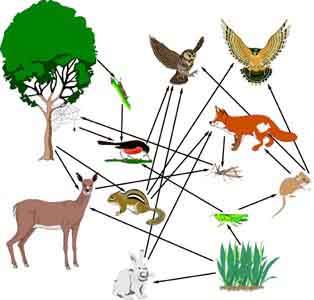
What does a food web represent?
All connections of energy flow throughout all organisms in a habitat.
The specific ways that mutualism is carried out.
A single pathway or energy flow between organisms.
How carnivores get their food.

An energy pyramid represents what?
How much sunlight is available for the ecosystem to use.
How much energy a particular organism needs.
How much energy is needed to build a pyramid.
The amount of energy available to the next 'feeder' in a food web.
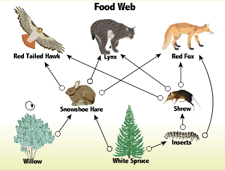
What may happen if the snowshoe hare was removed from the food web pictured?
The insects in the habitat would increase.
The shrew population would decrease due to being only hawk food source.
The willow tree population would decrease.
Foxes would dies due to no food source.

The rabbit in this food web would be considered a:
Decomposer
Producer
Secondary Consumer
Primary Consumer
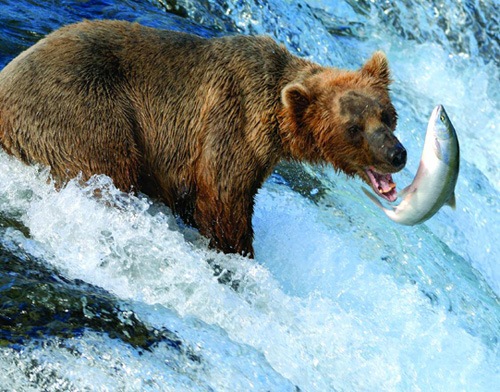
The image provided is an example of a(n):
Producer
Autotroph
Consumer
Insect

An organism that gets energy from breaking down dead organisms, non-living material or waste is a(an) ___________.
producer
consumer
decomposer
autotroph
Which of the following is a producer?


Through what process do producers make their own food?
Parthenogenesis
Photosynthesis
Meiosis
Mitosis

If a disease strikes the snakes the rabbits will
increase
decrease
not be affected
If a disease strikes the snakes the hawks will
increase
decrease
not be affected

Which of these organisms would receive energy from the snake?
Plant
Rabbit
Mouse
Hawk

