
 Worksheets
Soils
Total questions: 56
Worksheet time: 33mins
What is soil?
The material covering the face of the earth that supports the growth of plants
The most precious natural resource we have
A non-renewable resource
All the above
What are the four major components of soil?
Minerals, Air, Water, and Organic Matter
Minerals, Water, Humus, and Organic Matter
Humus, Air, O2, and Carbon
Carbon, Minerals, Humus, Organic Matter
Minerals in the soil are….
Substances in the soil that are derived from the non-living sources (inorganic)
Fills the gaps left in the soil by the grouping together of mineral particle
The matter in the soil that came from living organisms
None of the above
Air and Water in the soil….
Substances in the soil that are derived from the non-living sources (inorganic)
Fills the gaps left in the soil
The matter in the soil that came from living organisms
None of the above
Organic Matter/Humus in the soil is….
Substances in the soil that are derived from the non-living sources (inorganic)
Fills the gaps left in the soil
The matter in the soil that came from living organisms
None of the above
Parent material is important to the soil because?
All Soil comes from it
It can be organic or inorganic
Both A and B
None of the above
Organic Soils are….
Derived from parent material that was once living
Very productive
Made from carbon sources
All the above
Inorganic soils are….
Made from parent materials such as rocks and other non-living origins
Made from carbon sources
Derived from parent material that was once living
None of the above

What is the layer of soil that contains humus, leaf litter, and other organic matter?
O - Organic
A - Topsoil
B - Subsoil
R - Bedrock

Which layer is the bottom of the soil profile?
C - Partially Weathered Parent Material
D - Separated rock
R - Bedrock
A - Topsoil
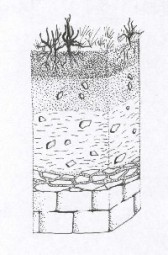
Layers of soil are also known as:
Soil Profiles
Soil Horizons
Soil sheets
Soil cores

Soil is made of
weathered rocks and minerals
dead plants and animals
air and water
all of the above
An organism, especially a soil bacterium, fungus, or invertebrate, that breaks down organic material is a...
Decomposer
Burrower
Humus source

What am I?
Decomposer
Burrower
Humus Source
Which are forms of erosion? (select all that apply)
Wind
Rain
Freeze Thaw Cycle
Photosynthesis
Glaciers play a major role in forming soils, what do glaciers do? (select all that apply)
Picks up soil, rocks, boulders and crushes them
Transports soil, rocks, and boulders
Eats soil
Causes soil to vanish into thin air
Alluvial soils are?
Deposited by water
Deposited by wind
Eats soil
Deposited by glaciers
If soil particles are suspended, what does that mean?
It means they are floating in the air
It means they are floating around in water and can be transported
They are deltas
Delaware River
Deltas are
Delaware River
The Nile River
Where the soil that was suspended in water is deposited at the end of the river
Where the soil suspended in water overflows
What is till as it relates to soil?
The mass of sediments deposited by the wind
The mass of sediments picked up and moved by a glacier
The boulders and rocks moved by the freeze thaw cycle
The sediments moved by a floodplain
What does it mean to be a moraine soil?
The sediments deposited by wind
The sediment accumulation of glacial till
The accumulation of sands to form dunes
The accumulation of Loess
Wind deposited soils are known as a/an?
Loess
Till
Alluvial
Aeolian
As wind erodes stone, the worn away particles create a soil known as…
Loess
Aeolian
Dunes
Alluvial
Large deposits of sand are known as...
Loess
Aeolian
Dunes
Alluvial
Volcanic soils come from minerals in the earth. What are the two sources of this mineral content?
Lava and Ash
Lava and Magma
Rock and Ash
Igneous Rock and Ash
Physical soil properties of soil are characterized as..
Alluvial, Aeolian, Texture
Texture, Structure, and pH
Texture, Structure, and Alluvial
Texture, Structure, and Consistency
Soil texture refers to…
Peds
Soil Particles surrounded by water
How soil particles cling together because of their individual shapes
Refers to the size of individual soil particles
Sand does…
Not hold water well
Not hold nutrients well
Hold water well
Both A and B
Silt does a good job at…
Holding onto water
Keeping nutrients suspended in the soil solution, making it fertile
Leaching nutrients out of the soil
Both A and B
Clay can hold what two things well, sometimes too well…
Hold water
Hold Nutrients
Both a and B
None of the above
The optimal mineral content of soil is…
40% Sand, 40% Clay, 20% Silt
40% Sand, 40% Silt, 20% Clay
10% Sand, 80% Silt, 10% Clay
Soil solution is…
Refers to the size of individual soil particles
Soil Particles surrounded by water
How soil particles cling together because of their individual shapes
Refers to the water around soil that suspends plant useable nutrients
Coarse soils are prone to what…
Having a good time
Leaching
Run-Off
Soil pH
Fine textured soils hold the soil solution longer for plants but sometimes too long… What can happen to their roots if water is held too long?
They can become happy
They can succumb to root rot
They can die from lack of Oxygen
Both B and C
What is soil pH?
The measurement of Hydrogen atoms in a soil
The measurement of Helium atoms in a soil
The measurement of soil atoms in a soil
The measurement of Nitrogen Atoms in a soil
Soil pH is more simply put as…
The logarithmic scale (1-14) of soil acidity and alkalinity of a soil
The amount of water in a soil
The type of soil solution in a soil
The measure of hydrogen peroxide in a soil
The pH range for soil is…
1-14
7 being neutral
Below 7 Acid and above 7 Base
All the above
What is soil structure?
The size of individual soil particles
How groups of soil particles cling together because of their individual shapes
How acidic or basic a soil is
Speed of water penetration
What are peds?
The logarithmic scale of soil
Are held together by clay and organic matter
The name for groups of soil particles
The name of soils deposited by glaciers
Soil peds are the same as soil aggregates
True
False
Peds are held together by sand
True
False
Peds are characterized by three factors; Type(Shape), Class (Size), and Grade (Strength)
True
False
Weak structure means that soil can be readily handled without breaking
True
False
There are 7 different main soil Horizons
True
False
The A horizon is made up of exclusively organic matter
True
False
The O horizon is also known as the topsoil
True
False
The B horizon is where materials have leached from the other horizons and is known as Subsoil
True
False
The C horizon is rocky and coarse and is derived from the bedrock/parent material directly under them
True
False
The R Horizon is the bedrock, upon which all layers of soil lay
True
False
Plants need soil to supply them with nutrients
True
False
What is the Rhizosphere?
The area of the soil that contains the roots of plants, water and nutrients are here.
The logarithmic scale of soil solution
The place where rhizobia live
The area of a soil where water cannot pass.
What types of organisms that live in the Rhizosphere?
Fungi
Bacteria
Protozoa
All the above
What is a symbiotic relationship?
It is where one organism feeds on another, making it weaker
Where to organisms benefit one another by existing together
Venom
Where an organism infects and kills another
Microorganisms help with…
Help with the decomposition of dead plants and other organisms.
The circle of life that causes all organic matter return to the soil
Humus
Killing Fungi
What is the carbon cycle?
Help with the decomposition of dead plants and other organisms.
The circle of life that causes all organic matter return to the soil
Humus
Killing Fungi
Soil is the basis of all life. This thin fragile layer that surrounds the earth provides humans and all other animals with food. Our huge Ag Science industry depends on fertile soils. We must constantly seek ways to preserve it.
TRUE!
true
false
Tralse

