wayground logo

Free Printable Worksheets

NEW

Font size

S
M
L
XL
Worksheets

Kingdoms and Dichotomous Keys

Total questions: 35

Worksheet time: 48mins
Name
Class
Date
1.
When using a dichotomous key to identify organisms, what do we look at?
a)
physical features
b)
weather patterns
c)
environment
d)
diet
2.
What step do we always start with when using dichotomous keys?
a)
1
b)
2
c)
3
d)
4
3.
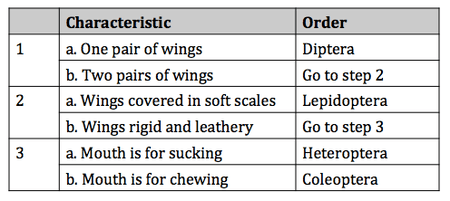
A dichotomous key for insects is given. To what order does an insect with two pairs of scaly wings belong?
a)
Coleoptera
b)
Heteroptera
c)
Diptera
d)
Lepidoptera
4.
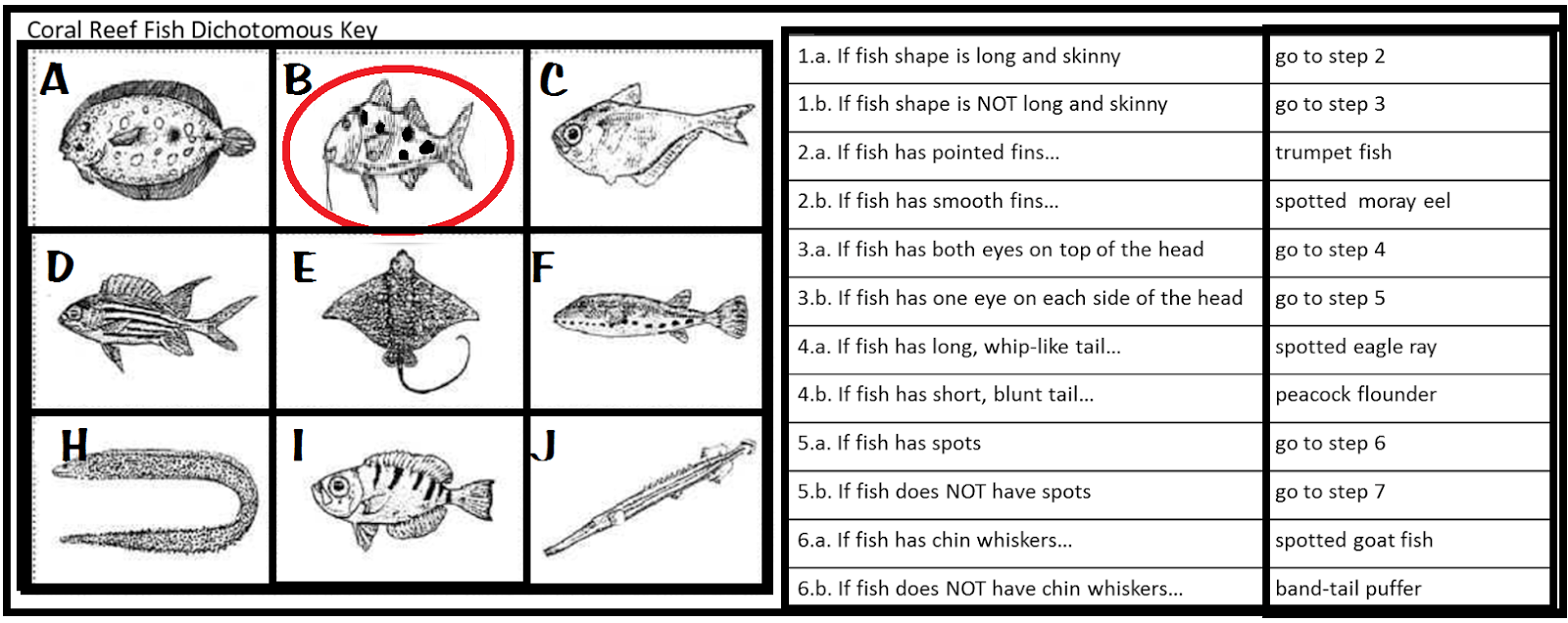
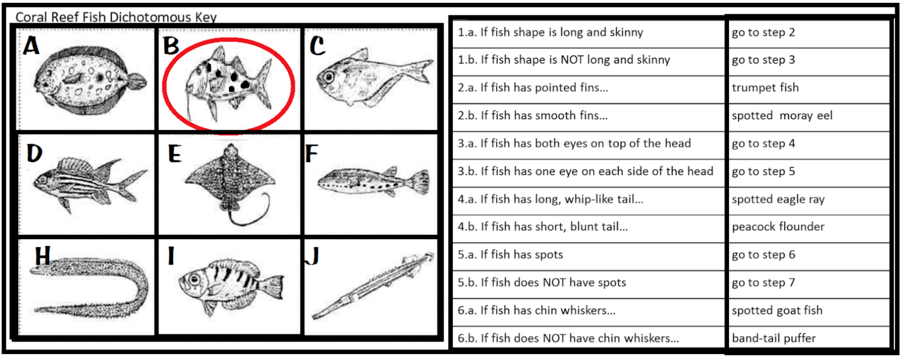
Using this dichotomous key, identity the name of the circled fish.
a)
band-tail puffer
b)
spotted goat fish
c)
peacock flounder
d)
trumpet fish
5.
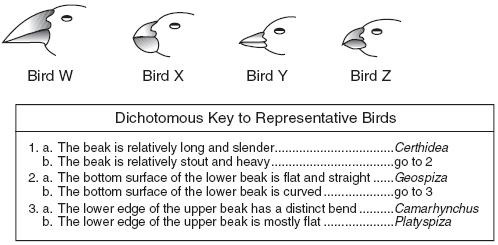
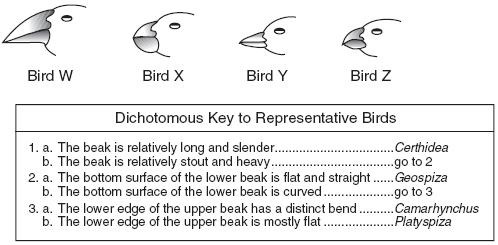
What is the name of bird W?
a)
Certhidea
b)
Geospiza
c)
Camarhynchus
d)
Platyspiza
6.
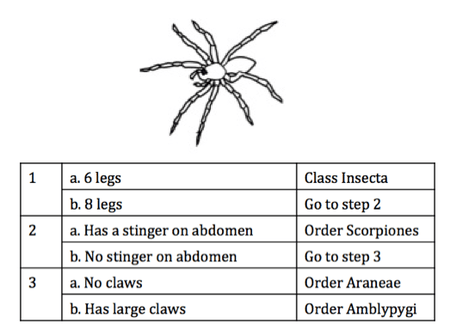
An illustration and a dichotomous key are given. What is the correct classification for this organism?
a)
Class Insecta
b)
Order Amblygygi
c)
Order Araneae
d)
Order Scorpiones
7.
A dichotomous key for trees is provided. Hikers found a tree that has large brown cones and single sharp needles. What species of tree have the hikers found?
a)
Juniper
b)
Pine
c)
Spruce
d)
Fir
8.
What is the name of bird Z?
a)
Certhidea
b)
Geospiza
c)
Camarhynchus
d)
Platyspiza
9.
A student discovers an arachnid with a segmented abdomen, long legs, and a tail with no stinger. The student uses the dichotomous key below to identify it. Which arachnid has the student found?
a)
Whip Scorpion
b)
Wind Scorpion
c)
Daddy long legs
d)
Scorpion
10.
Using this dichotomous key, identity the name of the circled fish.
a)
band-tail puffer
b)
spotted goat fish
c)
peacock flounder
d)
trumpet fish
11.
What is the purpose of a dichotomous key?
a)
to find a common ancestor
b)
to show the evolution of organisms
c)
to see what organisms eat
d)
to identify organisms
12.
Which of the following characteristics will most likely be helpful in identifying a butterfly using a dichotomous key?
a)
Migrates north every spring
b)
hangs on branches
c)
flutters wings fast on hot days
d)
Wings have long extensions
13.
A dichotomous key for insects is given. To what order does an insect with two pairs of scaly wings belong?
a)
Coleoptera
b)
Heteroptera
c)
Diptera
d)
Lepidoptera
14.
Tool used by a taxonomist to identify an unknown organism is a:
a)
dichotomous key
b)
binomial nmenclature
c)
scientific name
d)
binomial key
15.
A botanist discovers a new plant in the jungle. Which of the
following observations of the plant’s characteristics would be useful in determining its identity with a dichotomous key?
a)
It was discovered in the summertime
b)
It is wet from a recent rain storm.
c)
Its leaves curl up on the edges.
d)
It is eaten by native jungle ants.
16.

Leaf S

a)

Eastern white pine

b)

balsam poplar

c)

sweet gum

d)

ginko

17.

Which characteristics are used to identify the American Robin?

a)

Head color, Beak shape, and Beak Color

b)

Head color and Beak Color

c)

Beak Shape and Beak Color

d)

Beak Color

18.
If an organism is eukarytotic, unicellular, heterotrophic, and reproduces asexually, which kingdoms will it belong to?
a)
Plantae
b)
Animalia
c)
Fungi
d)
Protista
19.
Bacteria is what kind of cell?
a)
Eukaryotic
b)
Prokaryotic
20.
What kind of cell is this?
a)
Eukaryotic
b)
Prokaryotic
21.
What is unicellular? 
a)
one cell 
b)
many cells 
c)
no nuclues 
d)
DNA 
22.
What is multicellular? 
a)
one cell 
b)
no cells 
c)
many cells 
d)
no nucleus 
23.
Plants and animal cells are examples of ___ cells 
a)
prokaryotic cells 
b)
eukaryotic cells 
24.

This kingdom is characterized by ancient bacteria that can live in extreme environments, such as volcanoes.

a)

Archaeabacteria

b)

Euacteria

c)

Protista

d)

Fungi

25.

This kingdom contains decomposing heterotrophs.

a)

Fungi

b)

Animalia

c)

Protista

d)

Archaebacteria

26.
Organisms that are classified as autotrophic are able to-
a)
be seen with the human eye
b)
move
c)
reproduce
d)
make their own food
27.
Heterotrophs obtain energy from ______?
a)
light
b)
light and inorganic substaces
c)
other organisms
28.

which of the following kingdoms are prokaryotes

a)

Fungi & Protista

b)

Plantae & Animalia

c)

Protista & Eubacteria

d)

Archaebacteria & Eubacteria

29.
Multicellular, eukaryotic, autotrophs are...
a)
Plants
b)
Animals
c)
Bacteria
d)
Fungi
30.
If an organism is prokaryotic, unicellular, heterotrophic, reproduces asexually, and lives in a normal environment, which kingdom will it belong to?
a)
Eubacteria
b)
Fungi
c)
Archaea
d)
Protista
31.
If an organism is eukarytoic, multicellular, heterotrophic, and reproduces sexually, which kingdom will it belong to?
a)
Plantae
b)
Animalia
c)
Fungi
d)
Protista
32.

Which of the following is a multicellular organism?

a)
b)
c)
d)
33.

Which of the following is prokaryotic?

a)
b)
c)
d)
34.

Which kingdom contains twice as many species as Kingdom Protista?

a)

Protista

b)

Animalia

c)

Plantae

d)

Fungi

35.

Eukaryotic cells are different from prokaryotic cells because eukaryotic cells

a)

have a cell wall

b)

are smaller

c)

have a nucleus

d)

are all unicellular