wayground logo

Free Printable Worksheets

Font size

S
M
L
XL
Worksheets

Genetics Review

Total questions: 30

Worksheet time: 1hrs 25mins

Name
Class
Date
1.
------is the combination of two alleles that are different from one another.
a)
homozygous
b)
heterzygous
c)
phenotype
d)
trait
2.
The letters that make-up the genetic code for a trait
a)
genotype
b)
heterzygous
c)
phenotype
d)
trait
3.
---- Is the combination of two alleles that are the same
a)
genotype
b)
homozygous
c)
phenotype
d)
trait
4.
----is the type of gene that always shows itself when present
a)
genotype
b)
homozygous
c)
phenotype
d)
dominant
5.
The physical appearance of the allele combination the offspring receives
a)
genotype
b)
homozygous
c)
phenotype
d)
dominant
6.
Black fur (B) is dominant. Find the probability of a black offspring in a cross: bb x bb. 
a)
0%
b)
25%
c)
50%
d)
100%
7.
Look at the Punnett Square. What's the probability of having the recessive offspring?
a)
100%
b)
75%
c)
50%
d)
25%
8.
What are the parents' genotypes?
a)
Homozygous for brown eyes
b)
Heterozygous for brown eyes
c)
Homozygous for blue eyes
d)
Heterozygous for blue eyes
9.
What is the phenotype for the recessive trait?
a)
brown eyes
b)
green eyes
c)
blue eyes
10.
A type of gene that can be hidden is called
a)
genotype
b)
recessive
c)
dominant
d)
allele
11.
A section of the DNA strand that determines a specific trait
a)
gene
b)
trait
c)
chromosome
d)
allele
12.
If red flowers (R) are dominant over white, what is the probability that the offspring will be red? 
a)
1 out of 4
b)
2 out of 4
c)
3 out of 4
d)
4 out of 4
13.
What is NOT a possible offspring genotype? 
a)
BB
b)
Bb
c)
bb
14.
Round seeds (R) are dominant to wrinkled seeds (r). What is the genotype for a wrinkled offspring?
a)
RR
b)
Rr
c)
rr
15.

What is the missing genotype?

a)

BB

b)

Bb

c)

bb

16.

What percentage of the offspring will have brown eyes?

a)

25%

b)

50%

c)

75%

d)

100%

17.

The device used to predict genetic outcomes.

a)

Geneticist

b)

Fate

c)

Punnett Square

d)

Pedigree

18.

When a single-celled organism splits into 2 new organisms it is called _________________.

a)

fragmentation

b)

fission

c)

budding

d)

sporulation

19.

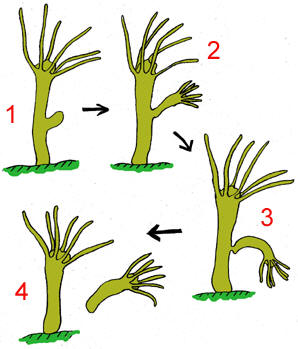
When an offspring grows off from the body of a parent organism it is called __________________.

a)

budding

b)

fission

c)

fragmentation

d)

sporulation

20.

Some advantages of sexual reproduction include: (select all that apply)

a)

genetic variation

b)

improves chances of adapting to the environment

c)

helps species survive catastrophes

d)

it doesn't take as much energy as asexual reproduction

21.

What are some disadvantages to sexual reproduction? (select all that apply)

a)

it takes a lot of energy to find a mate

b)

you don't need another mate

c)

it requires a male and a female

d)

more genetic errors can occur

22.

What are some advantages of asexual reproduction are: (select all that apply)

a)

it only requires one organism

b)

it takes less energy than sexual reproduction

c)

offspring are already well-adapted for the environment

d)

there is a lot of genetic variety

23.

Male and female reproductive cells are collectively known as:

a)

spores

b)

pollen

c)

gametes

d)

offspring

24.

How many parents are required for sexual reproduction?

a)

0

b)

1

c)

2

d)

3

25.

If a sex cell has 10 chromosomes, how many chromosomes will there be after fertilization?

a)

5

b)

10

c)

15

d)

20

26.

Which of the following is not a benefit of asexual reproduction?

a)

Offspring will be successful in an unchanged environment.

b)

Good at adapting to changing environments.

c)

Only requires one parent to produce offspring.

d)

Can reproduce rapidly.

27.

An organism that has been reproduced by asexual means receives ______________ of its chromosomes from its one parent.

a)

3

b)

25%

c)

50%

d)

100%

28.

In asexual reproduction, all of the offspring are:

a)

Physically Identical

b)

Genetically Identical

c)

Physically and Genetically Identical

d)

Not Identical

29.
TT,tt,PP,pp,SS,ss are examples of alleles that are?
a)
homozygous
b)
heterozygous
c)
different
d)
homologous 
30.
"The Great White Shark was 20 feet in length.  Phenotype or Genotype?
a)
phenotype
b)
genotype