Worksheets
Do you remember class 8 ?
Total questions: 29
Worksheet time: 15mins

What is the SI unit of length?
km (Kilometres)
hm (Hectometres)
cm (Centimetres)
m (Metres)

What is the SI unit of mass?
kg (Kilogram)
hg (Hectogram)
g (Gram)
cg (Centigram)

What is the SI unit of time?
yr (Year)
s (Second)
h (Hour)
min (Minute)

The diagram shows part of a ruler being used to find the length of a nail. What is the length of the nail?
*Give your answer in SI units.
2.7 cm
0.027 m
3.7 cm
0.037 m
What is the correct equation used to calculate the speed of an object?
v = d / t
v = d . t
v = t / d
v = d / t2
What is the SI unit of speed?
km / h
m / s2
m / s
km / s

A car travels 100 km. The journey takes two hours. The highest speed of the car is 80 km/h and the lowest speed is 40 km/h.
What is the average speed for the journey?
40 km/h
50 km/h
60 km/h
120 km/h
What is the correct equation used to calculate the acceleration of an object?
a = d / t2
a = t / (v - u)
a = (v - u) / t
a = (v - u) . t
What is the SI unit of acceleration?
m / s
m / s2
m2 / s
km / s2
A car takes 8 s to increase its speed from 10 m/s to 30 m/s.
What is the acceleration?
2.5 m/s
3.75 m/s2
1.25 m/s
2.5 m/s2
What is the SI unit of force?
J (Joule)
N (Newton)
N/kg (Newton per kilogram)
K (Kelvin)
What is the SI of Work?
J (Joule)
N (Newton)
K (Kelvin)
W (Watt)
What is the equation used to calculate Work?
W = m . v
W = F . d
W = F / d
W = m . v2

How much work is done is a force of 12 N moves an object a distance of 5 m?
30 J
2.4 J
60 J
12 J
What is the SI unit of Energy?
J (Joule)
N (Newton)
K (Kelvin)
W (Watt)
What is the equation used to calculate Kinetic Energy?
K = m . v2
K = m . v
K = 1/2 . m . v2
K = 1/2 . (m . v)2
What is the equation used to calculate Gravitational Potential Energy?
Ug = m . g . h
Ug = m . g
Ug = 1/2 . k . x2
Ug = m . v2
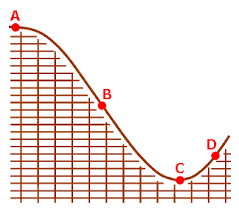
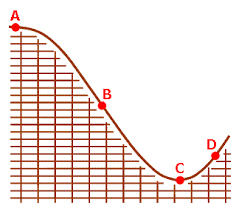
At which point(s) on the roller coaster is the gravitational potential energy at its maximum?
A
B
C
D
What is stated by the Law of Conservation of Energy?
Energy cannot be created or destroyed, but it can change from one form to another.
The energy of a system will increase over tiime.
The energy of a system will decrease over time.
Energy is only conserved in the absence of friction.

What type of wave is this?
Transverse
Longitudinal

What type of wave is this?
Transverse
Longitudinal
What is the SI unit of frequency?
s (second)
Hz (Hertz)
W (Watt)
m (metre)

What part of the wave is the arrow pointing to?
Crest
Trough
Amplitude
Wavelength

What part of the wave is the arrow pointing to?
Crest
Trough
Amplitude
Wavelength