
 Worksheets
Review: Ocean Currents
Total questions: 20
Worksheet time: 11mins
Name
Class
Date
1.
Where is ocean water the densest.
a)
The surface
b)
The middle
c)
The bottom
2.
Warm ocean currents generally come from
a)
The North Pole
b)
The South Pole
c)
The Equator
d)
Both A and B
3.
What happens to a current when it comes in contact with a continent or landmass?
a)
It continues over the continent
b)
It stops
c)
It changes direction
d)
It is absorbed by the land
4.
Cold ocean currents generally come from
a)
The North Pole
b)
The South Pole
c)
The Equator
d)
Both A and B
5.
Constantly moving system of deep-ocean circulation driven by temperature and salinity. It moves water around the globe.
a)
California Current
b)
Global Conveyor Belt
c)
Surface Currents
d)
Gulf Stream
6.
When surface currents meet continents they ___?
a)
Stop moving
b)
Are deflected (change paths)
c)
Continue in the direction they were going
7.

Ocean currents bring warm water from the equator towards Earth's
a)
Southern Hemisphere
b)
Continents
c)
Equator
d)
Poles
8.
What heats the Earth's oceans?
a)
People
b)
Boats
c)
a heater
d)
sun
9.

A large volume of water flowing from one place to another?
a)
global winds
b)
coriolis effect
c)
ocean current
d)
tradewinds
10.

Why does heat rise in a convection current?
a)
less dense
b)
more dense
c)
more humid
d)
less humid
11.

Why does cold water sink in a convection current?
a)
Less dense
b)
more dense
c)
Less humid
d)
More humid
12.
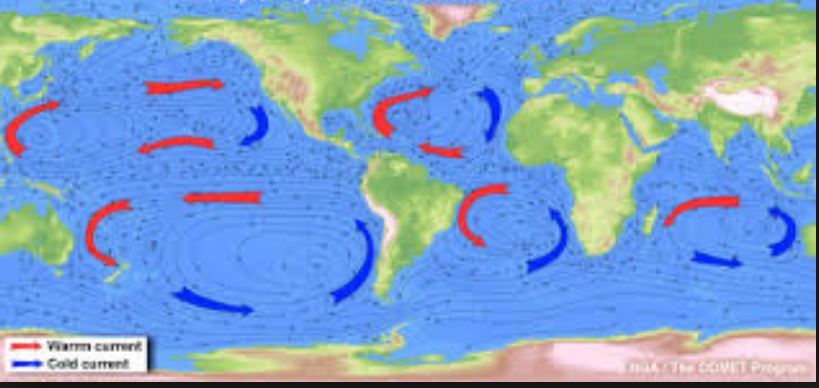
Analyze the image. What could explain why certain parts of the ocean have warmer temperatures?
a)
the uneven heating of the Earth's surface
b)
the rising of cold air and the sinking of warm air
c)
hurricanes
13.
Analyze the image. The red arrows represent warm water rising and the blue arrows represent cold water sinking. What type of heat transfer is responsible for this movement?
a)
conduction
b)
convection
c)
radiation
14.
Which of the following is correct?
a)
warmer ocean currents = warmer climate
b)
cooler ocean currents = warmer climate
c)
warmer ocean currents = cooler climate
15.

The amount of matter in a given volume
a)
climate
b)
convection
c)
salinity
d)
density
e)
temperature
16.

Based on the illustration, which of the following statements describes the relationship between density and temperature?
a)
Cold water is denser than warm water
b)
Warm water is denser than cold water
c)
Warm and cold water equal densities
d)
The density of water is not affected by temperature
17.
What 3 factors most directly affect surface currents in the ocean?
a)
Dissolved solids, gases & energy
b)
Upwelling, convection & sun's energy
c)
Deep currents, convection currents & surface wind
d)
Surface wind, Coriolis effect & continental deflection
18.
Areas near the equator get the least amount of energy from the sun.
a)
True
b)
False
19.
Cold water
a)
sinks.
b)
rises.
c)
mixes together with surrounding warm water.
d)
remains still.
20.
Warm water
a)
sinks.
b)
rises.
c)
mixes together with surrounding cold water.
d)
remains still.
100 %

