wayground logo

Free Printable Worksheets

Font size

S
M
L
XL
Worksheets

homeostasis feedback loops

Total questions: 35

Worksheet time: 37mins

Name
Class
Date
1.

What is the point of a feedback loop?

a)

To provide the body with more energy

b)

To provide the body with more food

c)

To make sure the conditions in the body are always changing

d)

To make sure the conditions in the body remain stable

2.

A feedback loop best fits which characteristic of life?

a)

Cells

b)

Organization

c)

Homeostasis

d)

Adaptation

3.

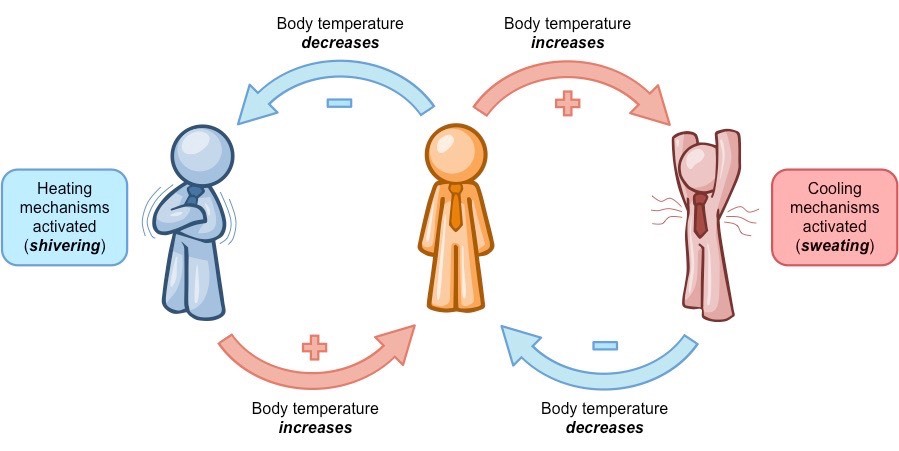
In this body temperature feedback loop, predict what would happen if cooling mechanisms were NOT activated?

a)

The body would not warm up.

b)

The body would not cool down.

c)

Your body would get colder and colder.

d)

Your body would release lots of heat.

4.

According to the feedback loop, what does high blood sugar promote?

a)

Insulin Release

b)

Glucagon Release

c)

Insulin Uptake

d)

Glycogen Uptake

5.

What is the difference between what will happen if their is too much Glucose or too little Glucose? SELECT ALL THAT APPLY

a)

With too much Glucose, Insulin is released. With too little Glucose, Glucagon is released.

b)

With too much Glucose, the pancreas produces insulin. With too little Glucose, the pancreas produces glucagon.

c)

With too much Glucose, Glucagon is released. With too little Glucose, Insulin is released.

d)

There is no difference.

6.
Failure to maintain homeostasis could result in:
a)
lack of internal balance
b)
eventual death
c)
difficulty carrying on metabolism 
d)
all three
7.
The two types of feedback systems that help organisms maintain homeostasis are:
a)
positive and negative 
b)
receptor and effector
c)
static and dynamic
d)
minor and major
8.
Maintaining body temperature is an example of a:
a)
negative feedback loop
b)
positive feedback loop
9.
Humans have ___ for body temperature, blood glucose concentrations, electrolyte concentrations, pH levels, tendon tension and variables.
a)
positive feedback mechanisms
b)
set points
c)
a wide internal range
d)
no regulation
10.
The "cause" for something to happen is the
a)
response
b)
effect
c)
stimulus
d)
homeostasis
11.
The "effect" of a given stimulus is the...
a)
response
b)
stimulus
c)
cause
d)
result
12.
When you get cut, your skin cells release hormones that signal platelets to come and stop the bleeding. Platelets then release more hormones that signal even more platelets to help stop bleeding. The hormone signals continue until the cut is closed.
a)
Positive Feedback Response
b)
Negative Feedback Loop 
13.
When glucose levels in the blood rise, your brain sends a signal to your pancreas. The pancreas releases insulin, which opens channels in cell membranes to allow glucose to enter the cell, lowering blood sugar levels. 
a)
Positive Feedback Response
b)
Negative Feedback Loop 
14.
If the calcium in your blood decreases below homeostasis levels, a gland in the brain will sense the decrease and send a chemical message to your bones. Your bones will release calcium into the blood, bringing blood calcium levels back up.
a)
Positive Feedback Response
b)
Negative Feedback Loop 
15.
As you get dehydrated, your blood becomes thicker and harder to pump. Your kidneys will respond by stopping urine production, sending the water from urine into your bloodstream to thin your blood back to normal level.
a)
Positive Feedback Response
b)
Negative Feedback Loop 
16.
Negative Feedback Loops:
a)
amplify processes
b)
prevent small changes from getting larger
c)
are initiated during childbirth
d)
are found only in plants
17.
What does the term "steady state" refer to with respect to the process of homeostasis?
a)
balanced external environment
b)
balanced internal environment
c)
changing external environment
d)
changing internal environment
18.
What is another word that can be used to describe "homeostasis"?
a)
STABLE
b)
EQUAL
c)
COMPLETE
d)
CORRECT
19.

What is the point of a feedback loop?

a)

To provide the body with more energy

b)

To provide the body with more food

c)

To make sure the conditions in the body are always changing

d)

To make sure the conditions in the body remain stable

20.

If the environment gets cold, we will often shiver in order to:

a)

keep body temperature the same as the external temperature

b)

decrease body temperature

c)

increase body temperature

d)

regulate blood pressure

21.
Feedback loops are important because they allow organisms and the environment to
a)
change based on new inputs
b)
fall apart
c)
change based on new outputs
d)
maintain balance
22.
The maintenance of an organism’s internal environment is called:
a)
compensating
b)
homeostasis
c)
balancing
d)
routine
23.
What does insulin do for your body?
a)
it helps to transport sugar from your blood to other body cells
b)
it acts as a receptor and tells the body when it is full
c)
it is a hormone released to induce sleep
24.
Hormone that causes blood sugar to be raised
a)
Glucagon
b)
Glycogen
c)
Insulin
d)
Glucose
25.
What happens in the liver when the bloodstream has lower than usual glucose levels
a)
Glucose is converted to glycogen
b)
Glycogen is converted to glucose
c)
The liver keeps storing glycogen
26.

The ultimate cause of death

a)

Over Heating

b)

Diabetes

c)

Bad Hair

d)

Loss of Homeostasis

27.
If the environment gets cold, we will often shiver in order to:
a)
keep body temperature the same as the external temperature
b)
decrease body temperature
c)
increase body temperature
d)
regulate blood pressure
28.
The tendency of an organism to maintain a balanced state in order to stay healthy.
a)
Stimuli
b)
Response
c)
Tropism
d)
Homestasis
29.

Which body system controls the body to maintain homeostasis?

a)

excretory

b)

nervous

c)

circulatory

d)

skeletal

30.

What is the cause of insulin being released?

a)

a drop (decrease) in blood sugar

b)

REM sleep

c)

a rise (increase) in blood sugar

d)

heavy exercise

31.

On a hot day, which of these is an outward sign that thermoregulation is taking place?

a)

Sunburn

b)

Sweating

c)

Dry Mouth

d)

Slow Breathing

32.

Why is maintaining glucose concentrations important?

a)

Helps build stomach acid

b)

Supplies energy needed for cells to survive and grow

c)

Needed to regulate insulin

d)

Gives oxygen to muscle cells

33.

Homeostatic Mechanisms

a)

keep living systems at a static point

b)

help to keep a relatively constant internal environment in organisms

c)

usually operate by positive feedback

d)

allow organisms to operate under extreme conditions

34.

Thermoregulation happens when organisms regulate

a)

temperature

b)

blood glucose

c)

oxygen and carbon dioxide

d)

water and solutes

35.

Gas exchange occurs to regulate

a)

temperature

b)

blood glucose

c)

oxygen and carbon dioxide

d)

water and solutes