wayground logo

Free Printable Worksheets

NEW

Font size

S
M
L
XL
Worksheets

The Great Depression

Total questions: 50

Worksheet time: 50mins

Name
Class
Date
1.
Which was NOT a LONG-TERM cause of the Great Depression?
a)
Buying stock on margin
b)
Stock market crash (Black Tuesday)
c)
too much production and consumer spending
d)
Laisezz-faire economic policies
2.
The Great Depression began in
a)
1925
b)
1929
c)
1932
d)
1940
3.
In the 1930's, people would line up at ____________ to get food.  These were normally run by charities.
a)
churches
b)
businesses
c)
soup kitchens
d)
work
4.
Who was president at the time of the Stock Market Crash of 1929?
a)
Abraham Lincoln
b)
Franklin D. Roosevelt
c)
Theodore Roosevelt
d)
Herbert Hoover
5.
After the Stock Market Crash, many people lost their life savings because _______________.
a)
banks closed
b)
banks gave away their money
c)
they couldn't remember where they put it
d)
someone stole it
6.
Which economic factor contributed most directly to the start of the Great Depression?
a)
low worker productivity
b)
high income taxes
c)
decreasing tariff rates
d)
buying stocks on margin
7.
What tool - passed during the Hoover Administration -  designed to protect American manufacturers actually ended up creating a worldwide depression?
a)
Reconstruction Finance Committee
b)
Hawley-Smoot Tariff
c)
New Deal
d)
Second New Deal
8.

How did the Stock Market Crash lead to the beginning of the Great Depression?

a)

16 million stocks were shared in a single day that led to the loss of billions of dollars

b)

banks closed their doors to try to prevent a run on banks

c)

prices for goods increased so much that people couldn't buy basic items

d)

Herbert Hoover blamed the Stock Market Crash for the Great Depression

9.

Which of the following people created government agencies and social programs that led to the end of the Great Depression?

a)

Henry Ford

b)

Herbert Hoover

c)

Franklin D Roosevelt

d)

Theodore Roosevelt

10.

What was the name of the program created by President FDR?

a)

The Answer

b)

The Solution

c)

The New Deal

d)

The Right Deal

11.

Which of the following would NOT be a characteristic of the Great Depression?

a)

High Unemployment

b)

Low levels of production

c)

increasing income

d)

lack of confidence in banks

12.

Which of the following was a main feature of the New Deal?

a)

preparing for war

b)

regulating trade

c)

providing jobs

d)

desegregation

13.

This person was blamed for not helping struggling Americans during the beginning of the Depression.

a)

Franklin D Roosevelt

b)

Harry Truman

c)

Calvin Coolidge

d)

Herbert Hoover

14.

Which event occurred on Black Tuesday?

a)

many factories closed

b)

many banks closed

c)

many people lost their homes

d)

the stock market crashed

15.

What was the "New Deal" of the 1930s?

a)

a government program that gave free land to homesteaders

b)

a government program that helped women get the vote

c)

a government program that spread civil rights throughout the country

d)

a government program designed to help people during the depression

16.
President Franklin Roosevelt asked Congress to pass a series of acts called the New Deal. Which is one way the New Deal helped people during the Great Depression?
a)
It gave all people the right to vote. 
b)
It created programs to put people back to work.    
c)
It let all new immigrants become American citizens. 
d)
It let people travel around the country freely. 
17.

The Great Depression was an economic slowdown in the 1920s and 1930s. Which of the following was one cause of the Great Depression in the United States?

a)

the end of the gold rush

b)

the crash of the stock market

c)

the ending of World War II

d)

the high price of oil

18.
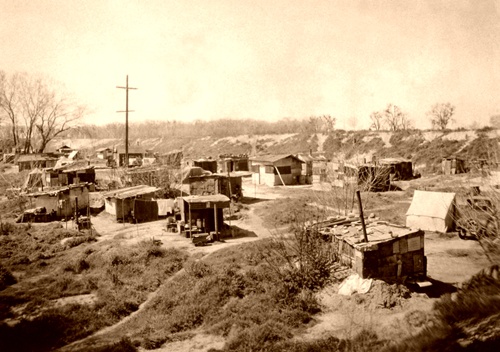
What was the main reason for the emergence of “Hoovervilles” like the one shown in the photograph?
a)
Many Americans had lost jobs during the Great Depression.
b)
Thousands of homes had been destroyed by the effects of the Dust Bowl.
c)
Housing projects could not keep up with the demand for homes needed by the poor.
d)
Preparations for World War I had created a shortage of building materials.
19.
A drought in the Great Plains that affected farmers greatly.
a)
Drought
b)
Dust Bowl
c)
Angel's Grave
d)
Texas Cattle Storm
20.

Which event eventually ended the Great Depression?

a)

The New Deal

b)

Creation of the TVA

c)

World War 2

d)

The publication of Gone With the Wind

21.
Buying on margin means:
a)
buying stocks at a fraction of their price, with the promise of paying the rest later
b)
planning out your budget to make sure you have enough to get by
c)
Buying a few stocks from many companies to ensure profit
d)
Pouring all of your money into one stock in order to ensure profit
22.
The purpose of the New Deal program was to...
a)
improve working conditions in factories
b)
stop the sale of alcohol in states
c)
end discrimination against African Americans
d)
help the nation recover from the Depression
23.
Which of the following was "NOT" a cause of the Great Depression?
a)
Over speculation on stocks using borrowed money
b)
High tariffs discouraged international trade
c)
Unpaid debts from fighting World War I
d)
Too much debt from buying goods on installment plans
24.
How did the Great Depression affect workers?
a)
One-half of workers were unemployed
b)
Workers’ incomes rose to high levels
c)
One-fourth of workers were without jobs
d)
Workers were able to afford luxury items
25.

Large numbers of banks and businesses failed• Large numbers of people were homeless and hungry• Farmers’ incomes fell to low levels

What was the cause of these?

a)

The New Deal

b)

Great Depression

c)

Great Migration

d)

The Dust Bowl

26.
How did "bank runs" impact the American people during the Great Depression?
a)
Banks eventually ran out of money to loan, and people's life savings were gone.
b)
Banks made loans throughout the Great Depression, helping people pays bills until they could find work.
c)
Banks were able to people's deposits safe, but they could not loan out any more money.
d)
Banks were not at all involved in the Great Depression because people did not use them.
27.
Which of these statements is true of the 1932 presidential election?
a)
Franklin Roosevelt won in a landslide.
b)
Hoover lost by a narrow margin.
c)
Huey Long ran a strong third-party campaign.
d)
Roosevelt won a third term.
28.
A major difference between the philosophies of President Herbert Hoover and President Franklin D. Roosevelt in responding to the Great Depression is that Roosevelt
a)
wanted to rely on private charities to provide assistance
b)
stressed the need for individual rugged individualism
c)
supported direct relief to people out of work
d)
thought the government should not be involved in economic reform
29.
FDR addressed the American public in weekly broadcasts known as:
a)
FDR Hour
b)
Hangin' With Franklin
c)
Fireside Chats
d)
Around the Fire
30.
What was a guiding principle of the New Deal economic policies?
a)
Pro-business tax breaks would solve the problems associated with urban poverty.
b)
Antitrust legislation would destroy the free market economy of the United States.
c)
Rugged individualism must be allowed to solve social inequality.
d)
Government must assume more responsibility for helping the poor.
31.
The Civilian Conservation Corps (CCC) and the Works Progress Administration (WPA) were both New Deal programs developed to address the problem of
a)
excessive stock market speculation
b)
high unemployment
c)
increased use of credit
d)
limited income of senior citizens
32.
A major reason that President Franklin D. Roosevelt proposed adding Justices to the Supreme Court in 1937 was to
a)
make the Court processes more democratic
b)
end corruption and favoritism in handling cases
c)
influence Court decisions related to New Deal programs
d)
ensure the appointment of members of minority groups
33.
Passage of the Social Security Act (1935) helped American workers by 
a)
creating jobs for the unemployed
b)
guaranteeing a minimum wage
c)
legalizing the right to join labor unions
d)
providing financial assistance after retirement
34.
A major result of the New Deal was that it
a)
eliminated poverty in the US
b)
extended the merit system in the civil service
c)
destroyed the private enterprise system
d)
greatly increased the size and power of the Federal Government
35.
What was FDR’s plan to add justices to the Supreme Court called?
a)
The Yes Man Trials
b)
Court Packing Scheme
c)
Operation Puppet
d)
Court Repatriation
36.

The creator of this political cartoon was expressing his concerns about -

a)

the Senate confirmation hearings of Supreme Court nominee Clarence Thomas

b)

the US declaration of war on Japan after the bombing of Pearl Harbor

c)

the expansion of executive power during the Great Depression

d)

the involvement of US government officials in the Iran-Contra scandal

37.

Which New Deal program was created to protect peoples deposits in banks?

a)

WPA

b)

CCC

c)

SSA

d)

FDIC

38.

Shantytowns were often called “Hoovervilles”. Why?

a)

many people blamed President Hoover for the Great Depression

b)

many people loved President Hoover so they named their neighborhoods for him

c)

President Hoover built small Shantytowns to help the homeless during the Great Depression

d)

people lived in a city called Hoover

39.

Why were more people able to own automobiles, radios, washing machines, and other goods in the 1920s?

a)

because of advertising

b)

because of lower taxes on imports

c)

because of installment buying

d)

because the trucking industry grew

40.
a type of credit in which a small down payment is followed by monthly payments
a)
bull market
b)
buying on margin
c)
installment buying
d)
consumer revolution
41.
a form of credit often used to purchase stock in the 1920s
a)
bull market
b)
buying on margin
c)
installment buying
d)
consumer revolution
42.
Which of the following statements best describes what happened on Black Tuesday?
a)
Stock prices fell and the stock market crashed.
b)
Bank runs forced many banks to close their doors.
c)
Federal troops attacked the Bonus Army marchers.
d)
The Supreme Court ruled that the NRA was unconstitutional.
43.
This is the process of taking money borrowed from the bank or a broker, and putting it into the stock market
a)
Buying on Margin 
b)
Speculation 
c)
Buying on Credit 
d)
Overconsumption 
44.
Legislation that provided for old-age pensions for workers, unemployment insurance, and other welfare programs
a)
Federal Securities Act
b)
Social Security Act
c)
Wagner Act
d)
Federal Pension Act
45.
When Roosevelt took office, what was the unemployment rate?
a)
25%
b)
50%
c)
75%
d)
100%
46.

These were a series of radio addresses given by President Roosevelt

a)

Hooverville

b)

GNP

c)

Fireside chats

d)

Black Tuesday

47.
Which of these New Deal programs was designed to provide pensions (retirement funds) for citizens?
a)
Social Security
b)
Federal Securities Exchange
c)
Agricultrual Application Commission
d)
Federal Deposit Insurance Corporation
48.
Which of the following is the most valid statement regarding the long-term economic effects of  the Great Depression? 
a)
The government placed fewer restrictions on large corporations
b)
The role of the federal government was expanded
c)
The government reduced its dependence on foreign trade
d)
The American people had greater confidence in the nation’s economic leadership
49.

How did the Great Depression impact employment?

a)

The number of people employed stayed consistent.

b)

The number of people employed increased sharply.

c)

The percentage of people unemployed increased sharply.

d)

The percentage of people in the military decreased steadily.

50.

How did high U.S. tariffs on imports likely contribute to the Great Depression?

a)

Other nations raised tariffs that cut U.S. exports.

b)

The United States experienced a rapid rise in inflation.

c)

Other nations boycotted U.S. goods because of high prices.

d)

The United States experienced a moderate rise in employment.