

Wayground logo

Free Printable Worksheets

Font size

S
M
L
XL
Worksheets

4th six weeks common assessment

Total questions: 50

Worksheet time: 1hrs 14mins

Name
Class
Date
1.
During cellular respiration, what do animal cells use to produce energy from food?
a)
sunlight
b)
meat
c)
water
d)
oxygen
2.
During photosynthesis, what gas do plants release?
a)
oxygen
b)
carbon dioxide
c)
water
d)
nitrogen
3.
Gas exchange through the stems or leaves of a plant takes place through the.....
a)
stomata
b)
chloroplasts
c)
roots
d)
underside of the leaves
4.
Photosynthesis is important because....
a)
plants need air to breathe
b)
it makes the plants green
c)
it is the process by which plants make their own food
d)
without it the Earth would all be a desert
5.
What is the function of the vascular tissue in the plant?
a)
it protects the plant from water loss
b)
it conducts the water and other materials throughout the plant
c)
it opens and closes the stomata
d)
it allows carbon dioxide to enter the leaf and allow oxygen and water to exit.
6.
What part of the plant if responsible for opening and closing the stoma?
a)
cuticle
b)
vascular tissue
c)
guard cell
d)
stoma
7.
What are the reactants (what's needed) for photosynthesis?
a)
glucose and oxygen
b)
light, water, and carbon dioxide
8.
What gas is released by plants during photosynthesis?
a)
sulfur
b)
carbon dioxide
c)
oxygen
d)
hydrogen
9.
What is the purpose of photosynthesis?
a)
make glucose
b)
make ATP
c)
make light
d)
release carbon dioxide
10.
What are the products (what's made) during photosynthesis?
a)
glucose and oxygen
b)
water, light, and carbon dioxide
11.
In which way are photosynthesis and cellular respiration different?
a)
Cellular respiration stores ATP, while photosynthesis releases ATP.
b)
Cellular respiration produces oxygen, while photosynthesis uses oxygen.
c)
Photosynthesis releases energy, while cellular respiration stores energy.
d)
Photosynthesis used carbon dioxide, while cellular respiration produces carbon dioxide.
12.
What is the correct equation for cellular respiration?
a)
6O2 + C6H12O6 -> 6CO2 + 6H2O + Energy
b)
6O2 + C6H12O6 + Energy -> 6CO2 + 6H2O
c)
6CO2 + 6H2O -> 6O2 + C6H12O6 + Energy
d)
6CO2 + 6H2O + Energy -> 6O2 + C6H12O6
13.
The two main stages of photosynthesis are the
a)
light reactions and respiration
b)
dark reactions and the Calvin cycle 
c)
light reactions and the Calvin cycle
d)
dark reactions and fermentation
14.
Which organelle performs PHOTOSYNTHESIS?
a)
Chloroplast
b)
Mitochondria
c)
ribosomes
d)
vacuoles
15.
Which of the following processes is responsible for the bending of the stem of a plant toward a light source?
a)
The amount of chlorophyll produced on the side facing the light increases
b)
The rate of cell division on the side facing the light increases
c)
The rate of cell division on the side away from the light increases
d)
The cells on the side of the stem away from the light elongate
16.
Which of the following mechanisms is most important in the movement of water from root to leaves in the xylem?
a)
gravity
b)
root pressure
c)
transpiration
d)
osmosis
17.
How does the sperm of flowering plants reach the egg?
a)
Via a pollen tube that grows from the pollen grain through the carpel tissues to the egg
b)
Via raindrops of a dew film that allows the sperm to swim from the male plant to the female plant
c)
Usually via an insect, which places sperm in the ovary while probing for nectar
d)
By actively swimming down though the style to the egg
18.

Root hairs help the plant to --

a)

make more sugar

b)

store more chlorophyll

c)

absorb more water

19.

All of the following describes the function of roots EXCEPT

a)

absorb water from the soil

b)

absorb sugar from the soil

c)

absorb minerals from the soil

d)

absorb nutrients from the soil

20.

Stomata are microscopic openings located on the underside of the leaf. One function of stomata is to -

a)

absorb water for the plant

b)

aid in the reproduction of the plant

c)

store glucose for photosynthesis

d)

allow gases to diffuse in and out of the plant

21.

Reproduction occurs in the flowers of

a)

angiosperms

b)

bryophytes

c)

mosses

d)

gymnosperms

22.

The function of the leaves is to

a)

perform photosynthesis to produce sugar

b)

absorb and store water

c)

aid in the reproduction of the plant

23.

Auxin is a hormone that helps plants perform phototropism. The function of auxin is to

a)

cause the sunny side of the plant to grow so that the plant gets taller

b)

cause the shady side of the plant to shrink so that the sunny side can reach the light

c)

cause the sunny side of the plant to collapse to make the sun visible

d)

cause the shady side of the plant to grow so that the plant bends towards the light

24.

The xylem is responsible for transporting substances from the roots to the shoots. All of the following substance are transported by the xylem EXCEPT -

a)

glucose

b)

water

c)

minerals

25.

Plants must grow toward necessary resources such as light, as well as water and minerals found deep within the soil. The processes that allow plants to respond to these stimuli are known as

a)

mechanisms

b)

simulations

c)

tropisms

26.

Which of the following is NOT a true statement regarding stomata?

a)

They close to allow photosynthesis to take place.

b)

They close during dry periods to limit water loss.

c)

They open to allow water to exit the plant via transpiration.

d)

They open to allow gasses to diffuse in and out of the leaf.
27.
Which plant parts are the tubes that carry water throughout the plant?
a)
xylem
b)
phloem
c)
roots
d)
leaves
28.
Which plant parts carry sugars and other nutrients throughout the plant?
a)
phloem
b)
xylem
c)
roots
d)
leaves
29.
What is the name of the organelle in the leaves of plants that absorbs the Sun's energy?
a)
roots
b)
chlorophyll
c)
chloroplast
d)
stomata
30.
The two structures that limit transpiration  are known as
a)
Guard cells and xylem
b)
Stomata and guard cells
c)
xylem and phloem
d)
stomata and phloem
31.
What is the region of rapid cell division in plants?
a)
Guard
b)
Stomata
c)
Xylem
d)
Meristem
32.
Roots perform all of the following functions EXCEPT
a)
Carrying out the light reactions of photosynthesis
b)
Anchoring the plant in the soil
c)
Absorbing water and nutrients from the soil
d)
Storing water and minerals
33.
The plant tissue that carries food materials DOWNWARD from the leaves to the rest of the pant is the ______.
a)
Phloem
b)
Stomata
c)
Chlorophyll
d)
Xylem
34.
Vascular tissue that transports water and minerals UPWARDS from a plant's roots is know as ______.
a)
Chlorophyll
b)
Phloem
c)
Stomata
d)
Xylem
35.
Plant absorbs water through the _________. 
a)
stem
b)
roots 
c)
leaves 
d)
all of the above
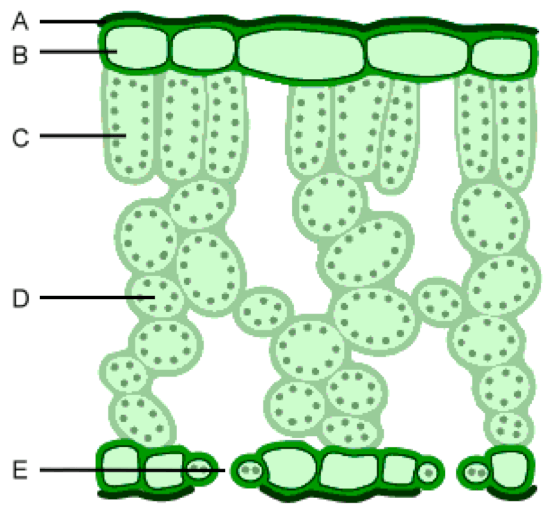
36.
What is E pointing to?
a)
waxy cuticle
b)
stomata
c)
upper epidermis
d)
cuticle
37.
Heterotrophs
a)
Are all prokaryotic
b)
Can make their own food
c)
Cannot make their own food
d)
Are producers
38.
Organsisms maintain a balance between their cells and the external environment through the process of ----
a)
growth
b)
pH
c)
cellular respiration
d)
homeostasis
39.
Which is not a type of tissue in plants?
a)
Dermal
b)
Connective
c)
Vascular
d)
Ground
40.
What is a sac-like structure used to store water and nutrients? These are much larger in plant cells?
a)
Lysosomes
b)
Mitochondria
c)
Vacuoles
d)
Golgi Body
41.

The differences between two molecules include the type of sugar that forms a section of the molecules and the identity of one of the four nitrogenous bases that make up another section of the molecules. These two molecules are —

a)

proteins

b)

lipids

c)

nucleic acids

d)

complex carbohydrates

42.

An advertisement for a health supplement for dogs claims to build lean muscle and strengthen tendons and ligaments, as well as provide energy. Which two biomolecules must the supplement contain to provide these benefits?

a)

Carbohydrates and lipids

b)

Proteins and carbohydrates

c)

Nucleic acids and carbohydrates

d)

Lipids and nucleic acids

43.

Which of the following is not a lipid?

a)

steroid

b)

cholesterol

c)

wax

d)

cellulose

44.

Many land plants store energy in starch. When energy is needed, the starch molecules can be broken down quickly. Starch is which of the following molecules?

a)

amino acid

b)

lipid

c)

polysaccharide

d)

RNA chain

45.

Beeswax is a waxy substance that is produced by bees and then harvested by humans for a variety of uses. Ancient Romans used beeswax as a waterproofing agent because it is not water-permeable. Beeswax is which of the following types of organic molecule?

a)

carbohydrate

b)

lipid

c)

nucleic acid

d)

protein

46.

Which of the following macromolecules are a prominent part of animal tissues that function in insulation, helping animals conserve heat?

a)

carbohydrates

b)

lipids

c)

proteins

d)

nucleic acids

47.

Many plants have waxy coatings on some surfaces. This coating reduces water loss because it is not water-permeable. This waxy coating is which of the following types of organic molecule?

a)

carbohydrate

b)

lipid

c)

nucleic acid

d)

protein

48.

The enzymes that catalyze cellular reactions are macromolecules called proteins. Which of the following elements most often compose proteins?

a)

carbon and hydrogen

b)

carbon, hydrogen, oxygen, and nitrogen

c)

carbon, hydrogen, and oxygen

d)

carbon, hydrogen, oxygen, nitrogen, and phosphorus

49.

A biomolecule that is a large, complex set of chains composed of alternating subunits called nucleotides has which of these functions in the cell?

a)

storing energy

b)

catalyzing cellular reactions

c)

building tissue

d)

storing genetic information

50.
This is a type of protein that can speed up chemical reactions. 
a)
Nucleic Acid
b)
Organic
c)
Enzyme
d)
Chloroplast
