
 Worksheets
Flow of energy in ecosystems
Total questions: 71
Worksheet time: 41mins
Relating to water; living in or near water or taking place in water.
Aquatic
Bernie the dolphin
Savannah
Artic
The smallest particle of an element; made of electrons, protons, and neutrons
Atom
Dust
Molecule
H2O
An organism that must consume other organisms for nutrients.
Consumer
Producer
Parasite
Decomposer
Organisms such as bacteria and fungi that break down the remains of dead plants and animals without need for internal digestion
Decomposers
Consumer
Predator
Producer
A system comprising all the biotic and abiotic factors in an area and all the interactions among them
Ecosystem
Environment
Tundra
Environmental Interactions
The ability of a system to do work; required for changes to happen within a system
Energy
Food Web
Energy Transfer
Competition
Transfer of energy from the Sun through the different trophic levels of the biosphere
Energy Transfer
Photosynthesis
Consumer
Limited Resources

Overlapping food chains with different pathways for the flow of food energy in an ecosystem
Food Web
Ecosystem
Deciduous Forest
Energy Transfer
The movement of elements or molecules through a repeated sequence of events, such as the water cycle.
Matter cycle
Transfusion
Food Chain
Recycle
Substances that provide nourishment essential for growth and the maintenance of life
Nutrients
Food
Water
Food Chain

Organisms that transform energy from the Sun and use carbon dioxide and water to make food
Producers
Decomposers
Photosynthesis
Consumers

Relating to the Earth or to land.
Terrestrial
Living
Martian
Mammals

The position an organism occupies on the food web
Trophic Level
Consumer
Apex Predator
Food Chain

Organism that obtains energy by eating animals
Carnivore
Omnivore
Decomposer
Herbivore

Organism that obtains energy by eating both plants and animals
Omnivore
Andrissa
Carnivore
Herbivore

Organism that obtains energy by eating only plants
Herbivore
Mrs. Wong
Carnivore
Omnivore
Organisms that make their own food
Producer
Consumer
Decomposer
Organisms that obtain energy by feeding on other organisms
Producer
Consumer
Decomposer
Organisms that break down wastes and dead organisms and return the raw materials to the environment
Producer
Consumer
Decomposer
Consumers that eat only plants
Carnivores
Omnivores
Herbivores
Scavengers
Consumers that eat only animals
Carnivores
Omnivores
Herbivores
Scavengers
Consumers that eat both plants and animals
Omnivores
Carnivores
Herbivores
Scavengers
Consumers that feed on the bodies of dead organisms
Carnivores
Omnivores
Herbivores
Scavengers
A food _______ is a series of events in which one organism eats another and obtains energy.
chain
web
pyramid
plate
A food _______ consists of many overlapping food ________.
web, chains
chain, webs
pyramid, webs
web, pyramids

In the food web above, what eats the rabbit?
Fox
Hawk
Vole
Grass
As you work your way up the energy pyramid, what happens to the energy?
It increases
It decreases
It stays the same
Nothing

In the energy pyramid, what is the bottom level composed of?
Producers
First-Level Consumers
Second-Level Consumers
Third-Level Consumers
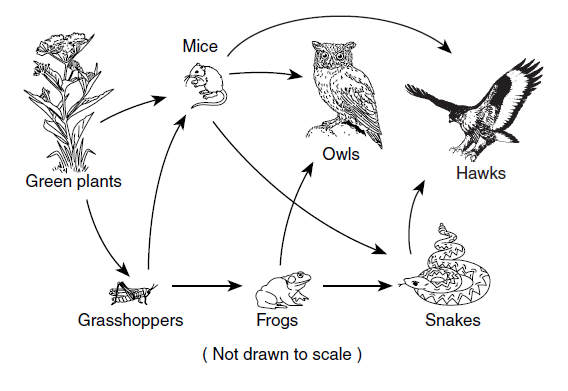
Which group of organisms is missing from the food web above?
Carnivore
Herbivore
Omnivore
Decomposer

Looking at the chart below what type of organism is the Alaskan brown bear?
Carnivore
Herbivore
Omnivore
Decomposer
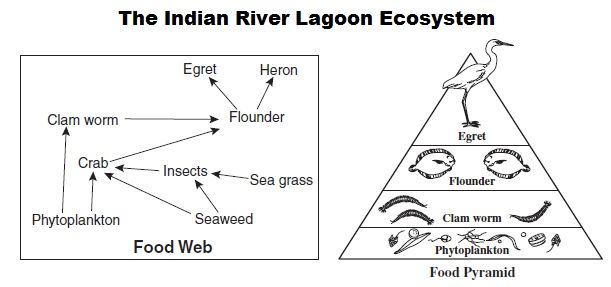
Which of the following has the largest population in the Indian River Lagoon system?
Crab
Egret
Flounder
Phytoplankton
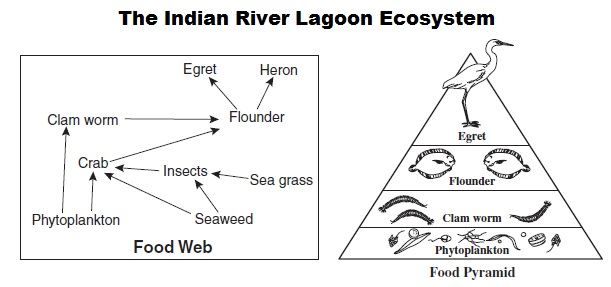
In the Indian River Lagoon System, many organisms compete for food. Which organism in the food web competes with the egrets for food?
Clam worm
Crab
Flounder
Heron

Which of the following statements most accurately describes the energy transfer between the levels of the food pyramid in the Indian River Lagoon System?
Energy travels up the pyramid
Energy stays in the phytoplankton at the lowest level
Energy is released in the environment only at the top level
Energy moves from the flounder to both the clam and the egret
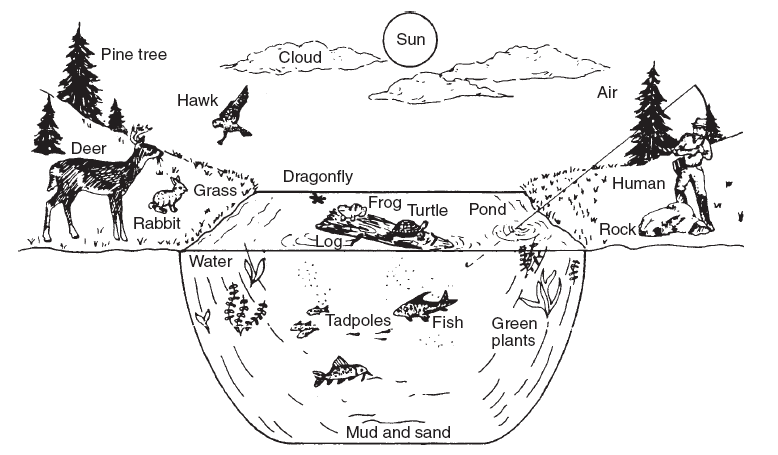
What is the primary source of energy for the ecosystem pictured above?
Grass and Green plants
Hawks and Deer
Tadpoles and Fish
Sun

Observe the food chain below. What would be the result of disease killing off most of the mouse population?
All populations would be relatively unaffected
The grasshoppers would become extinct
The grasshopper population would decrease; the owl population would increase
The grasshopper population would increase and the owl population would decrease
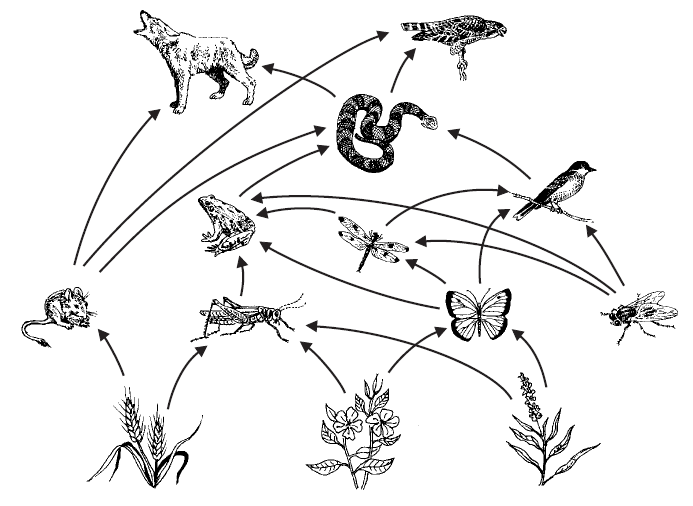
In this food web, which of the following organisms eats the largest variety of different producers?
Mouse
Grasshopper
Dragonfly
Butterfly

Which type of interaction exists between shrimp and blue crabs in this food web?
Blue crabs prey on shrimp.
Shrimp compete with blue crabs for food.
Shrimp help blue crabs filter polluted water.
Shrimp decompose matter for blue crabs.

Which is the producer on this food chain?
Owl
Snake
Grass
Grasshopper

Which is the secondary consumer?
Owl
Grass
Grasshopper
Bluebird

Which is the primary consumer on this food chain?
Owl
Grasshopper
Grass
Snake

What is the tertiary consumer in this food chain?
Snake
Owl
Bluebird
Grasshopper

Which is the Quaternary (top predator) in this food chain?
Owl
Grass
Snake
Bluebird

Which is the decomposer in this food chain?
Owl
Grass
Grasshopper
Mushrooms

Which organism depends on only producers for food?
Whiptail
Squirrel
Jackrabbit
Bobcat

Which organism relies on other animals for food?
Pacific tree frog
Mule Deer
Raven
Douglas Squirrel

Which is the producer on this food chain?
Grass
Snake
Mouse
Grasshopper

Which is the secondary consumer?
Hawk
Snake
Grasshopper
Mouse

Which is the primary consumer on this food chain?
Hawk
Grasshopper
Grass
Mushrooms

What is the tertiary consumer in this food chain?
Snake
Hawk
Bluebird
Grasshopper

Which is the Quaternary (top predator) in this food chain?
Hawk
Grass
Snake
Mouse

Which is the decomposer in this food chain?
Mushrooms
Grass
Grasshopper
Hawk
Which type of symbiosis involves both species benefitting? +/+
Mutualism
Commensalism
Parasitism
Which type of symbiosis involves one species benefitting while the other is harmed? +/-
Mutualism
Commensalism
Parasitism
Which type of symbiosis involves one species benefitting while the other is unaffected? +/0
Mutualism
Commensalism
Parasitism
6.The first species to populate an area after a disturbance is called:
A pioneer species
A pilgrim species
A founder species
A primary species

Both the lion and the cheetah eat some of the same prey in this ecosystem. Two organisms going after the same resource is known as
Mutualism
Parasitism
Competition
Commensalism

Coyote populations have been increasing in recent years. Which would not be a reason for their increase?
More food is available
Less competition from other predators
Less available habitat to live in.
Less threat of being hunted by humans

If the populations of grasshoppers would decrease, what affect would that have on the population of lizards?
Increase
Stay the same
Decrease
Unable to determine
If the population of rattlesnakes were to decrease, why would that help to increase the population of hawks?
Rattlesnakes eat hawks
Hawks eat rattlesnakes
Rattlesnakes and hawks both eat kangaroo rats.
It would not help the hawk population.
Rats were introduced to Australia and the rat population exploded over several years. Which would not be a reason for their population growing?
Large amounts of available food
Increase in the number of predators.
More water available
Large habitats to live in
The ability to recover from or adjust from or adjust easily to misfortune or change.
Catastrophic
Disruptive
Population
Resilient
Characterized by constant change, activity, or progress.
Dynamic
Matter
Disruptive
Mass
Population
The ability of an organism, population, community, or ecosystem to persist in the face of stressful or changing conditions
A group of organisms that are similar to one another and can mate to produce offspring
Characterized by constant change, activity, or progress
A group of interacting individuals of the same species located in the same area

The attached picture is an example of what natural process?
Ecological succession
Evolution of species
Environmental growth and development
Species variation
An algal bloom affects its environment in all of the following ways EXCEPT –
It decreases the amount of oxygen in the water.
It filters the water to make it healthier for wildlife.
It blocks sunlight so plants cannot perform photosynthesis.
It produces harmful toxins.

The peppered moth (Biston betularia) has two forms, a white-bodied and a dark-bodied form. The table provided shows the percentage of each type in a moth population over several years.
(See Attached Table)
The data provided on the shift in population of the peppered moth could support a claim that this population is responding to a change in the environment. In order for this data to support that claim, what other data would be needed?
Data showing a steady change in the color of trees in this habitat between 1965 and 1985.
Data showing that eventually there were no more dark-bodied moths after 1985.
Data showing that in the years after 1985 the trend reversed leading to more dark moths.
Data showing that, in 1965, the two forms migrated from different habitats.

Information on brown tree snakes is provided along with information on the island of Guam. Brown tree snakes were first brought to Guam in 1950.
(See Attached Diagram)
Which of the following would provide evidence that the change to this environment brought about by the introduction of the brown tree snake has had an effect on the populations of organisms that lived on Guam?
Many of the military bases on Guam were closed in the 1980s.
Several other species of snakes were known to live on Guam before 1950.
The population of lizards on Guam in 1960 was very small.
The longest brown tree snake ever found on Guam measured 3 meters in length.
A physical disruption to an ecosystem occurred when a highway was built through a forest. Which of the following would provide evidence that the addition of a highway to this forest affected populations?
The amount of water runoff from higher elevations increased after the highway was built.
The trees that were not cut down during the construction of the highway continued to grow.
There were fewer species of nesting birds living in the forest after the highway was built.
A greater area of the forest floor was exposed to the sunlight after the highway was built.
Bank swallows are birds that make their nests on the edges of rivers. Bank swallows can’t swim or breathe underwater. They feed on flying insects and, in the spring, lay four or five eggs. Which of the following observations would provide evidence that the population of bank swallows was affected by a change in the environment?
The largest swallows catch and eat more insects than the smallest ones.
Swallows that lay four eggs one year may lay five eggs the following year.
Fewer swallows build nests along the river when the water level rises.
Swallows share a food source with other animals that also eat insects.

Trout is a fish that lays its eggs in cold fresh water but spends some of its life in the ocean. Trout eat smaller fish. The graph provided shows the population of trout in the state of Wisconsin between the years 1999 and 2014.
(See Attached Graph)
Which change to the ecosystem had the largest effect on the the population of trout in Wisconsin?
A hard freeze of many of the lakes in Wisconsin in the winter of 2006
The slow rise in lake temperatures in Wisconsin between 1999 and 2014
The rise in population of smaller fish in Wisconsin lakes between 2010 and 2011
A shift in ocean currents that occurred in 2000 and again in 2001

