Wayground logo

Free Printable Worksheets

Font size

S
M
L
XL
Worksheets

The Sun-Earth-Moon System

Total questions: 40

Worksheet time: 27mins

Name
Class
Date
1.

The Earth spinning on its axis is called?

a)

Revolution

b)

Rotation

c)

Research

d)

Seasons

2.

When Earth's rotation axis is tilted directly toward or away from the sun and you have the longest or shortest days of the year, this is known as

a)

equinox

b)

solstice

c)

seasons

d)

rotation

3.

The Earth going around the Sun one time is called a . . .?

a)

Revolution

b)

Rotation

c)

Shadow

d)

Seasons

4.

The path an object follows as it moves around another object is a

a)

rotation

b)

revolution

c)

orbit

d)

line

5.

The line on which an object rotates is a

a)

rotation line

b)

rotation axis

c)

orbit

d)

spinny stick

6.

How long does a revolution take?

a)

365.25 days

b)

24 hours

c)

30 Seconds

d)

One Week

7.

What causes the unequal heating of the earth that leads to four seasons?

a)

rotation

b)

revolution

c)

tilted Earth

d)

solar radiation

8.

The day of the year with the most daylight hours is the

a)

spring equinox

b)

fall equinox

c)

summer solstice

d)

winter solstice

9.

When daylight hours are almost equal to night time hours, it is called

a)

equinox

b)

solstice

10.

On what date would the northern hemisphere experience the Vernal Equinox?

a)

March 20 or 21

b)

June 21

c)

September 22 or 23

d)

December 21 or 22

11.

On what date would the southern hemisphere experience the Summer Solstice?

a)

September 22 or 23

b)

December 21 or 22

c)

March 20 or 21

d)

June 21

12.

How long does it take for the earth to rotate?

a)

one day

b)

one week

c)

one hour

d)

one month

13.
Which season is taking place in the Northern Hemisphere in Position 3?
a)
Winter
b)
Spring
c)
Summer
d)
Fall
14.
Which season is taking place in the Northern Hemisphere in Position 4?
a)
Winter
b)
Spring
c)
Summer
d)
Fall
15.
The Earth's axis is tilted _____ degrees.
a)
23.5
b)
25.3
c)
30.2
d)
24
16.

The lit part of the moon that can be seen from Earth is called a

a)

phase

b)

reflection

c)

quarter

d)

shadow

17.

The moon changes appearance over the course of its cycle because

a)

of its relative position to the Earth and Sun.

b)

the Sun revolves around the Moon.

c)

the Earth revolves around the Moon

d)

of the rotation of the Moon.

18.

Use the calendar to predict the moon phase on March 9th.

a)

New Moon

b)

Full Moon

c)

Third Quarter

d)

First Quarter

19.

Use the calendar to predict the moon phase on March 16th.

a)

New Moon

b)

Full Moon

c)

Third Quarter

d)

First Quarter

20.
What Moon phase is this?
a)
Old Moon
b)
Far Side of the Moon
c)
New Moon
d)
Waxing Gibbous
21.
What Moon phase is this?
a)
Waning Crescent
b)
Waxing Crescent
c)
Waxing Gibbous
d)
Waning Gibbous
22.
What Moon phase is this?
a)
Full Moon
b)
Waxing Gibbous
c)
New Moon
d)
Half Moon
23.
What Moon phase is this?
a)
Waxing Crescent
b)
Waning Gibbous
c)
Waning Crescent
d)
Waxing Gibbous
24.
What Moon phase is this?
a)
Waxing Gibbous
b)
Waning Crescent
c)
Waning Gibbous
d)
Full Moon
25.
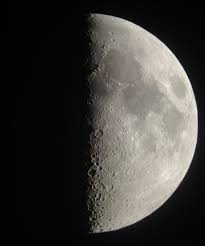
Name the moon phase
a)
First Quarter
b)
Last Quarter
c)
New Moon
d)
Full Moon
26.
The Moon ________ around the Earth.
a)
moves parallel
b)
rotates
c)
doesn't move
d)
revolves
27.
As the moon's shape appears to get smaller, we say that the moon is _________.
a)
swelling
b)
waxing
c)
waning
d)
disappearing
28.
Phases of the moon in which the moon appears to be getting larger are referred to as _______.
a)
waxing
b)
waning
c)
new
d)
eclipse
29.
A solar eclipse only happens during a ________ moon.
a)
New
b)
Cresent
c)
Gibbous
d)
Full
30.
A lunar eclipse only happens during a ________ moon.
a)
New
b)
Cresent
c)
Gibbous
d)
Full
31.
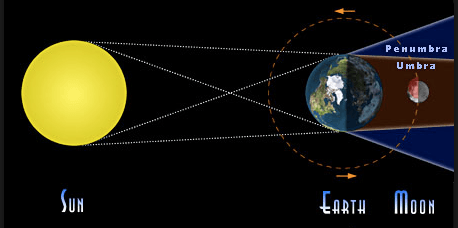
What is the darkest inner part of the shadow cone called, where a total eclipse can be viewed.
a)
Total
b)
Umbra
c)
Penumbra
32.
What is the larger outer lighter part of the shadow cone called, where a partial eclipse can be viewed?
a)
Partial
b)
Umbra
c)
Penumbra
33.
Which type of eclipse occurs when the Moon comes directly between Earth and the Sun?
a)
Lunar eclipse
b)
Solar eclipse
34.
During a solar eclipse...
a)
The sun is blocked by the moon
b)
The Earth is blocked moon
c)
The moon is blocked by the sun
d)
You are blocked
35.
Which of the following is NOT true about a total solar eclipse?
a)
It can be viewed from every spot on earth
b)
It is dangerous to look at without the proper device
c)
When it happens, the moon blocks all of the sun except the corona
d)
You must be within the moon's umbra to see it
36.
A lunar eclipse occurs when the Moon casts a shadow on Earth.
a)
True
b)
False
37.
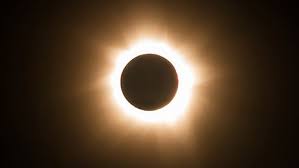
Which type of eclipse is shown in this picture?
a)
Solar Eclipse
b)
Orbit
c)
Lunar Eclipse
d)
Total Eclipse
38.
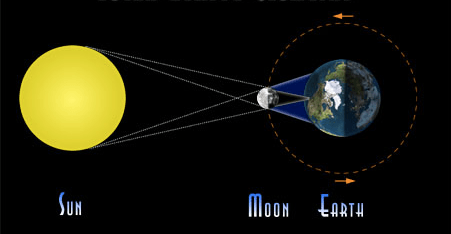
Which type of eclipse is shown in the diagram?
a)
Solar Eclipse
b)
Lunar Eclipse
c)
Total Eclipse
d)
Partial Eclipse
39.
We do NOT have a solar or lunar eclipse each month because...
a)
The tilt of the moon's orbit is at 5 degrees
b)
The moon is too small
c)
The moon's orbital distance changes
d)
All choices
40.
What season is it in the Southern Hemisphere when it is fall in the Northern Hemisphere?
a)
winter
b)
spring
c)
summer
d)
fall