wayground logo

Free Printable Worksheets

Font size

S
M
L
XL
Worksheets

Astronomy

Total questions: 121

Worksheet time: 2hrs 39mins

Name
Class
Date
1.
Pluto is called a dwarf planet. It is smaller than the planets in the solar system. The size of each solar system planet is listed in the table below. Which planet is MOST likely closest to Pluto in size?  
 
a)
Mars
b)
Mercury
c)
Jupiter
d)
Neptune
2.
Which set of planets is in order, from largest to smallest?
a)
Jupiter, Mars, Mercury
b)
Jupiter, Venus, Earth
c)
Uranus, Saturn, Mars
d)
Uranus, Mars, Venus
3.
How do gas giants compare to the terrestrial planets?
a)
terrestrial planets are much larger
b)
terrestrial planets are much smaller
c)
gas giants are slightly larger
d)
gas giants are slightly smaller
4.
Jenny knows that when it is daytime on one part of Earth, it is nighttime on another. What makes daylight turn to darkness?
a)
the rotation of Earth
b)
the tilt of Earth on its axis
c)
Earth revolving around the Sun
d)
the Sun traveling away from Earth
5.
Of the billions of stars in our galaxy, why is the Sun the only star in the galaxy that supplies energy to Earth?
a)
The Sun is the closest star.
b)
The Sun is the hottest star.
c)
The Sun is the biggest star.
d)
The Sun is the oldest star.
6.
Compared to the Sun, all other stars look like points of light in the night sky because the stars _______.
a)
are much smaller than the Sun.
b)
are much farther away than the Sun.
c)
give off different colors than the Sun.
d)
give off much less light than the Sun.
7.
Why does the Sun appear to be the largest star when there are stars that are much larger than the Sun?
a)
Stars have the same temperature as the Sun.
b)
Stars usually appear in groups called clusters.
c)
The Sun is closer to Earth than other stars.
d)
The Sun is younger than most other stars.
8.
About how long does it take Earth to make one complete orbit (revolution) around the Sun?
a)
24 hours
b)
7 day
c)
1 month
d)
1 year
9.
What causes the seasons of the year?
a)
The tilt of Earth on its axis
b)
The rotation of the Moon around Earth
c)
The spinning of Earth on its axis
d)
The northern and southern hemisphere
10.
Which of the following is the result of the rotation of Earth?
a)
Cloud formation
b)
Day and night
c)
The seasons
d)
Weather
11.
How many planets are in the solar system?
a)
10
b)
8
c)
9
d)
7
12.
Which planets have rings?
a)
Earth, Mercury, Jupiter, and Saturn
b)
Pluto, Venus, Neptune, and Mars
c)
Saturn, Uranus, Jupiter, and Neptune
d)
Mars, Earth, Uranus, and Venus
13.
Which planet has the most moons?
a)
Jupiter
b)
Earth
c)
Saturn
d)
Mars
14.
Which planet is closest to the Sun?
a)
Earth
b)
Jupiter
c)
Mercury
d)
Venus
15.
The Roman god of water is the inspiration for which planet?
a)
Jupiter
b)
Neptune
c)
Venus
d)
Mars
16.
How many planets have water on them?
a)
6
b)
3
c)
4
d)
1
17.
Which planet is home to the Great Red Spot?
a)
Jupiter
b)
Mars
c)
Saturn
d)
Venus
18.
Which planets have zero moons?
a)
Uranus and Mercury
b)
Neptune and Mars
c)
Venus and Earth
d)
Mercury and Venus
19.
Which planet is now classified as a dwarf planet?
a)
Mercury
b)
Mars
c)
Pluto
d)
Jupiter
20.
What is the hottest planet?
a)
Mercury
b)
Venus
c)
Earth
d)
Mars
21.
Which planet orbits on its axis sideways?
a)
Earth
b)
Jupiter
c)
Saturn
d)
Uranus
22.
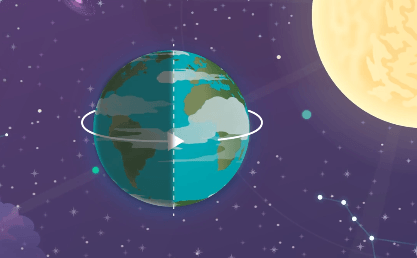
Which of the following is best shown in the picture?
a)
Earth's revolution
b)
A month on Earth
c)
A year on Earth
d)
Earth's rotation
23.
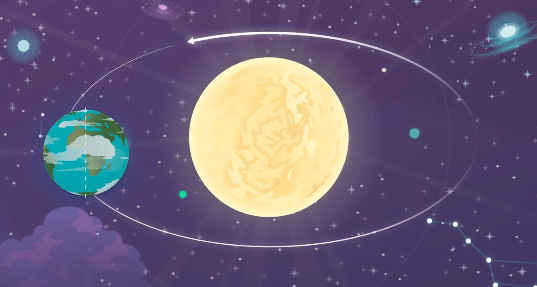
Which of the following do the blue arrows represent in the picture?
a)
A day on Earth
b)
Earth's rotation around the Sun
c)
Earth's revolution around the Sun
d)
A month on Earth
24.
What type of orbit does the Earth have?  This was proven by astronomer Johannes Kepler.
a)
An elliptical orbit around the moon.
b)
An elliptical orbit around the Sun.
c)
A circular orbit around the moon.
d)
A circular orbit around the Sun.
25.
Day and night are caused by _______________.
a)
Earth's rotation
b)
Earth's revolution
c)
Moon's revolution
d)
Moon's rotation
26.
Earth revolves around ________, because it has the __________ in the solar system.
a)
the moon; most gravitational force
b)
the sun; least gravitational force
c)
Jupiter; most gravitational
d)
the sun; most gravitational force
27.
Bodies, natural satellites that orbit the Sun
a)
Sun
b)
Planets
c)
Moon
d)
Stars
28.
The third planet from the Sun
a)
Mercury
b)
Neptune
c)
Venus
d)
Earth
29.
The central star in our solar system
a)
Earth
b)
Sun
c)
Northern Star
d)
Moon
30.
What type of surface does the first four planets have?
a)
Rock
b)
Liquid
c)
Gas
d)
Gas and Liquid
31.
What planet is closest to the Sun?
a)
Mercury
b)
Earth
c)
Neptune
d)
Mars
32.
Which shows the planets in correct order?
a)
MVEMSUNJ
b)
VEMMSUJN
c)
MVEMJPSUN
d)
MVEMJSUN
33.
Which planet is farthest from the Sun?
a)
Saturn
b)
Uranus
c)
Neptune
d)
Venus
34.
In 365 days, the Earth __________ around the Sun
a)
Rotates
b)
Revolves
35.
In 24 hours, the Earth _____________.
a)
Revolves
b)
Rotates
36.
What is the name of our galaxy?
a)
Local Group
b)
Orion
c)
Andromeda
d)
Milky Way
37.

Which two element make up most of the sun?

a)

helium and hydrogen

b)

ammonia and methane

c)

hydrogen and oxygen

d)

oxygen and helium

38.
One of the main differences between the outer and inner planets is __________.
a)
The inner planets all have water
b)
the inner planets are much bigger than the outer planets
c)
the outer planets are gas planets
d)
the outer planets have rings, and the inner planets don't
39.

As the solar system formed, two types of planets were produced. Which statement is a fact that helps account for the difference in composition between terrestrial and the Jovian (gas) planets

a)

The farther from the Sun, the cooler the temperature is.

b)

Large planets have less stable orbits than small planets

c)

Metallic elements have lower melting points than nonmetallic elements

40.
The second planet of the Solar System is...
a)
Venus
b)
Mercury
c)
Mars
41.
The fifth planet of the Solar System is...
a)
Saturn
b)
Jupiter
c)
Uranus
42.
The third planet of the Solar System is...
a)
Mars
b)
Venus
c)
Earth
43.
The last (eighth) planet of the Solar System is...
a)
Neptun
b)
Uranus
c)
Mercury
44.
The first planet of the Solar System is...
a)
Mars
b)
Mercury
c)
Venus
45.
The fourth planet of the Solar System is...
a)
Jupiter
b)
Mars
c)
Earth
46.
The biggest planet of the Solar System is...
a)
Saturn
b)
Uranus
c)
Jupiter
47.
The hottest planet of the Solar System is...
a)
Mercury
b)
Venus
c)
Jupiter
48.
The smallest planet of the Solar System is...
a)
Mercury
b)
Venus
c)
Mars
49.
The coldest planet in the Solar System is...
a)
Uranus
b)
Neptune
c)
Saturn
50.
At the centre of the Solar System there is..
a)
The Moon
b)
The Sun
c)
The Earth
51.
How many gas giants are there in the Solar System?
a)
Two
b)
Four
c)
Three
52.
Our solar system has several terrestrial planets.  They include:
a)
Jupiter, Earth, Mars
b)
Venus, Mercury, Mars
c)
Saturn, Neptune, Uranus
d)
Pluto, Jupiter, Earth
53.
True or False: All Planets have rings.
a)
True
b)
False
54.
True or False: Every Planet has at least one moon.
a)
True
b)
False
55.
The asteroid belt is located between which two planets?
a)
Earth and Mars.
b)
Venus and Earth.
c)
Mars and Jupiter.
d)
Mercury and Earth.
56.
The asteroid belt is located between which two planets?
a)
Earth and Mars.
b)
Venus and Earth.
c)
Mars and Jupiter.
d)
Mercury and Earth.
57.
Which of the 8 planets have the most moons?
a)
Earth
b)
Jupiter
c)
Saturn
d)
Uranus
58.
It takes one year for the Earth to orbit the Sun. based on the data in the table, which planet has the longest year?
a)
Jupiter
b)
Mars
c)
Mercury
d)
Neptune
59.
Based on the Earth's rotation, it can be concluded that:
a)
It is warmer in the nighttime than it is in the daytime.
b)
Daytime lasts longer than nighttime.
c)
Some parts of the world would never see the sunshine.
d)
It is always nighttime on some part of the Earth
60.
The earth's __________________ is responsible for days and nights
a)
Rotation
b)
Revolution
c)
Atmosphere
d)
Tilted Axis
61.
Night and day are caused by earth's ___
a)
revolution
b)
rotation
62.
When the earth moves around the sun, this is called a ___ .
a)
revolution
b)
rotation
63.
The planet which is the smallest and closest to the sun is __
a)
Venus
b)
Earth
c)
Mercury
d)
Pluto
64.
This planet is the largest in our solar system.
a)
the sun
b)
Saturn
c)
Jupiter
d)
Neptune
65.
This type of planet has no solid surface.
a)
terrestrial
b)
gas giant
66.
The largest object in our solar system is 
a)
Jupiter
b)
our sun
c)
Earth
d)
Saturn
67.
This planet has thousands of rings around it.
a)
Jupiter
b)
Uranus
c)
Neptune
d)
Saturn
68.
the time required for the earth to orbit around the sun 
a)
Year
b)
Month
c)
Day
d)
6 Months
69.
the time required for the earth to rotate once on it axis 
a)
Year
b)
Month
c)
Day
d)
6 Months
70.
The greater the mass, the ______the gravity
a)
Lower
b)
Greater
c)
Smaller
d)
Heavier
71.
The largest asteroid is :
a)
Found between Mars and Earth
b)
Found between Saturn and Jupiter
c)
Found between Mars and Jupiter
d)
Found between Earth and Venus
72.

How many planets are there in the Solar System?

a)

Nine

b)

Fifteen

c)

Eight

d)

Eleven

73.

What does Earth orbit around?

a)

Pluto

b)

The moon

c)

The Solar System

d)

The Sun

74.

An orbit is...

a)

The spinning of the Earth

b)

The path that Earth follows around the Sun

c)

How long it takes the Earth to revolve around the Sun

d)

The path that the Sun follows around the Earth

75.

One full orbit is called a...

a)

Axis

b)

Rotation

c)

Inertia

d)

Revolution

76.

How long does Earth's revolution around the Sun take?

a)

24 hours

b)

365 days

c)

10 years

d)

30 minutes

77.

year

a)

the time required for the moon to orbit once around the Earth

b)

the time required for the Earth to rotate once on its axis

c)

the time required for Earth to orbit once around the sun

d)

the study of the universe

78.

day

a)

the time required for the moon to orbit once around the Earth

b)

the time required for the Earth to rotate once on its axis

c)

the time required for Earth to orbit once around the sun

d)

the study of the universe

79.

constellation

a)

the line where the sky and the Earth appear to meet

b)

the point in the sky directly above an observer (person) on Earth

c)

the angle between an object in the sky and the horizon

d)

a region of the sky that contains a recognizable star pattern

80.

What determines the measurement of a full year on Earth?

a)

Hemisphere

b)

Axis

c)

Rotation

d)

Revolution

81.

What determines the measurement of a day on Earth?

a)

Hemisphere

b)

Axis

c)

Rotation

d)

Revolution

82.

What is the circular motion around the Sun?

a)

Rotation

b)

Orbit

c)

Axis

d)

Hemisphere

83.

The amount of daylight we experience varies from day to day. What factors contribute to this?

a)

The gravitational pull of the Moon

b)

The patterns of the ocean tides

c)

The tilted axis and rotation of the Earth

d)

The tilted axis and rotation of the Sun

84.

Why do we rotate and what are the causes?

a)

Because of the suns gravity and that’s why we have day and night.

b)

None of the above.

c)

For us to survive.

d)

When it spin we live more and more.

85.

What is the sun?

a)

The sun is a fireball.

b)

The sun is a planet.

c)

The sun is a star.

d)

The sun is a animal.

86.

Uranus,earth,venus,Mercury,Mars,plito,sun what is it.

a)

inner.

b)

Outer.

c)

Order.

d)

Of from sun.

87.

What is the closest planet to the Sun?

a)

Mars

b)

Mercury

c)

Earth

88.

What planet is known as the red planet?

a)

Mars

b)

Jupiter

c)

Saturn

89.

The sun is not a star.

a)

True

b)

False

90.

The planet Neptune is bigger than Earth.

a)

True

b)

False

91.

What is the name of the 2nd biggest planet in our solar system?

a)

Saturn

b)

Jupiter

c)

Venus

92.

The order of the planets...

a)

Mercury, venus, mars, earth

b)

venus,mercury,jupitor,mars

c)

mercury, venus earth, mars

d)

mercury, venus, earth, mercury

93.

What is the sun?

a)

Fortnite

b)

A Star

c)

A big Ball

d)

Fire

94.

The yearly orbit of Earth around the Sun is called its

a)

rotation

b)

ellipse

c)

revolution

d)

tilt

95.

The planet that appears to roll on its side is

a)

Mars

b)

Venus

c)

Saturn

d)

Uranus

96.

Which planets has the most moons?

a)

Earth

b)

Uranus

c)

Jupiter

d)

Pluto

97.
Put the planets in order from the sun.
a)
Mercury, Venus, Mars Earth, Jupiter, Saturn, Uranus, Neptune, Pluto
b)
Mercury, Venus, Earth, Mars, Jupiter, Sarturn, Neptune, Uranus, Pluto
c)
Mercury, Venus, Earth, Mars, Jupiter, Sarturn,  Uranus, Neptune,Pluto
d)
Mercury, Venus, Earth, Mars, Sarturn, Jupiter, Neptune, Uranus, Pluto
98.
The Earth is rotating on its axis, creating _____
a)
the 12 months
b)
the years
c)
the seasons
d)
day and night
99.

How long does it take for us to orbit around the sun?

a)

365 days

b)

24 hours

c)

365 and 1/4 days

100.

Earth's rotation is what causes day and night.

a)

True

b)

False

101.
The MOON REVOLVES around the:
a)
Sun
b)
Earth
c)
The Moon doesn't revolve
d)
The Earth and Sun 
102.
What does ROTATION mean?
a)
To SPIN
b)
To ORBIT or GO AROUND
103.
How long does it take for the Earth to make one full orbit around the Sun?
a)
one day
b)
one week
c)
one month
d)
one year
104.

What are the inner planets in order from the sun?

a)

Mars,Neptune,Earth,Jupiter,Mercury,Venus

b)

Mercury,Venus,Earth,Mars

c)

Jupiter,Saturn,Mars,Mercury

d)

Mercury,Mars,Venus,Earth

105.

What are the outer planets in order from the sun?

a)

Jupiter,Saturn,Earth,Neptune,Pluto

b)

Jupiter,Neptune,Mars,Venus

c)

Jupiter,Saturn,Uranus,Neptune

d)

Pluto,Mars,Jupiter,Neptune

106.

How many planets have no moons?

a)

2

b)

3

c)

7

d)

1

107.

How many planets are there?

a)

9

b)

3

c)

8

d)

10

108.

Which planet is the only planet to have water?

a)

Earth

b)

Mars

c)

Jupiter

d)

Mercury

109.

Which planet is known for the Giant red spot?

a)

Mars

b)

Nepturne

c)

Saturn

d)

Jupiter

110.

Why is Venus the hottest planet?

a)

It is the closest to the sun

b)

The green house effect

c)

it is not the hottest planet

d)

It doesn't have an atmosphere

111.

What separates the inner planets from the outer planets?

a)

Kiper Belt

b)

Asteroid Belt

c)

Oort Cloud

d)

None of the above

112.

What causes day and night

a)

Earth orbiting the sun

b)

seasons

c)

the moon orbiting the earth

d)

Earth's rotation on its axis

113.

Why do stars appear to move across the sky?

a)

They do move

b)

The suns orbit

c)

The earths rotation

d)

The earths orbit

114.

How big is the sun compared to other stars

a)

Small

b)

Medium

c)

Huge

d)

Large

115.

Is the moon gas or rock

a)

Gas

b)

Rock

c)

Neither

116.

What is in the center of the solar system?

a)

asteroid belt

b)

the sun

c)

a comet

d)

galaxy

117.

What is the closest object to Earth?

a)

Moon

b)

Sun

c)

Pluto

d)

Jupiter

118.

What is the area between Mars & Jupiter called?

a)

The Kuiper Belt

b)

Nebula

c)

Ceres

d)

The Asteroid Belt

119.
One complete turn of the Earth on its axis (24 hours)
a)
Asteroids
b)
Rotation
c)
Axis
d)
Constellations
120.
The curved path of the Earth around the sun
a)
Solar System
b)
Revolution
c)
Axis
d)
Orbit
121.
A group of stars that forms a particular shape in the sky and has been given a name
a)
Solar System
b)
Constellations
c)
Revolution
d)
Axis