
 Worksheets
Ecology Mastery / Grade recovery
Total questions: 116
Worksheet time: 4hrs 36mins
What is a food chain?
The flow of energy from one thing to another
The way animals eat each other
The way the sun makes everything
What is a Producer?
An animal that eat plants
An animal that eats meat
A plant that produces their own food
What is a Herbivores?
A animal that eats plants
A animal that eats meat
A plant that makes its own food
A plant that eats meat
What is a Carnivore?
A animal that eats plants
A animal that eats meat
A animal that makes it own food
A animal that doesn't eat animals or plants
What is a Decomposer?
An animal that eats everything
A plant that eats dead animals and plants
A human
The sun
What do plants need to make their own food?
Sun, Water, and Animals
Sun, Coke, and Soil
Sun, Water, and Soil
which one is a Producer?


What is a decomposer?


Which one is a Herbivore?


which one is a Omnivore


Which one is a Carnivore?


What provides energy to plants for photosynthesis?
The Sun
The Soil
Plants are called ______________ because they produce their own food.
consumers
producers
A mouse is a ___________ because it cannot make its own food.
consumer
producer
Humans that eat both plants and animals are--
Herbivores
Carnivores
Omnivores
These animals only eat meat-
carnivores
omnivores
herbivores
These organisms break down dead and decaying matter.
consumers
decomposers
producers
What do ALL living things need to survive?
children
a home
food
oxygen

What does food provide us with?
food provides us with energy
food provides us with a feeling of satiation
food provides us with comfort
What is the main source of energy from the foods we eat?
fats
calories
fiber
glucose

Where do plants get their energy from?
the water
the sun
the dirt
people

What is the main source of energy for out planet?
the moon
gravity
the solar system
the sun

What is the name to the process by which plants make their own food?
photosynthesis
photosynthetic
autotrophic
heterotrophic

What is a food chain?
A chain of things linked together
A diagram showing how energy is transferred from one organism to another
A diagram showing what organisms like to eat
A chain of predators and preys

What does the arrow in the food chain show?
the direction of heat transfer
the direction of what organism eats what organism
the direction of energy transfer

In this diagram, where does the owl get its energy from?
the corn
the mouse
the snake
the sun

Where is the human getting his energy from?
the sun
the algae
the small marine animals
the fish
What is the starting source of energy for all food chains?
grass
sun
bug
mushrooms
What do the arrows represent in a food chain?
Stop
Start
Gives energy to

What is this model called?
Food Chain
Food Web
Habitat
Herbivore
An animal that ONLY eats plants is called a
Herbivore
Carnivore
Omnivore
Plantivore
An animal that ONLY eats other animals is called a
Carnivore
Omnivore
Herbivore
Consumer

Why do people eat?
to gather family
to sleep
for energy
for exercise

Lions only eat buffalo, antelopes, zebras and crocodiles. They are called __________.
Omnivore
Herbivore
Carnivore
Delivore

Bears eat fish, insects, plants, seeds, nuts and young elk. They are called __________.
Franivore
Carnivore
Herbivore
Omnivore

An animal that only eats plants is a...
carnivore
omnivore
herbivore
decomposer

What's the name of this habitat?
Forest
Desert
Ocean
Tundra

What's the name of this habitat?
Forest
Desert
Ocean
Tundra

What's the name of this habitat?
Forest
Desert
Ocean
Tundra

Where does energy for all living things begin?
Mars
The Moon
The Sun
Water
What is an organism that makes its own food using energy from the sun.
The Sun
Producer
Water
Space
What is an organism that gets energy by eating other organisms?
The Sun
Water
Space
Consumer
What is an animal that eats only plants for food energy
Herbivore
Carnivore
The Sun
Insects
What is an animal that eats other animals for food energy.
Herbivore
Insectivore
Carnivore
The Sun
What is an animal that eats other animals and plants for food energy.
Herbivore
Carnivore
Insectivore
Ominivore
What is an organism that gets energy by feeding on dead material and wastes.
Garbage Truck
Decomposer
Leaves
The Sun

I make my own food.
Carnivore
Producer
Omnivore
Consumer
I am a predator that has NO predators in my environment.
Apex Predator
Primary Consumer
Producer
Decomposer
I am an autotroph.
Carnivore
Producer
Omnivore
Consumer
I only eat meat/animals.
Carnivore
Omnivore
Herbivore
Decomposer
I eat meat, but may or may not also eat plants.
Producer
Primary Consumer
Secondary or Tertiary Consumer
Decomposer
I eat plants and animals.
Carnivore
Omnivore
Herbivore
Decomposer
I ONLY eat plants.
Carnivore
Omnivore
Herbivore
Decomposer
I ONLY eat plants.
Tertiary Consumer
Secondary Consumer
Primary Consumer
Producer
I feed on dead organisms, causing them to decay, returning nutrients to the earth.
Carnivore
Omnivore
Herbivore
Decomposer

This chart is called a
Lifespan
Water Cycle
Growth Chart
Food Chain
What is the source of all energy on Earth?
The Sun
Producers
Consumers
The Teacher

Which of the following animals are herbivores?
1. Hawks
2. Polar bears
3. Oxen
4. Lizard

Which of the following can be inferred about the decomposers?
1. If there were no decomposers, wastes and the remains of dead animals would pile up.
2. They break down the alive animals which then return to soil, so plants can use them again.
3. They are one type of animals that eat both plant and animals called omnivores.
4. They simply use sunlight and water to produce the energy.

biotic
abiotic

biotic
abiotic

biotic
abiotic

biotic
abiotic
Living
biotic
abiotic
Dead
Biotic
Abiotic

biotic
abiotic
Ecology is the study of:
only the living things in the environment
only the nonliving things in the environment
how living things interact with each other and the nonliving things in the environment
scientists who perform research on living things
What term do ecologists use to describe where an animal lives (an animal’s home)?
Ecosystem
Ecologist
Habitat
Population
What is a species?
Different animals that compete for the same resources
A group of similar organisms that can reproduce with each other
A group of organisms that live together
A group of organisms that are physically and functionally very different from each other
Which of the following is an example of a living thing?
A bacterium
A shell
Water
Sweat
Which of the following is NOT a nonliving thing? (which one is living?)
Sun
Rocks
Milk
Wood
What type of organism can make its own food?
A producer (an autotroph)
A consumer (a heterotroph)
A decomposer
All of the above
Organisms that can make their own food do so by the process of:
decomposition
respiration
photosynthesis
scavenging
What type of consumer eats plants?
Herbivore
Omnivore
Carnivore
Both herbivore and omnivore
What is a food chain?
A representation of an organism’s life cycle
A way to show the feeding relationships between organisms
The sequence of events that occurs during photosynthesis
A way to show how animals interact with nonliving parts of the environment
The first organism in a food chain is ALWAYS a:
producer
consumer
decomposer
Any of the above
How much energy is transferred between trophic levels?
25%
20%
10%
90%
What is a niche?
The habitat that an organism lives in
An organism’s “role” in an ecosystem
A type of consumer
The relationship between a producer and consumer
What happens when different species try to occupy the same niche?
The species compete with each other
The species cooperate with each other
The species coexist with each other
All of the above
In what type of relationship do both organisms benefit from the relationship?
Parasitism
Mutualism
Commensalism
Predation
How does oxygen cycle between plants and animals?
Plants and animals both release oxygen
Plants and animals convert water into oxygen
Plants take in oxygen that is produced by animals
Animals take in oxygen that is produced by plants
When we say that a species adapts to changes in the environment, we mean that:
the species becomes extinct
the species has to move to a new environment
the species adjusts and copes with the changes
the species is completely unaffected by the changes
What is biodiversity?
The different ways species reproduce
The degree of variation of life on Earth
A way to describe similarities between different species
The process of creating new species
The water cycle starts with the energy from the______
oceans
plants
sun
wind
Organisms that need nitrogen to survive.
only plants
only animals
only bacteria
all living things
How is nitrogen "fixed" into a usable form for plants?
Through action of bacteria only
Through lightning only
Through action of bacteria and lightning
Through photosynthesis
How do animals get the nitrogen they need?
From the air they breathe
From the water they drink
From the food they eat
From the sun
Gas that makes up 78% of our atmosphere.
Oxygen
Nitrogen
Hydrogen
Carbon Dioxide
What is the process of combining nitrogen gas with other elements to make nitrogen into usable compounds?
nitrogen composition
nitrogen fixation
ammonia
denitrification
What process occurs when dead plant and animal matter decomposes and nitrogen is released back into the atmosphere?
Assimilation
Fixation
Ammonification
Denitrification
Plants and animals cannot use nitrogen directly from the air.
True
False
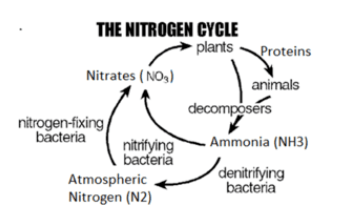
According to this diagram, plants use nitrogen to make _________________________
bacteria
animals
proteins
decomposers
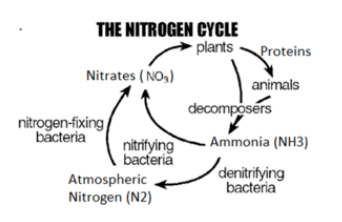
According to this diagram, animals get proteins from eating ________________________
decomposers
bacteria
plants
sunlight
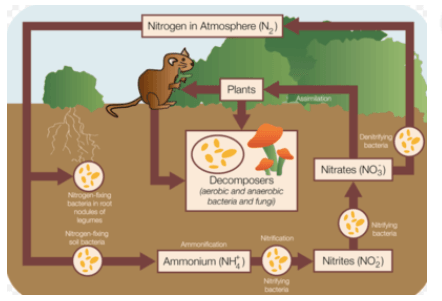
A correct path that nitrogen could take would be
air -> animals -> plants -> bacteria
animals -> air -> bacteria -> plants
bacteria -> air -> plants -> animals
air -> bacteria -> plants -> animals
Which process contributes carbon dioxide to the atmosphere?
respiration
photosynthesis
tree farms
___ is a word that describes how many different species of organisms live in a place.
biodiversity
ecology
symbiosis
adaptation
___ is when living things of the same species work together to survive. (like a pack of wolves)
competition
cooperation
predation
symbiosis
___ is when one organism (a predator) eats another organism (the prey).
competition
cooperation
predation
symbiosis
___ is when living things struggle against one another to get resources – like food, water, space, mates, etc.
competition
cooperation
predation
symbiosis
In an ecosystem, everything is ___.
connected to everything else
separate from each other
alive
must eat other organisms to survive

The diagram below shows a list of ___ of a polar bear that help it survive in its cold, snowy habitat.
adaptations
habitats
resources
biomes
A ___ is the place that an organism lives - its natural home.
habitat
community
population
ecology
___ the branch of science that studies how organisms interact with one another & with their environment.
ecology
geology
astronomy
chemistry
An ___ is any feature or trait that helps an organism survive.
adaptation
resource
habitat
ecology
A ___ is anything that an organism needs to survive.
resource
adaptation
habitat
ecology
A ___ is word that means "a specific type of living thing" (like a polar bear).
species
organism
population
animal
Which of the following shows the levels of organization in order from the smallest to the largest?
organism, population, community, ecosystem
ecosystem, community, population, organism
population, organism, community, ecosystem
organism, community, population, ecosystem
A ___ is all of the organisms of the same kind in a place.
organism
population
community
ecosystem
___ is a word that describes all of the non-living parts of an ecosystem.
abiotic
biotic
robotic
probiotic

