
 Worksheets
1 & 2nd Quarter Practice Assessment
Total questions: 120
Worksheet time: 2hrs 0mins
A pattern of disturbance that travels through a substance from one location to another location.
Wave
Amplitude
Wave Crest
Wave Trough
Wave Height
The distance from the wave crest or trough to the equilibrium Level
Wave
Amplitude
Wave Crest
Wave Trough
Wave Height

The lowest part of a wave.
Wave
Amplitude
Wave Crest
Wave Trough
Wave Height

distance between two consecutive wave crests or between two consecutive wave troughs.
Wave
Amplitude
Wave Length
Wave Trough
Wave Height

The number of waves passing a fixed point in a specified period of time
Wave Height
Wave Length
Wave Frequency
Wave Trough

The part of a wave that the particles are more pushed together.
Compression
Rarefaction
Particles
Wave

The part of a wave that the particles are pulled apart
Compression
Rarefaction
Particles
Wave


A wave that can travel through matter and empty space is a:
electromagnetic wave
longitudinal wavy
transverse wave
Which are properties of a mechanical wave?
can be longitudinal or transverse
can move through space
must have matter to move
carries energy

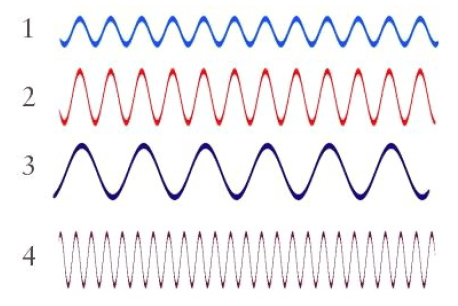
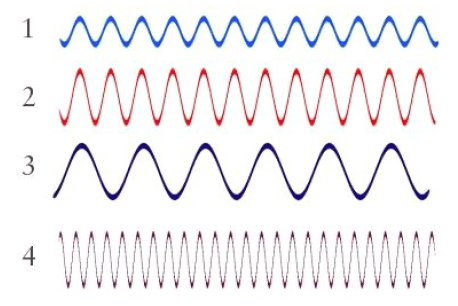
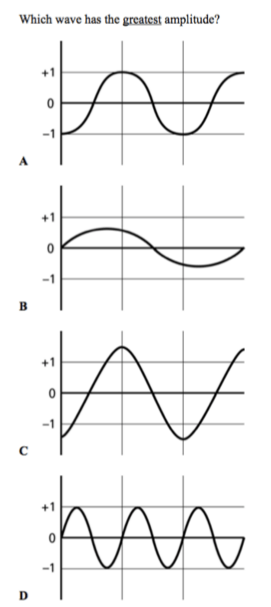

What is the amplitude of this wave?
4
8
2
6.3
If you increase the energy put into a wave how will the change the wave?
Change the crest
Change the trough
Change the type of wave
Change the frequency

When a wave has increased frequency...
the wavelengths become shorter.
the wavelengths become longer.
amplitude must increase.
amplitude must decrease.

Which wave is carrying more energy?
The blue wave because it has a larger amplitude.
The blue wave because it has higher frequency.
The red wave because it has higher amplitude.
The red wave because it has higher frequency.
A high ______________________ creates a HIGH pitched sound (You will see more waves passing).
Wavelength
Crest
Trough
Frequency
______________ measures the loudness of a sound (how high or tall the wave is).
Frequency
Trough
Amplitude
Wavelength

Of the two waves presented, which wave has the greatest energy?
Top wave (higher frequency/shorter wavelength)
Bottom wave (lower frequency/longer wavelength)
Both waves have the same amplitude, therefore the same energy.
Wave speed is the _______ in a given amount of time.
distance a wave moves
amount of energy a wave produces
number of crests produced by a wave
frequency in which a wave passes a point
What type of energy does a sound wave have?
Mechanical
Radiant
Electrical
Sound
Sound is produced by -----
Heat energy
Low temperatures
Vibrations
Friction
Sound waves are also known as ----- waves.
Compression
Longitudinal
Neither
Both longitudinal and compression

The measure of the amount of energy in a wave is ----
Wavelength
Hertz
Frequency
Amplitude
The speed of sound depends on these two things:
The type of medium and the temperature of the medium
Speed of the medium and temperature of the medium
Temperature of the medium and sound of the medium
None of the above
Sound waves travel the fastest through ---
Liquids
Gases
Solids

Sonar and echolocation use ----- to detect objects under water.
Refraction
Reflection
Three different objects are shown in the pictures below. Which of the following absorbs all colors of light?


Three different objects are shown in the pictures below. Which of the following transmits all colors of light?
Which of the following situations would cause light to refract?
traveling through a vacuum
moving from air to water
moving through the air
passing from one glass block to another
Which of the images best describes the absorption of light?


Which of the images best describes the reflection of light?
How does light travel through a uniform medium?
in an unpredictable course
in a straight line
in an angled path
in a wave-like pattern

Which type of wave on the Electromagnetic Spectrum has the lowest frequency?
radio waves
infrared waves
UV rays
gamma rays
Which type of wave on the Electromagnetic Spectrum has the highest frequency?
radio waves
infrared waves
UV rays
gamma rays

Which color within the visible spectrum has the longest wavelength?
red
orange
yellow
green
blue

Which color in the visible spectrum has the shortest wavelength?
red
orange
yellow
blue
violet

Select the statement that is true.
The shorter the wavelength, the lower the frequency.
The higher the amplitude, the lower the frequency.
The longer the wavelength, the lower the frequency.
Which type of wave on the Electromagnetic Spectrum has the highest frequency?
radio waves
infrared waves
UV rays
gamma rays
Which type of wave on the Electromagnetic Spectrum has the lowest frequency?
radio waves
infrared waves
UV rays
gamma rays
Two light waves have the same wavelength. The wave with the greater amplitude carries _______ energy.
less
more
same amount
Two light waves have the same amplitude. The wave with the higher frequency carries ______ energy.
less
more
the same amount of
The range of electromagnetic waves placed in a certain order is called the
electromagnetic spectrum.
electromagnetic wavelength.
electromagnetic frequency.
electromagnetic field.
Which of the images best describes the absorption of light?
Which of the images best describes the reflection of light?
What is the saying that can help you remember the order of the visible spectrum?
ROYGBIV
RYOBIVG
ROYBVIG
RIBYOVG

What does the picture below illustrate?
Visible Light Spectrum
Electromagnetic Spectrum
Frequency Indicator
Color Line
How are we able to see the color white?
All colors except red are absorbed
All colors are absorbed
All colors are reflected
All colors except red are reflected
A prism can be used to...
separate visible light into colors
make a beam of light brighter
measure the speed of light
make UV light visible
What happens when light transitions into a new medium?
Reflection
Absorbing
Refraction
Mirror

What is this a picture of?
Reflection
Refraction
Light emitted from a star or galaxy can be separated into a band of colors, called a ________.
Red Shift
Wave Length
Spectrum
Microwave
As galaxies move away from our galaxy
a shift on the electromagnetic spectrum
(EMS) is noticed. This phenomena is
called _____________.
redshift
blueshift
unshift
blackshift
How does Cosmic Microwave Background Radiation support the Big Band Theory?
Microwaves are found everywhere in the universe.
Microwaves occurred at the time of the Big Bang
Microwaves are useful in our everyday lives
Only A & B
Which statement is true about the Big Bang Theory? Choose all that apply.
It should appear longer because of a redshift.
the universe formed by the rapid expansion of space from a point 10–20 billion years ago
The universe is expanding because light from faraway stars and galaxies is shifting towards the blue colors.
When stars and galaxies move farther away from each other, we say that the universe is expanding and that this is due to a shift in the frequency of light coming from these light sources.
Cosmic Microwave Background Radiation is a form of _________.
Matter
Energy
Visible Light
Water
Red light has a ______ pitch, or frequency, than the blue end.
Low
High
the same
nice


The smallest part of any element. Made up of protons, neutrons and electrons.
Atom
AMU
Ion
Isotope
Identifies the number of protons in an atoms nucleus.
Electron Cloud
Atomic Theory
Atomic Number
Mass Number

The region inside an atom where electrons are likely to be found
Proton
Atom
Electron Cloud
Neutron
The total number of protons and neutrons in the nucleus of an atom
Atomic Number
Mass Number
Atomic Theory
Electron Cloud

The particles in the nucleus of an atom that do not have a charge (neutral)
Proton
Electron
Neutron
Ion

Negatively charged particles within the electron cloud outside the nucleus.
neutrons
protons
electrons
isotopes


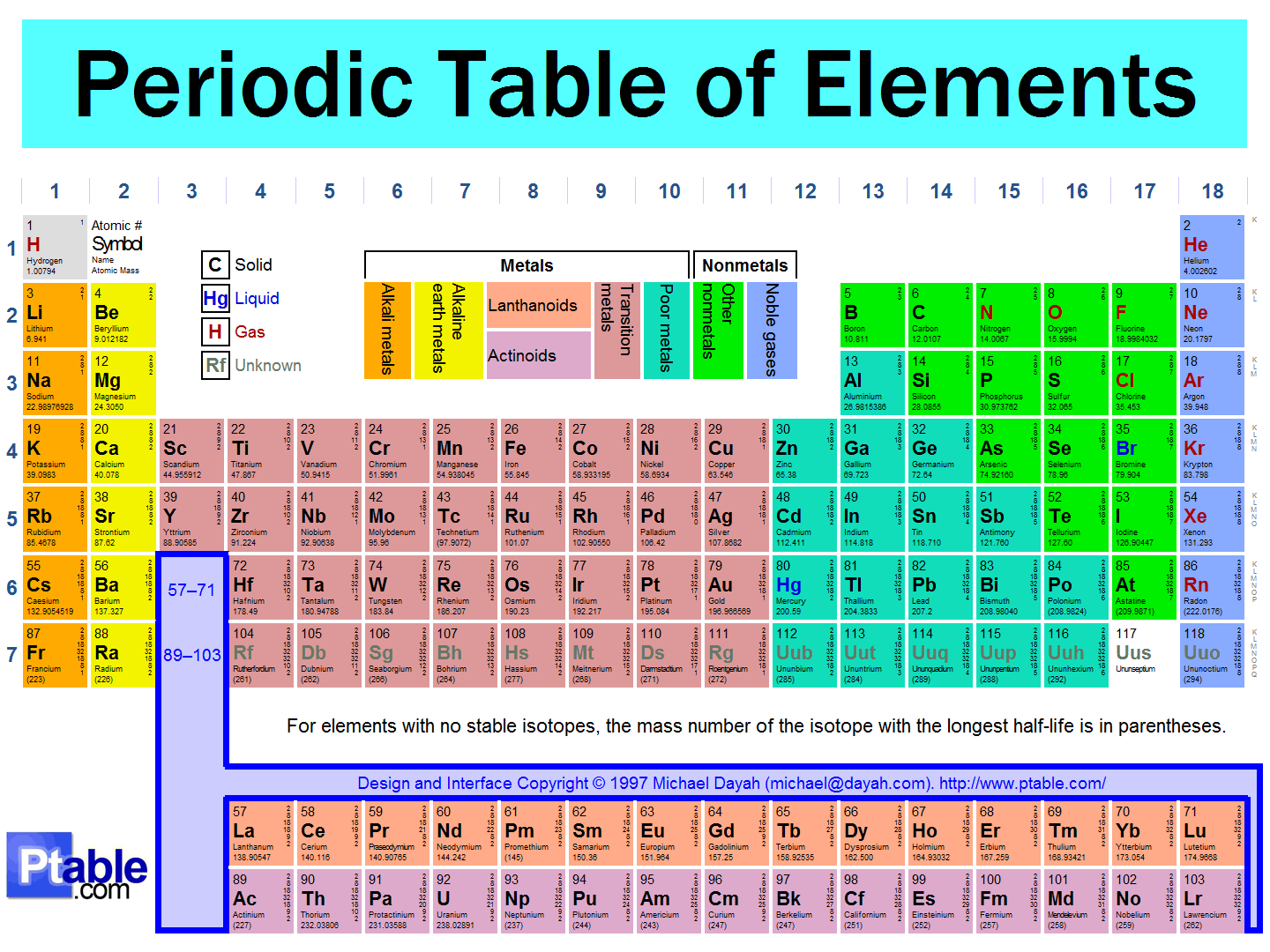
How many protons does Potassium (K) have?
39
19
20
39.10

How many neutrons can be found in an atom of Na (Sodium)?
12
11
22.99
23

How many valence electrons does this element have?
20
2
4
1
one or two letters that represent the name of an element
element name
element symbol
atomic number
atomic mass
A subatomic particle that has a positive charge and that is found in the nucleus of an atom
Proton
elecrtron
groups
neutrons
neutron
A subatomic particle that has a positive charge and that is found in the nucleus of an atom
not able to conduct heat or electricity, little to no metallic luster
A subatomic particle that has a negative charge
A small particle in the nucleus of the atom, with no electrical charge
How do you calculate the number of neutrons? *
Mass = Atomic number - Neutrons
Mass - Atomic number = Neutrons
Atomic number = Neutrons

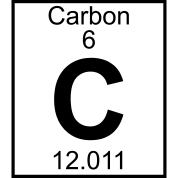
What is the name of the element? (Periodic table will be needed)
sodium
magnesium
vanadium


A theory that says the universe began as a small point that expanded rapidly about 13.7 billion years ago.
Big Bang Theory
Singularity Theory
Galaxy Theory


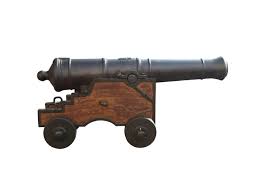


1st
Law of Motion
2nd
Law of Motion
3rd
Law of Motion

What law is best described
A person not paying attention while skateboarding hits a rock. The skateboard stops...they don't.
The Law of Inertia (1st law)
The Law of Acceleration (2nd law)
The Law of Conservation of Momentum
Action Reaction Law (3rd law)

Which Law? Force = Mass x Acceleration
Newton's 1st Law
Newton's 2nd Law
Newton's 3rd Law
Newton's 4th Law
What is the unit of force?
Pound (lb)
Kilogram (kg)
Newton (N)
Joule (J)
How do you calculate force using mass and acceleration?
F = m + a
F = m - a
F = m × a
F = m / a
What is Newton's Second Law of Motion?
The acceleration of an object is directly proportional to the net force acting on it and inversely proportional to its mass (F = m × a).
An object in motion stays in motion unless acted upon by an external force.
The force acting on an object is equal to the mass of the object multiplied by its velocity.
For every action, there is an equal and opposite reaction.
What is Newton's Third Law of Motion?
For every action, there is an equal and opposite reaction.
An object in motion stays in motion unless acted upon by an external force.
The force of gravity is proportional to the mass of the objects involved.
Energy cannot be created or destroyed, only transformed.

