Wayground logo

Free Printable Worksheets

Font size

S
M
L
XL
Worksheets

4th Six Weeks WINN Exam

Total questions: 25

Worksheet time: 14mins

Name
Class
Date
1.

What event changed the role of the US and led to us declaring war and sending troops into battle?

a)

attack on Pearl Harbor

b)

Lend-Lease Act

c)

Operation Torch

2.

Who transmitted code messages for the allies during WWII?

a)

women

b)

Navajo

c)

African Americans

3.

What is Genocide?

a)

prejudice, racism, hatred against Jews

b)

systematic attempt to eliminate an entire race

c)

organized attack on Jewish homes and businesses

4.

This was a military tactic used by the US in the Pacific Theatre

a)

Blitzkreig

b)

Island-hopping

c)

Trench warfare

5.
Who was the dictator of Germany that rose to power with the Nazi Party?
a)
Joseph Stalin
b)
Winston Churchill
c)
Adolf Hitler
d)
Franklin D. Roosevelt
6.
How are dictators able  to rise to power after countries suffer hardships? 
a)
People want strong leaders to solve their problems.
b)
Dictators promise freedom. 
c)
Dictators allow everyone to vote. 
d)
Dictators promise to end fascism.
7.
Why were natural resources, like gasoline, scarce during WWII?
a)
The U.S. government did not want to spend money on natural  resources.
b)
The U.S. had all the  natural resources it needed.
c)
Natural resources were scarce because they were needed for the  war effort. 
d)
Americans were greedy and did not want to share the natural resources. 
8.
What did allied forces do on D-Day, June 6, 1944?
a)
They sent thousands of troops to Berlin.
b)
They stormed the beaches of Normandy, France.
c)
The fought the Nazi troops in Russia.
d)
They took control of many Japanese islands.
9.
Which famous leader in WWII was Emperor of Japan, ordered the  attack on Pearl Harbor, and had a military alliance with Nazi  Germany?
a)
Hirohito
b)
Winston Churchill
c)
Harry S. Truman
d)
Joseph Stalin 
10.
Which organization was created after World War II to help countries peacefully resolve conflicts?
a)
League of Nations
b)
Warsaw Pact
c)
North American Treaty Organization
d)
United Nations
11.
Who was Rosie the  Riveter?
a)
The first woman to work in a factory during WWII
b)
a representation of American women that went to work during WWII
c)
A pretty girl used for make-up advertisements
d)
A famous pilot
12.
What two nations were in competition with each other during the Cold War?
a)
Spain and Portugal
b)
England and France
c)
Germany and Italy
d)
United States and Soviet Union
13.

Where was Korea divided?

a)

18 parallel

b)

34 parallel

c)

38 parallel

d)

15 parallel

14.
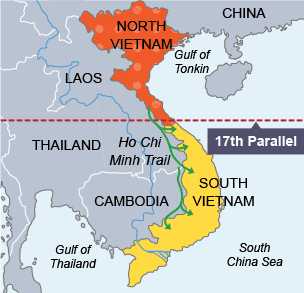
In the 1950s, the United States became involved in the Vietnam War. Why did the United States become involved in this war?
a)
to prevent the collapse of the government of North Vietnam
b)
to stop Vietnam from taking over Hong Kong
c)
to stop the spread of communism to South Vietnam
d)
to prevent attacks against United States shipping
15.
This "figurative" wall divided communist countries from democratic counties--
a)
Great Wall of China
b)
Berlin Wall
c)
Iron Curtain
d)
Wall of Democracy
16.
Which of the following foreign policies gave financial aid to European nations to rebuild after WWII?
a)
Truman Doctrine
b)
Marshall Plan
c)
Warsaw Pact
d)
Domino Theory
17.
What was the mutual defense alliance of non communist nations?
a)
NATO
b)
Warsaw Pact
c)
Truman Doctrine
d)
Open Skies
18.

Images like this one refer to what theory about the spread of Communism in Asia (China, Korea, Vietnam)?

a)

The Mar$hall Plan

b)

The Domino Theory

c)

Proxy Wars

d)

Flexible Response

19.

Truman's policy of preventing the expansion of communism was -

a)

containment

b)

deterrence

c)

militarism

d)

perestroika

20.

Congress granted LBJ power to go to war with North Vietnam by passing the __________.

a)

Great Society

b)

War Powers Act

c)

26th Amendment

d)

Gulf of Tonkin Resolution

21.

What was the goal of "Vietnamization"?

a)

Hand South Vietnam over to the communists

b)

Keep peace with the Soviet Union

c)

Retake territory lost during the Tet Offensive

d)

Force South Vietnam to take over more of the fighting

22.

The Gulf of Tonkin Resolution led to...

a)

American withdrawal from Vietnam

b)

Public disapproval of the war

c)

Escalation of the war

23.

The ratification of the 26th amendment which lowered the voting age to 18 was a result of the

a)

Fear of communism

b)

reporting Watergate

c)

reaction to Sputnik

d)

participation in Vietnam War

24.

One reason the USA was involved in the Vietnam War was to

a)

prevent the spread of communism in Indochina

b)

reduce French influence in Vietnam

c)

stop china from seizing Vietnam

d)

support the government of North Vietnam

25.

The Kent State protest reflected student disapproval of

a)

lack of civil rights

b)

unequal status of American women

c)

college tuition

d)

Vietnam War