
 Worksheets
Earthś Layers and Continental Drift
Total questions: 30
Worksheet time: 15mins
Name
Class
Date
1.

The deepest borehole ever drilled was the Kola Superdeep Borehole located in Russia. It's depth is approximately 12 Km. To reach the center of Earth, we would need to drill over 6,000 Km. How do scientists study the deepest part of Earth if we've only drilled a fraction of the way through the crust?
a)
By sending humans directly into the inner core
b)
By visiting deep mines that go deep into the inner core
c)
Sending robots deep into the inner core
d)
By recording and studying seismic waves (earthquake P and S
waves)
2.
Which type of evidence was NOT used by Alfred Wegener to support his continental drift hypothesis?
a)
Similar mountain ranges found on the eastern side of South America and the western side of Africa.
b)
Identical fossils found on different continents.
c)
Tropical plant fossils found in S. America.
d)
Glacial erosion found in Australia and Africa.
3.

Scientists think that convection currents flow in Earth's
a)
Continental crust
b)
oceanic crust
c)
Asthenosphere
d)
Lithosphere
4.

When the heat source is removed from a fluid, the convection current will
a)
stop immediately
b)
change directions
c)
eventually stop
d)
speed up
5.

Geologist believe the inner core is solid but hotter than the outer core which is liquid. What is their reasoning for this?
a)
This is not what they believe. Instead they think the inner core is liquid because with depth temperature increases causing the iron to melt.
b)
Because Earth is a sphere the interior takes on the same shape.
c)
Because all of the pressure from the overlying layers force the material to be a solid despite the hot temperatures.
d)
They have no evidence to support this claim, its just a guess.
6.
The mantle of Earth is made of a plastic like material that when its heated, the material rises, cools, sinks and is then re-heated. This constant flow of a fluid is called
a)
a conduction current
b)
a hot spot
c)
a volcanic eruption
d)
a convection current
7.
In the early 1900's Alfred Wegener found evidence of identical rock types, identical fossils, and matching mountain ranges on different continents that are on opposite sides of an ocean. What could be the explanation for these observations?
a)
All animals can swim extremely long distances
b)
These observations have no significant meaning.
c)
In the past, continents were not located where they are today but were joined together
d)
mountains are made through the same processes therefore they are very similar in their structure throughout the entire world.
8.
According to Wegener's hypothesis of continental drift,
a)
Earth is shrinking
b)
The continents do not move, they only appear to drift.
c)
The Earth once had great land bridges that connected the continents.
d)
The continents were once joined and have since drifted apart.
9.
Why was Alfred Wegener's hypothesis of Continental Drift not accepted by the scientific community of his time?
a)
Because he was a meteorologist and only a geologist could make such a claim.
b)
Because he had no evidence to help support his hypothesis.
c)
Because he had too much evidence to support his claim which made his hypothesis confusing.
d)
because he could not effectively describe the force that caused the continents to move.
10.
All of the statements below supported the Theory of Continental Drift, EXECPT
a)
Continents look like they fit together like puzzle pieces, especially South America and Africa.
b)
Antarctica's land forms shows evidence of glacial erosion.
c)
Fossils match on different continents
d)
Rock formations match on different continents
11.
Which layer does the lithosphere (the outer most layer plus the crust) float on top of?
a)
the crust
b)
lithosphere
c)
asthenosphere
d)
outer core
12.
Which layer of Earth makes up the crust and the upper most part of the mantle. This is the rigid layer that is broken into sections called plates.
a)
Crust
b)
Lithosphere
c)
Asthenosphere
d)
Mantle
13.

Who is the scientist who proposed Continental Drift Theory?
a)
Albert Einstein
b)
Alfred Wegener
c)
Isaac Newton
d)
John Dalton
14.

What do you call the supercontinent landmass formed million years ago?
a)
Pangea
b)
Asia
c)
Pantallasa
d)
Eurasi
15.
True or False: When liquid gets hot, it becomes less dense.
a)
true
b)
false
16.
Convection currents are due to
a)
super hot core
b)
weather
c)
magnetic field
17.
During convection currents, _____ dense material rises, and _______ dense material sinks.
a)
less, more
b)
more, less
18.
What is the force that moves the continents?
a)
Conduction
b)
Convection
c)
Radiation
d)
Conveyor belts
19.
The continents move very slowly, only a few __________per year.
a)
meters
b)
kilometers
c)
centimeters
d)
miles
20.
What are the two types of crust?
a)
Oceanic crust
b)
Atmospheric crust
c)
Continental crust
d)
Radiant crust
21.
Which of the layers of Earth is the hottest?
a)
Outer core
b)
Crust
c)
Mantle
d)
Inner core
22.

Which layer of Earth is located above the outer core?
a)
crust
b)
inner core
c)
mantle
d)
lithosphere
23.
A dense ball of solid iron and nickel.
a)
crust
b)
inner core
c)
mantle
d)
outer core
24.
What is the top layer of the Earth's surface called?
a)
Mantle
b)
Innercore
c)
Outercore
d)
Crust
25.
What is the correct order (starting from the surface) of Earth's layers?
a)
crust, mantle, inner core, outer core
b)
mantle, outer core, inner core, crust
c)
inner core, outer core, mantle, crust
d)
crust, mantle, outer core, inner core
26.
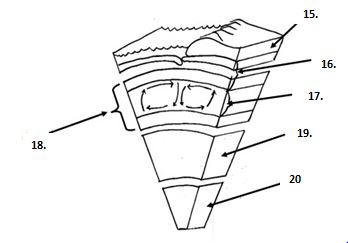
Identify each layer - #20.
a)
mantle
b)
asthenosphere
c)
inner core
d)
outer core
27.
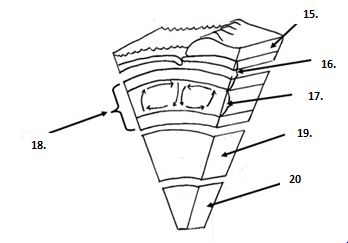
Identify each layer - #15.
a)
Lithosphere
b)
Mantle
c)
Crust
d)
Asthenosphere
28.
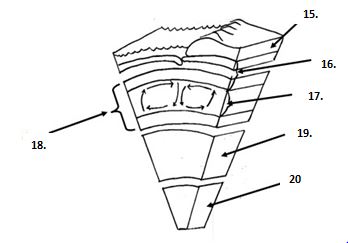
Identify each layer - #19.
a)
mantle
b)
lithosphere
c)
inner core
d)
outer core
29.
Temperature _____________________ as you go deeper into the earth.
a)
increases
b)
decreases
c)
goes up and down depending on the layer
d)
stays the same
30.
Pressure ______________________ as you go deeper into the Earth
a)
increases
b)
decreases
c)
goes up or down depending on the layer
d)
stays the same
100 %

