wayground logo

Free Printable Worksheets

NEW

Font size

S
M
L
XL
Worksheets

Water + Oceans

Total questions: 49

Worksheet time: 32mins

Name
Class
Date
1.

Which example is a form of precipitation?

a)

Dew

b)

Fog

c)

Frost

d)

Hail

2.

How is transpiration important to the water cycle?

a)

It is the evaporation of water from the leaves of plants back into the atmosphere allowing the cycle to continue.

b)

It results in the deposition of water vapor directly as ice, so water changes states causing the cycle to move to the next phase.

c)

It allows plants to absorb water through their roots which is then precipitated back into the atmosphere.

d)

It permits the diffusion of water from the surface to water tables deep underground which restores groundwater supplies.

3.

What is another name or synonym for the water cycle?

a)

Geologic cycle

b)

Hydrologic cycle

c)

Geosphere

d)

Carbon cycle

4.

What is the energy source that drives the water cycle?

a)

The moon T

b)

The heat from our home in the winter all around the world

c)

The sun

d)

he heat generated solely from the core of the earth

5.

What are formed when water vapor condenses?

a)

Clouds

b)

Mountains

c)

Transpiration

d)

Valleys

6.

The act of turning from a gas into a liquid. ________________________

a)

Condensation

b)

Evaporation

c)

Transpiration

d)

Precipitation

7.

The movement caused within a fluid by the tendency of hotter and therefore less dense material to rise, and colder, denser material to sink under the influence of gravity, which consequently results in transfer of heat. ____________________

a)

Evaporation

b)

Convection

c)

Precipitation

d)

Transpiration

8.

The mixture of gases that surround the earth. ____________________

a)

Landforms

b)

Sun

c)

Atmosphere

d)

Weathering

9.

The act of turning from a liquid into a gas. ___________________

a)

Transpiration

b)

Condensation

c)

Evaporation

d)

Precipitation

10.

The fall of water, ice, or snow deposited on the surface of the Earth from the atmosphere. __________

a)

Condensation

b)

Evaporation

c)

Precipitation

d)

Transpiration

11.
Which of these is an example of precipitation?
a)
snow
b)
air
c)
clouds
d)
vapor
12.
What is it called when plants give off water vapor as a waste product?
a)
condensation
b)
evaporation
c)
sublimation
d)
transpiration
13.
During which stage do clouds form?
a)
condensation
b)
evaporation
c)
precipitation
14.
Which stages does liquid water from the ocean turn into water vapor?
a)
condensation
b)
evaporation
c)
precipitation
d)
run off
15.
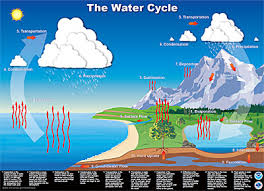
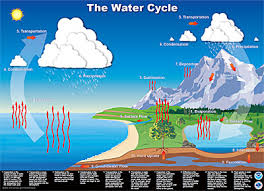
What is D?
a)
Evaporation
b)
Condensation
c)
Precipitation
d)
Runoff
16.
Two types of ocean currents are
a)
local and global
b)
sea and land
c)
surface and deep
d)
warm and cold
17.
The Gulf stream carries _____________ water from the east coast of The United States to the West coast of Europe.
a)
Cold
b)
Warm 
c)
Freezing
d)
Fresh
18.
Warm ocean currents generally come from
a)
The North Pole
b)
The South Pole
c)
The Equator
d)
Both A and B
19.
What process brings the deep cold ocean currents up to the surface?
a)
Conduction
b)
Global Wind Patterns
c)
Convection Currents
d)
Temperature and salinity
20.

______ causes surface currents.

a)

The Coriolis Effect

b)

gravity

c)

density differences

d)

wind

21.

_______ causes the Coriolis Effect

a)

Earth's rotation

b)

gravity

c)

wind

d)

density

22.

________ and _______ affect the ocean's density and cause the Global Conveyor Belt to travel

a)

gravity and the Coriolis Effect

b)

temperature and salinity

c)

wind and climate

d)

temperature and the Coriolis Effect

23.

The more scientific name of the Global Conveyor Belt is _____.

a)

halinethermal circulation

b)

thermohaline circulation

c)

thermodensity circulation

24.

What affects the density of water?

a)

Salt

b)

Temperature

c)

The seasons of the year

d)

Both A and B

25.
Two types of ocean currents are
a)
local and global
b)
sea and land
c)
surface and deep
d)
warm and cold
26.

What are a circular system of currents in the Earth's major oceans?

a)

ocean current

b)

gyre

c)

upwelling

d)

conveyor belt

27.

The Gulf Stream carries warm water to the North Atlantic Ocean, which contributes to

a)

a mild climate for the British Isles.

b)

a harsh winter in the British Isles.

c)

a cold-water surface current that flows to the British Isles.

d)

a warm-water surface current that flows along the coast of California.

28.

Ocean currents affect climates around the world. Based on the map, which area MOST likely has a warmer climate than expected?

a)

1

b)

2

c)

3

d)

4

29.
Currents that occur at or near the surface of the ocean are called 
a)
Deep Currents
b)
Convection Currents
c)
Surface Currents
d)
Wave Currents
30.
The warm, strong current off the coast of Florida is the 
a)
Gulf Stream
b)
California Current
c)
North Equatorial Current
d)
Brazil Current
31.
Ocean currents move energy in the form of
a)
Salt
b)
Water
c)
Heat
d)
Oxygen
32.
What causes surface currents north and south of the equator to move in different directions? 
a)
Gases in the ocean
b)
The rotation of the Earth
c)
Temperature differences
d)
Continental deflection
33.

Salinity is

a)

The salt content of a substance

b)

The Pepper content of a substance

c)

The circulation of hot and cold matter

d)

the weather pattern of a region

34.

What heats the Earth's oceans?

a)

People

b)

Boats

c)

a heater

d)

sun

35.
What is the major cause of surface currents?
a)
dolphins
b)
wind
c)
hurricanes
d)
tides
36.
Why does heat rise in a convection current?
a)
less dense
b)
more dense
c)
more humid
d)
less humid
37.
Why does cold water sink in a convection current?
a)
Less dense
b)
more dense
c)
Less humid
d)
More humid
38.
Is the California current a warm or cold current?
a)
warm current
b)
cold current
39.
Does the gulf stream originate near the Equator or the Poles? 
a)
Equator
b)
Poles
40.
 How does the Gulf Stream affect the climate in Florida and the United Kingdom?
a)
Florida and the United Kingdom have colder climates.
b)
Florida and the United Kingdom have dryer climates.
c)
Florida and the United Kingdom have warmer climates compared to locations at the same latitude.
d)
None of the above
41.
Does the gulf stream carry warm or cold water?
a)
warm water
b)
cold water
42.
Earth’s climate system is powered mainly by energy from:
a)
Tilt
b)
The sun
c)
Latitude
d)
The rain shadow
43.
Movements of ocean water in a continuous flow are called?
a)
ocean currents
b)
global winds
c)
air mass
d)
front
44.
Surface currents are a result of
a)
Global Wind Patterns & Continents
b)
Earth's Rotation & Convection Currents
c)
Density
d)
All of the above
45.
Temperature and salinity differences in ocean water cause:
a)
Mid-ocean ridges
b)
Deep Currents
c)
Surface Currents
d)
High tide and low tide
46.

Both El Nino and La Nina have this in common

a)

Influence birds that migrate over the ocean

b)

Influence rainy / dry weather world wide

c)

The weather at the polar regions

d)

The directions that ships travel in the oceans

47.

In Florida, El Nino impacts our weather by:

a)

creating larger waves at the beach

b)

more thunderstorms and crows flying around

c)

dry and hot

d)

wetter and more flood-prone

48.
El Nino occurs when the tropical ocean waters are warmer in which ocean?
a)
Atlantic
b)
Indian
c)
Pacific
d)
Arctic
49.
This can store a LOT of heat
a)
Atmosphere
b)
Ocean
c)
Land
d)
Ice