wayground logo

Free Printable Worksheets

Font size

S
M
L
XL
Worksheets

Bonds - Quiz 1

Total questions: 40

Worksheet time: 55mins

Name
Class
Date
1.

Among the elements A , B , C , the two elements that can combine together are ............... [ A= 9 , B=10 , C= 11 ]

a)

B and C

b)

A and B

c)

B and B

d)

A and C

2.

which of the following has the highest melting and boiling point ?

a)

LiCl

b)

AlCl3

c)

MgCl2

d)

NaCl

3.

all the following compounds are polar except :

a)

HCl

b)

Cl2

c)

NH3

d)

H2O

4.

which of the following compounds are more polar ?

[ E.N of elements , N= 3 , O=3.5 , F=4 , H = 2.1 ]

a)

NH3

b)

NF2

c)

NO2

d)

HF

5.

In which of the following pairs of elements the covalent bond between the two atoms is more polar ?

a)

Chlorine and bromine

b)

Chlorine and iodine

c)

flourine and chlorine

d)

flourine and iodine

6.
What are ionic bonds?
a)
valence electrons transferred between atoms
b)
Inner most electrons transferred between atoms
7.
Why do ionic bonds form?
a)
so the number of protons equals the number of electrons
b)
to fill the outermost energy level
c)
so an atom can become unstable
8.
An electron has what kind of charge?
a)
no charge
b)
positive 
c)
negative
d)
it depends
9.
An atom that has gained or lost electrons is called ...
a)
a winner
b)
an isotope
c)
an ion
d)
a loser
10.
metals need how much energy to lose their valence electrons
a)
a large amount of energy
b)
a small amount of energy
c)
no energy needed
d)
What's energy?
11.
If an aluminum atom has 13 protons (+) and 10 electrons (-), what is it's charge?
a)
Al3+
b)
Al13+
c)
Al10+
d)
Al10-
12.
If an oxygen atom has 8 protons (+) and 10 electrons (-), what is it's charge?
a)
O10-
b)
O8+
c)
O2-
d)
O10+
13.
Ionic bonds are between...
a)
nonmetals and nonmetals
b)
carbon and oxygen
c)
metals and nonmentals
d)
hydrogen and chlorine
14.
Covalent bonds are between...
a)
two or more nonmetals
b)
sodium and chlorine
c)
metals and metals
d)
metals and nonmetals
15.
If an atom loses two electrons what charge will it have?
a)
-2
b)
-1
c)
+1
d)
+2
16.
How many valence electrons does oxygen have?
a)
2
b)
4
c)
5
d)
6
17.
How do covalent bonds form?
a)
Donating & receiving valence e- between atoms.
b)
Opposite slight charges attract each other between compounds.
c)
Scientists are still not sure how they form.
d)
Sharing valence e- between atoms.
18.
Which of the following is NOT formed by a covalent bond?
a)
K2S
b)
H2O
c)
I2
d)
CO2
19.
What do we call a covalent bond where electrons are shared UNEVENLY or UNEQUALLY?
a)
Ionic
b)
Polar Covalent
c)
Nonpolar Covalent
d)
Van der Waals Force
20.
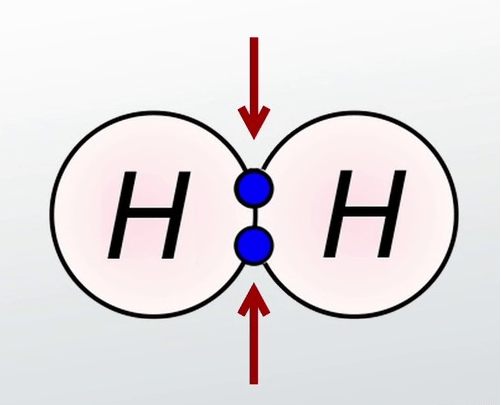
What type of bond is shown in this image?
a)
Ionic
b)
Polar Covalent
c)
Nonpolar Covalent
d)
Van der Waals Force
21.
How are covalent bonds formed?
a)
Sharing of electrons
b)
Transfer of electrons
22.

How many valence electrons does Hydrogen Have?

a)

1 Valence electron

b)

2 Valence electron

c)

3 Valence electron

d)

4 Valence electron

e)

5 Valence electron

23.

How many valence electrons does Helium Have?

a)

1 Valence electron

b)

2 Valence electron

c)

3 Valence electron

d)

4 Valence electron

e)

5 Valence electron

24.

How many valence electrons does Aluminum Have?

a)

1 Valence electron

b)

2 Valence electron

c)

3 Valence electron

d)

4 Valence electron

e)

5 Valence electron

25.

How many valence electrons does Calcium Have?

a)

1 Valence electron

b)

2 Valence electron

c)

3 Valence electron

d)

4 Valence electron

e)

5 Valence electron

26.

What is the correct Lewis Dot Structure for ammonia NH3

a)
b)
c)
d)
27.

Which is the correct molecular structure for carbon dioxide?

a)
b)
c)
d)
28.

How many total valence electrons are participating in bonding in the molecule above?

a)

8

b)

4

c)

2

d)

3

29.
Which of the following is the correct Lewis dot structure for the molecule fluorine (F2)?
a)
A
b)
B
c)
C
d)
D
30.

CO2 has how many lone pairs?

a)

0

b)

1

c)

2

d)

3

e)

4

31.

NH3 has how many lone pairs?

a)

0

b)

1

c)

2

d)

3

32.

CCl4 has how many double bonds?

a)

0

b)

1

c)

2

d)

3

33.

CH2O has which of the following?

a)

Multiple double bonds

b)

Multiple single bonds

c)

One double bond

d)

One single bond

e)

A lone pair

34.
How many electrons should Lithium have around its Lewis dot model?
a)
1
b)
2
c)
3
d)
4
35.
How many electrons should Boron have around its Lewis dot model?
a)
1
b)
3
c)
5
d)
7
36.
How many electrons should Flourine have around its Lewis dot model?
a)
5
b)
6
c)
7
d)
8
37.

This could be the dot diagram of

a)

Mg

b)

Cl

c)

C

d)

O

38.

This is a correct dot diagram for nitrogen (N)

a)

true

b)

false

39.

This is a correct dot diagram for neon (Ne)

a)

true

b)

false

40.

How many valence electrons are indicated here:

a)

2

b)

4

c)

6

d)

7