wayground logo

Free Printable Worksheets

NEW

Font size

S
M
L
XL
Worksheets

Force and Motion Unit Exam

Total questions: 50

Worksheet time: 4hrs 10mins

Name
Class
Date
1.
The image below shows two teams playing tug-a-war. Which of the following is true about the forces?
a)
Net force is balanced
b)
Net force is unbalanced
c)
Team A is greater.
d)
Team B is greater.
2.
The forces acting on a box are shown in the figure below.  Which of the following is the net force on the box?
a)
70 N right
b)
70 N left
c)
10 N right
d)
10 N left
3.
What is the net force on this system?
a)
8000 N, LEFT
b)
4000 N, RIGHT
c)
4000 N, LEFT
d)
6000 N, LEFT
4.

What is the average speed of a ball if it rolls 20 meters in 40 seconds?

a)

20 m/s

b)

10 m/s

c)

0.5 m/s

d)

2 m/s

5.
What is the average speed of the bicyclist?
a)
20 m/s
b)
4 m/s
c)
5 m/s 
d)
5 s/m
6.

What is a likely explanation of the family’s motion in between X and Y on the graph?

a)

The family car was moving extremely quickly.

b)

The family stopped at a gas station to get something to eat.

c)

The family was driving really slowly so they wouldn’t hit a doe.

d)

The family realized they were late and started driving super fast.

7.
Which graph shows a student running at a constant speed?
a)
 A
b)
B
c)
C
d)
D
8.
A 70 kg adult and a 35 kg child start ice skating towards each other. Applying Newton’s Laws of Motion, what will happen if the two skaters push against one another?  
a)
The adult will move backward, and the child will not move.
b)
The adult will not move, and the child will move backward.
c)
They will both move backward at the same speed. 
d)
They will both move backward, but the child will move at a faster speed.
9.
According to Newton’s Third Law, if someone jumps off a skateboard, the skateboard will roll backwards because:
a)
the mass of the skateboard is the same as the mass of the person jumping of it
b)
the pull of gravity on the person is the same as on the skateboard, regardless of size.
c)
the air resistance on the person is great and the friction on the skateboard is small.
d)
for the force that sent the person forward, there is an equal force pushing back on the skateboard.
10.
Safety belts protect people in cars in the event of an accident because, according to Newton’s Laws of Motion, when an impact causes the car to suddenly change its motion, 
a)
the people in the car will continue to move in the same direction and at the same speed as before the impact
b)
the speed of the car always increases, giving it greater force since the mass will remain the same
11.
Which of the following describes an application of Newton’s Law of Inertia (the tendency for things to remain unchanged)?
a)
A car stops suddenly, but the passengers in the car are thrust forward into the seat belts.
b)
The force pushing downward on a box is equal to the force pushing upward on the box.
c)
Earth’s tectonic plates collide with equal force and equal acceleration.
12.
Two girls are pulling on opposite ends of a thick rope. Both girls pull on the rope with the same force but in opposite directions. If both girls continue to pull with the same force, what will most likely happen? 
a)
One girl will pull the other toward her.
b)
Both girls will stay in the same place. 
c)
Gravity will cause the rope to sag. 
d)
The rope will break.
13.
When a bird flies, its wings push air downward. As a result the air pushes back upward on the bird. Which law of motion most applies to the way the wings of a bird beat? 
a)
Every action has an equal and opposite reaction
b)
The rate of acceleration of an object depends on the amount of force applied.
c)
Objects in motion tend to remain in motion until acted upon by an another force. 
d)
Force is defined by mass times acceleration
14.
A student walking quickly while carrying an orange on his lunch tray stops suddenly. The orange will most likely roll off the tray due to
a)
inertia of the orange. 
b)
centripetal force of the orange
c)
the friction acting on the orange.
d)
the balanced forces acting on the orange.
15.
 Alesia is taking an all­ day ride on her bicycle. The graph shows how far she is from home at different times during her ride.  During which time period is Alesia moving fastest?
a)
0–1 hours 
b)
3–4 hours 
c)
4–5 hours
d)
6–7 hours 
16.
Angela blows air into a balloon and holds the end of it closed with her fingers. When she lets go of the end of the balloon, Angela observes that the release of the air propels the balloon.  The propelling of the balloon from the release of the air is an example of which of Newton’s laws? 
a)
The force of an object is the product of its mass multiplied by its acceleration. 
b)
 A force of attraction exists between any two objects with mass. 
c)
 For every action, there is an equal and opposite reaction.
d)
An object in motion tends to stay in motion unless an unbalanced force acts upon it. 
17.
The graph shows the motion of four cars. All four cars are moving east.   
Which car has a constant velocity? 
a)
1
b)
2
c)
3
d)
4
18.
A student reads his paper on friction to the class. Which statement should he include in his paper if he wants to present accurate information? 
a)
Friction increases mechanical advantage
b)
Friction opposes the direction of movement. 
c)
Friction makes movement of an object easier.
d)
Friction reduces the amount of work used to move an object. 
19.
What is speed?
a)
Speed is how far something travels in one hour.
b)
Speed is how fast it takes something to travel a set distance
c)
Speed is the distance something travels in a set amount of time.
d)
Speed is the change in velocity of something.
20.
When an object's distance from another object is changing, the object is .... 
a)
under pressure.
b)
 in motion
c)
not moving.
d)
changing reference point.
21.
Which of the following is an example of acceleration?
a)
A book laying on a table
b)
An airplane moving at a constant speed of 500 mph in a straight line
c)
A race car going into a curve
d)
An object at rest
22.
 If an unbalanced force acts on a stationary object, the object will:.
a)
remain stationary
b)
move away from the force
c)
accelerate in the direction of the force
d)
accelerate in the opposite direction of the force
23.
If no force is being applied to a stationary object, the object will...
a)
remain stationary.
b)
accelerate in the direction of the force.
c)
move at a constant speed in the direction of the force.
d)
accelerate in the opposite direction of the force
24.

How much force will produce equilibrium on the system?

a)

200 N

b)

350 N

c)

500 N

d)

700 N

25.

What is the vertical velocity of an object dropped from a height at 4 seconds? Ignore air resistance.

a)

10 m/s

b)

40 m/s

c)

50 m/s

d)

not enough information

26.

An object is dropped from rest and falls freely 20 m to Earth. Which of the following statements is TRUE?

a)

The speed of the object is 10 m/s at the end of its 1st second of falling.

b)

The speed of the object is 10 m/s during the entire 1st second of its fall.

c)

The speed of the object is 10 m/s during its entire time of its fall.

d)

The speed of the object is 10 m/s after it has fallen 9.8 meters.

27.

Determine the total distance traveled during 3 seconds.

a)

10 m

b)

30 m

c)

45 m

d)

90 m

28.

How many objects are involved in an action-reaction force pair?

a)

1

b)

2

c)

3

d)

as many as possible

29.
What is force?
a)
A force is a push or a pull upon an object resulting from the object's interaction with another object.
b)
something used in Star Wars 
c)
It is the amount of space between two points.
d)
It is Superman's power
30.
If an object is stationary (not moving) the forces acting upon it are _____________
a)
unbalanced
b)
weak
c)
balanced
d)
Hulk Smash!
31.
Why does a rolling ball stop?
a)
Gravity
b)
Friction
c)
Waterfalls
d)
Sand
32.
Velocity is 
a)
speed
b)
direction
c)
speed with a direction
33.
What pulls a ball back to earth?
a)
Gas
b)
Gravity
c)
Friction
d)
Molecules
34.
What is another name for the Laws of Motion?
a)
Newton's Motion 
b)
Motion Laws
c)
Newton's Laws
d)
Motion with Newton
35.
Newton's ____________ Law means that for every action there is an equal and opposite reaction. 
a)
First
b)
Second
c)
Third
d)
Fourth
36.
What is air resistance?
a)
friction in the air that slows things down
b)
when an airplane flies into a cloud
c)
when you feel the air hitting your face
37.
Why do we need friction?
a)
It helps objects go faster. 
b)
It helps objects go up higher.
c)
It helps make objects go slower or stop.
38.
The measure of the force of gravity on your body is your _________________
a)
height
b)
length
c)
weight
d)
age
39.

The measurement of speed and direction of an object

a)

speed

b)

velocity

c)

acceleration

d)

average speed

40.

What is the speed formula?

a)

d = s*t

b)

s= time/distance

c)

d= speed/time

d)

s = distance/time

41.

The acceleration of an object as produced by net force. F = m*a

a)

Newton's 1st Law

b)

Motion

c)

Newton's 2nd Law

d)

Newton's 3rd Law

42.
An object acted upon by a net force will accelerate in the direction of the force according to the equation 
Acceleration = net force/mass
a)
Newton's 1st Law
b)
Newton's 2nd Law
c)
Newton's 3rd Law
d)
Newton's 4th Law
43.
Wheels on a skateboard most likely experiences-
a)
Rolling Friction
b)
Sliding Friction
c)
Fluid Friction
d)
Static Friction
44.
Sally experiences-
a)
Rolling Friction
b)
Sliding Friction
c)
Fluid Friction
d)
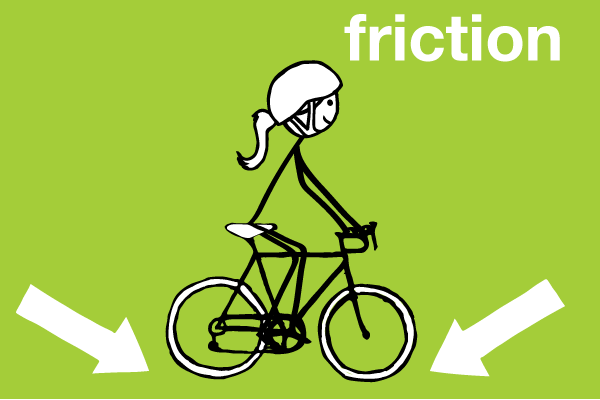
Static Friction
45.
Swimming fish experience-
a)
Rolling Friction
b)
Sliding Friction
c)
Fluid Friction
d)
Static Friction
46.
 What is the unit called that measures force?
a)
Isaac
b)
Yee
c)
Newton
d)
kilogram
47.
Distance and direction of an object's change in position from a starting point
a)
displacement
b)
distance
c)
motion
d)
reference point
48.
David walks 3 km north, and then turns east and walks 4 km. What is the distance?
a)
7 km
b)
3 km
c)
4 km
d)
1 km
49.

Inertia refers to _____

a)

the tendency of moving objects to remain in motion

b)

the force which keeps moving objects in motion with a constant velocity

c)

the force that keeps stationary objects at rest

50.
When an object is acted on by unbalanced forces, the object will 
a)
continue in the same direction
b)
continue at the same speed
c)
accelerate in the direction of the unbalanced force
d)
will have no change in motion